
Should a Singapore Business Choose a Local Number or a Toll-Free Number?
Your 1800 number isn’t free for most of Singapore: five in six of their phones are mobiles, and mobiles still pay airtime to call it.
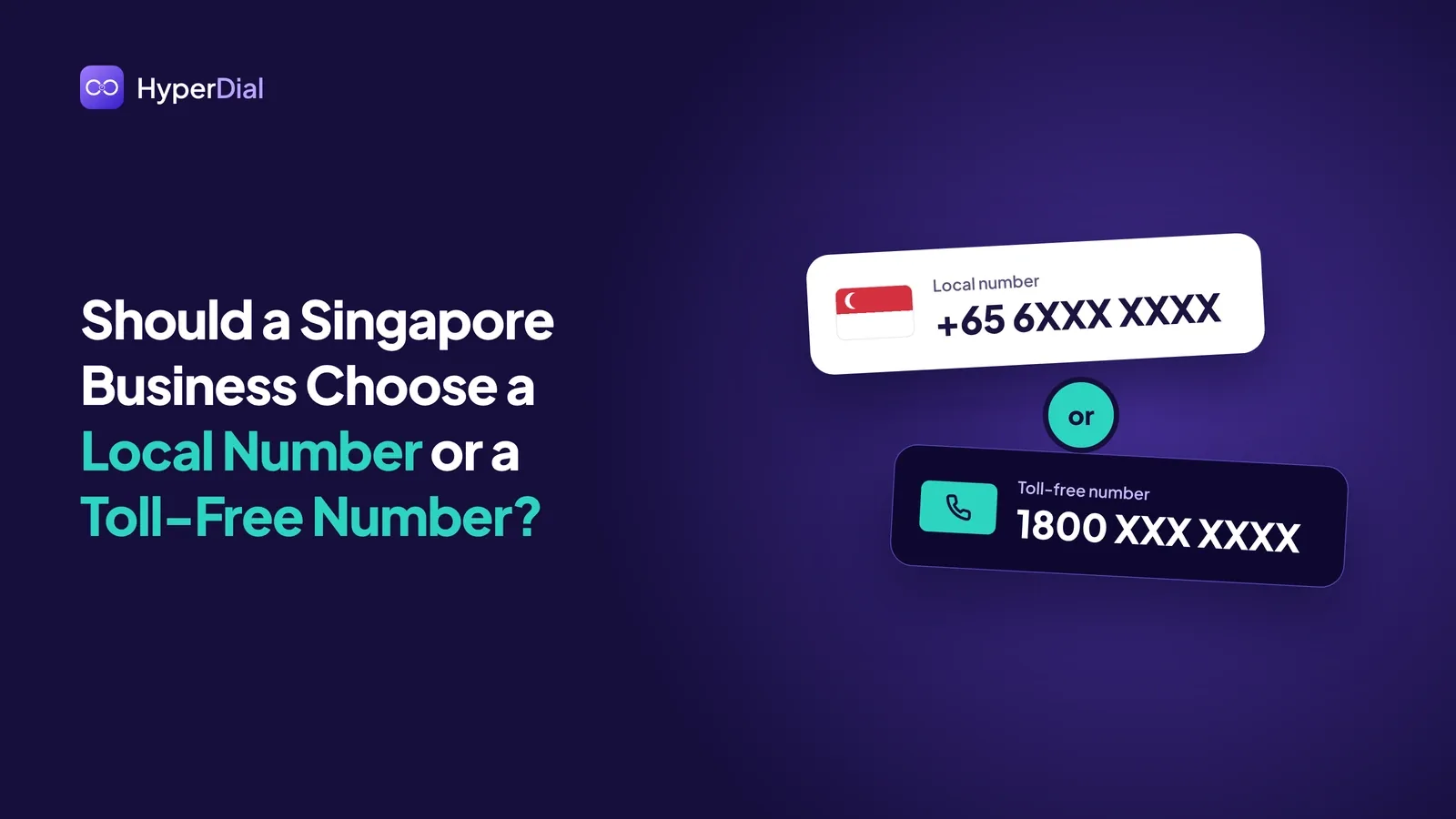
That last point changes the decision. Singapore has about five times as many mobile subscriptions as fixed lines, so most of your callers are on a mobile. This guide compares the two number types side by side and shows when each one earns its place. It also covers how to run both from one system.
Every fact in this guide links to its source, and we last checked them on 17 November 2026.
Key takeaways
- A local number does more jobs: incoming and outgoing calls, reachable from overseas, cheaper to run.
- An 1800 number isn't fully free for most callers. Calls from mobiles still use airtime.
- Choose 1800 for consumer support lines, hotlines and campaigns where "free to call" matters.
- Many businesses use both, routed into one phone system.
What is the difference between a Singapore local number and a toll-free number?
The difference between a Singapore local number and a toll-free number is who pays for the call and which calls the number can handle. With a local number, the caller pays their normal rate. For an 1800 toll-free number, the business pays for incoming calls. IMDA, the Infocomm Media Development Authority, sets the format of both in its National Numbering Plan, last issued in February 2026.
This table compares them on the points that matter most:
Table 1: Singapore local number vs 1800 toll-free number
| Feature | Local +65 number | 1800 toll-free number |
|---|---|---|
| Format | 8 digits, starting with 3 or 6 | 1800 plus 7 digits |
| Who pays for incoming calls | The caller | The business |
| Mobile callers | Pay their normal rate | Still pay airtime |
| Outgoing calls | Yes | Usually incoming only |
| Callers outside Singapore | Can dial it | Usually can't |
| Running cost | Lower | Higher, pays per minute |
Singapore has no area codes, so every local number covers the whole country. IMDA reserves numbers starting with 6 for fixed lines and internet calling, and numbers starting with 3 for internet calling. Both look local to someone in Singapore. Our guide on local vs toll-free numbers explains the general difference in any country.
Is an 1800 number really free for callers in Singapore?
An 1800 number is free for callers on a fixed line, but not fully free for callers on a mobile phone. IMDA's rules for the 1800 local toll-free service state that "airtime charges apply for mobile calls to 1800 local toll free service numbers". In practice, a call to your 1800 number from a mobile may use the caller's minutes or appear on their bill.
That matters because most people in Singapore call from a mobile. In June 2024, Singapore had 9,870,200 mobile subscriptions and 1,975,100 fixed-line subscriptions, according to IMDA's telecom statistics. That's about five mobiles for every fixed line.
So "free to call" is a real benefit for landline callers, such as offices and older customers at home. For mobile callers, an 1800 number still signals an established business, but it doesn't remove their cost.
When should a Singapore business choose a local number?
A Singapore business should choose a local number whenever the number has to make calls, reach people outside Singapore or keep costs low. It's the better choice in these cases:
- Outbound sales and follow-ups: a +65 number can call out, and people in Singapore recognize it as local.
- Business-to-business calls: most business buyers don't expect a free line and care more about a direct contact.
- Callers outside Singapore: overseas customers and partners can dial a +65 number at international rates.
- Direct lines for staff: each account manager or team can have its own number.
- Tight budgets: you don't pay for every incoming minute, as you do with an 1800 number.
Local numbers also matter for trust. International calls in Singapore show a "+" prefix, and people are advised to be wary of unexpected international calls. Our guide on local presence dialing explains why a familiar local number gets more answers.
When should a Singapore business choose a toll-free number?
A Singapore business should choose an 1800 toll-free number when it wants many Singapore consumers to call in and a free-to-call line would encourage them. An 1800 number makes sense in these cases:
- Customer support lines: for consumers who call with questions, orders or complaints.
- Hotlines and helplines: where you want no barrier to calling, especially from landlines.
- Advertising and campaigns: a memorable 1800 number on print, radio or TV ads.
- Nationwide consumer brands: where an 1800 number signals size and permanence.
Plan for the cost. You pay for incoming calls, so a busy line costs more than a local number with the same traffic. Memorable numbers can also be harder to get: IMDA allocates some special 1800 patterns, such as numbers made of repeated digits, by bidding. Our guide on who pays for toll-free calls explains how the costs work.
How do you decide between a local and a toll-free number in Singapore?
You decide between a local and a toll-free number by looking at who calls you, what the number has to do, and how you'll measure it. These three steps take you from guessing to a clear choice.
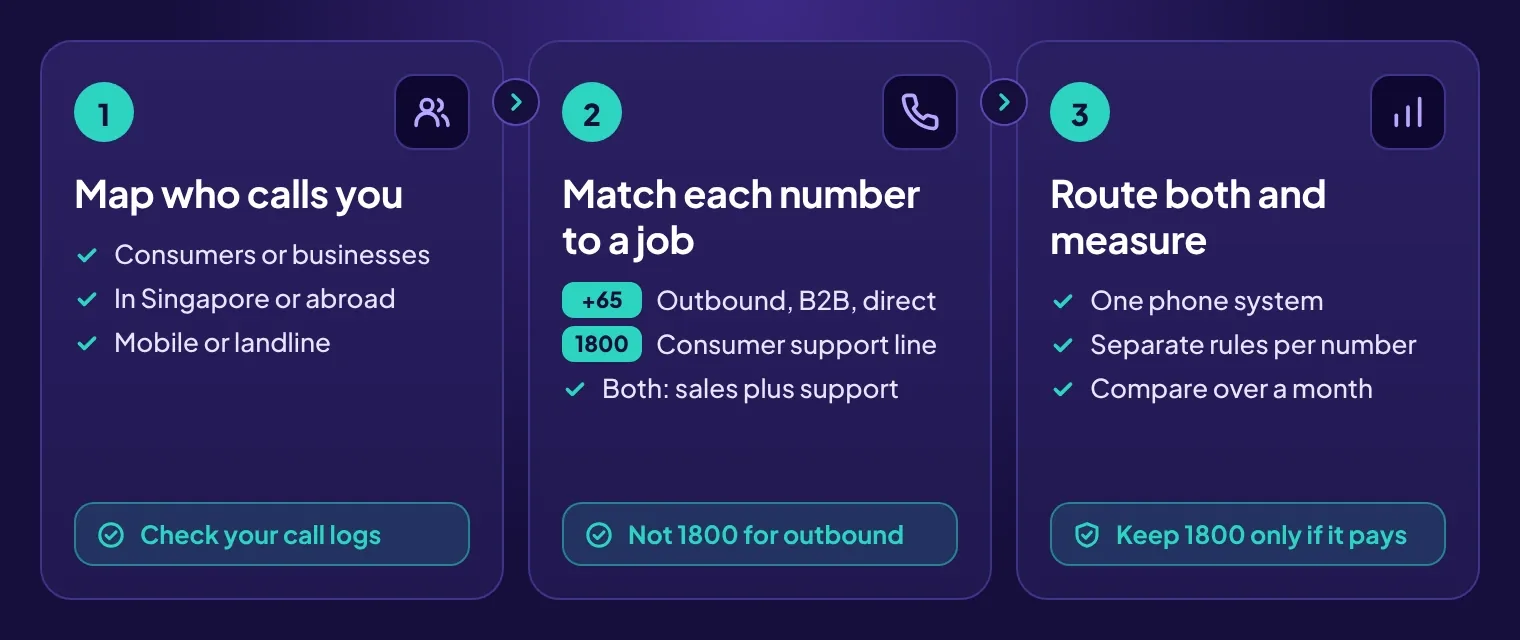
Step 1: Map who calls you and how
Start with your callers. Are they consumers or businesses, in Singapore or abroad, on mobiles or landlines? Check your current call logs if you have them, or ask your sales and support teams who they talk to most.
If most callers are businesses, on mobiles or outside Singapore, an 1800 number adds cost without much benefit. But if they're Singapore consumers calling a support line, a free number may be worth paying for. Our guide on call logs and why you need them shows what to look for.
Step 2: Match each number to a job
Give each number one clear job rather than one number for everything. Use this rule of thumb:
Choose a local number if the number makes outbound calls, serves businesses or overseas callers, or acts as a direct line.
Choose an 1800 number if the number is an incoming-only support line or hotline aimed at Singapore consumers.
Choose both if you sell by phone and also run a consumer support line.
The common mistake here is using an 1800 number for outbound sales. Toll-free numbers are built for incoming calls, so check whether your provider lets one appear as caller ID at all. Even where it can, a local number is the more natural fit for calling out.
Step 3: Route both into one system and measure
If you run both numbers, route them into the same phone system so calls reach the right team. Set separate rules for each number, such as sending 1800 calls to support and +65 calls to sales. Our guide on call routing strategies shows how to set that up.
Then compare the two over a month. Look at call volume, answer rate and cost per call for each number. Keep the 1800 line if it brings in calls you wouldn't otherwise get, and drop it if the local number does the same job for less.
What should overseas companies use to reach Singapore callers?
Overseas companies should usually start with a local +65 number, because it can make and take calls and anyone can dial it. An 1800 number is designed for calls within Singapore, so it doesn't help callers in other countries. A +65 local number gives Singapore customers a familiar number and still works for partners abroad.
There's a third option for companies based outside Singapore. IMDA's numbering plan reserves the 800 prefix for International Toll-Free Services, which let callers in Singapore reach a business in another country for free. Our guide to international toll-free numbers explains how these work.
Setting up from abroad? Our guide on whether an overseas company can get a Singapore business phone number covers the options. The guide to the documents needed for a Singapore virtual number covers verification.
How does HyperDial support local and toll-free numbers in Singapore?
HyperDial offers both Singapore local and 1800 toll-free numbers in one account, so you can run each for its own job. Here's what's included, as described on HyperDial's Singapore numbers page:
- Local +65 numbers: for outbound campaigns and direct inbound lines.
- 1800 toll-free numbers: for sales and support lines. Range availability depends on carrier agreements, so confirm the range before launch.
- Local presence: outbound calls show a Singapore number.
- Routing by number: HyperDial's call routing can route by the number dialed, so 1800 and +65 calls reach different teams.
- Porting: existing Singapore local and toll-free numbers can move to HyperDial, free on annual plans.
- Reporting: call analytics show total, answered and missed calls, so you can compare both numbers.
Numbers are billed at carrier cost, and the pricing page shows the free Base plan with no expiry. One honest limit: 1800 range availability varies, so a specific number pattern may not be available.
What should you do next?
List who calls your business, from where and on what kind of phone. If you make outbound calls or serve businesses, start with a local +65 number. Add an 1800 line for a consumer support or hotline number if your callers would use it. To compare options, see HyperDial's Singapore numbers page, check the pricing page or book a demo.
Sources


