
Can an Overseas Company Get a Singapore Business Phone Number?
Your +65 number won’t help if Singapore phones still see a “+” in front of your calls.
That's the short version. The details decide whether your number actually works for you. Requirements vary by provider and number type, and Singapore has its own rules on marketing calls, caller ID and SMS. This guide covers which numbers you can get, what you'll need and the three steps to set one up. It also covers the rules that apply even when you're based abroad.
Every fact in this guide links to its source, and we last checked them on 17 November 2026.
Key takeaways
- No local office needed for calls. Providers verify your company, not your address in Singapore, though some do ask for one.
- The first digit tells callers the number type: 6 for fixed lines, 3 for internet calling, 8 and 9 for mobiles, 1800 for toll-free.
- SMS sender names need a Singapore UEN, which means a local subsidiary or branch.
- Singapore's Do Not Call rules still apply to you, wherever your team sits.
What types of Singapore business phone numbers can an overseas company get?
An overseas company can usually get two kinds of Singapore business phone number: a local +65 number and an 1800 toll-free number. Singapore has no area codes. Every number is +65 followed by eight digits. The first digit shows what kind of service it is, as set out in IMDA's National Numbering Plan. IMDA, the Infocomm Media Development Authority, is the regulator that manages Singapore's numbers.
This table shows the main number types and how useful each is to a company based abroad:
Table 1: Singapore number types for overseas companies
| Starts with | Service | Use for an overseas company |
|---|---|---|
| 6 | Fixed line | Familiar to locals, harder to get remotely |
| 3 | Internet calling (IP telephony) | The usual cloud business number |
| 8 or 9 | Mobile | Tied to a SIM, rarely offered virtually |
| 1800 | Local toll-free | Free for callers in Singapore |
The 3-series is the one most cloud phone providers issue. IMDA's rules for level 3 numbers describe them as numbers for internet calling that work "in any domestic or overseas location". That's what lets a team in London or Bengaluru answer a Singapore number. Toll-free numbers start with 1800 and are free for callers inside Singapore. Our guide to international toll-free numbers explains how they work across countries.
What do you need to get a Singapore business phone number from overseas?
You need proof that your business is real, and what counts as proof depends on the provider and the number type. Most providers run a business verification check, often called KYC (know your customer), before a number goes live. Some accept your home-country company registration. Others ask for a Singapore address, a Singapore business registration or a local contact person.
What you need also depends on what the number has to do:
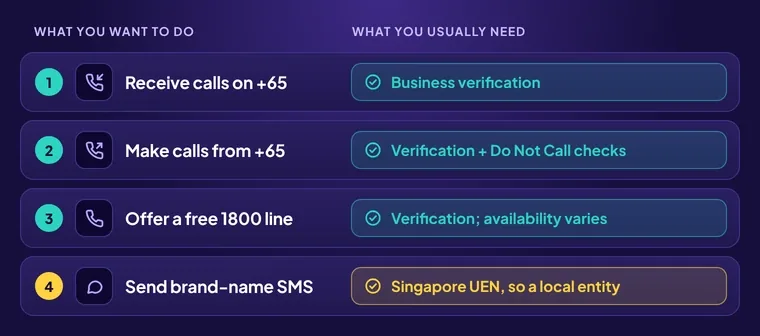
Table 2: What an overseas company needs, by use
| What you want to do | What you usually need |
|---|---|
| Receive calls on a +65 number | Business verification with the provider |
| Make calls from a +65 number | Verification, plus Do Not Call checks for marketing |
| Offer a free 1800 line | Verification; range availability varies |
| Send SMS with your brand name | A Singapore UEN, so a local entity |
The last row is the one that surprises people. Since 31 January 2023, organizations sending brand-name SMS to Singapore must register with the SMS Sender ID Registry. IMDA's factsheet on the full registry regime sets out the rule. Registration needs a Singapore UEN, a business identity number. When the regime started, messages from unregistered names were relabeled "Likely-SCAM".
Getting a UEN means registering a Singapore subsidiary or a branch. A branch needs a locally resident authorized representative and a Singapore registered office, according to ACRA's foreign company branch guide. For calls alone, you don't need either.
How do you get a Singapore business phone number as an overseas company?
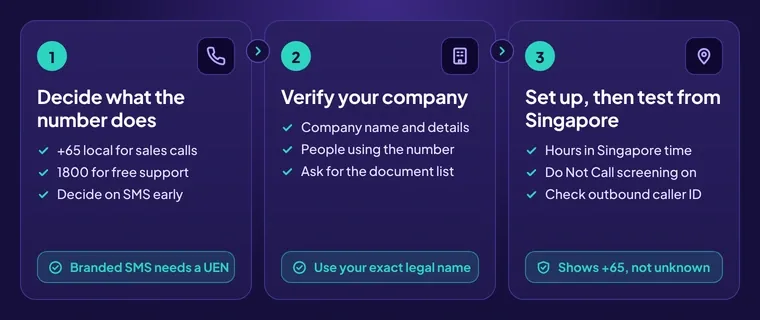
You get a Singapore business phone number by choosing a number type, verifying your company and setting up the number before your first call. These three steps take you from choosing to calling.
Step 1: Decide what the number has to do
Start with how customers will use the number, because that decides the type. A +65 local number suits sales calls and direct lines for account managers. An 1800 number suits a support line where you want callers in Singapore to ring for free. Many companies use both: a local number for outbound and a toll-free number on the website.
Decide on SMS at this stage too. If you plan to send texts under your brand name, you'll need a Singapore UEN first, so factor that into your timeline. Our guide on how to get a local phone number for another country covers the same decision for other markets.
Step 2: Verify your company with the provider
Business verification is the check a provider runs to confirm your company exists and will use the number legitimately. Expect to share your company name, registration details and the people who'll use the number. Ask for the full document list before you start, since requirements differ between providers.
The common mistake here is a mismatch. If the company name on your documents doesn't exactly match the name on your account, verification stalls. Use your legal name everywhere, including the spelling and punctuation on your registration certificate.
Step 3: Set up routing and compliance, then test from Singapore
Before you take a single customer call, point the number at the right team. Set business hours in Singapore time and decide where calls go when nobody answers. Our guide to call routing strategies shows how to design those paths. If the number will make marketing calls, switch on Do Not Call screening at this stage, not after the first campaign.
Then test from a phone in Singapore if you can. Ring the number and check the right person answers. Then call out and check what the person you call sees: your +65 number, not a "+" prefixed international number or "unknown". That last check matters more in Singapore than almost anywhere else, as the next section explains.
Will people in Singapore answer a call from your number?
People in Singapore are more likely to answer a call that arrives as a local Singapore number, because international calls are clearly marked. Since 15 April 2020, Singapore's telcos must show a "+" in front of every incoming international call. That rule is set out in IMDA's factsheet on mitigating spoof calls. Local calls show no "+".
That label has a real effect on answer rates. In a ministry reply in Parliament in May 2021, the government advised people not to pick up calls with a "+" or "+65" prefix. The exception is when they're expecting a call from overseas. Telcos also let subscribers block international calls altogether. Over 1.3 million subscribers had switched that block on, according to the ministry's anti-scam page, last updated in November 2026.
So a +65 number on its own isn't enough. Ask your provider how calls to Singapore are delivered: as local calls, or as international calls showing your +65 number with a "+" in front. Our guide on local presence dialing explains why a familiar number gets more answers. The guide on why a business number gets marked as spam covers keeping it trusted.
Which Singapore rules apply to an overseas company?
Singapore's marketing rules apply to calls and texts sent to Singapore numbers, wherever the sender is based. The most important for an outbound team is the Do Not Call (DNC) Registry, run by the Personal Data Protection Commission (PDPC). These are the points that catch overseas teams:
- Three separate registers: the DNC Registry has one each for voice calls, text messages and faxes, as the DNC Registry's consumer page explains. Check the register for the channel you're using.
- Checks expire: results from a register check are valid for 30 days, according to the DNC Registry's business rules. After that, you must check again.
- Overseas accounts exist: the same page offers an account type for overseas organizations not registered or present in Singapore.
- Business numbers count too: the rules cover messages to Singapore telephone numbers, including mobile, fixed-line, residential and business numbers.
- SMS sender names need a UEN: as covered above, brand-name SMS requires registration with a Singapore entity.
Consent matters beyond the DNC rules too. Singapore's Personal Data Protection Act 2012 governs how you collect and use personal data, including call recordings. Tell callers when a call is recorded, and keep a record of who agreed to be contacted. This guide isn't legal advice, so check your own obligations with a Singapore adviser.
How does HyperDial help overseas companies get a Singapore number?
HyperDial gives overseas companies Singapore local and 1800 toll-free numbers without a Singapore office, once a business verification check clears. Here's what that includes, as described on HyperDial's Singapore numbers page:
- No local office needed: a foreign company can get a number after verification, and the number is registered to the business using it.
- Local and toll-free: +65 local numbers for inbound and outbound calls, and 1800 numbers for sales and support lines. Confirm the 1800 range you want before launch.
- Do Not Call screening before dialing: numbers on the register are never dialed, and your own suppression lists apply on top.
- Consent and opt-outs: consent is recorded on the contact with the call that captured it, and opt-outs apply across voice, WhatsApp and SMS at once.
- Porting with a named engineer: an existing Singapore number can move to HyperDial, free on annual plans.
- One account for every market: run Singapore alongside India, the UK and the UAE, with numbers and compliance settings kept separate per region.
Numbers are billed at carrier cost, and the pricing page shows the free Base plan with no expiry. One honest limit: HyperDial can't register an SMS sender name for you without a Singapore UEN, because the registry requires one.
What should you do next?
Decide what your Singapore number has to do: take calls, make calls, offer a free line or send branded texts. If you need branded SMS, start the UEN process now. For calls alone, you can start today. See the number types on HyperDial's Singapore numbers page, compare plans on the pricing page, or book a demo to check availability for your range.
Sources
- IMDA, National Numbering Plan
- IMDA, Level 3 numbers (23 Oct 2017)
- IMDA, Factsheet on the full SMS Sender ID Registry regime
- ACRA, Registering as a foreign company branch
- IMDA, Factsheet on mitigating spoof calls (2020)
- MCI reply to a parliamentary question (11 May 2021)
- MDDI, Anti-scam efforts
- DNC Registry, consumer information
- DNC Registry, business rules
- Personal Data Protection Act 2012


