
Local vs Toll-Free Numbers : Which One Does Your Business Need?
Picking the wrong business number can cost you calls before anyone dials. Find out whether a local or toll-free number fits your business.
The phone number on your website, ads and invoices says a lot before anyone dials it. A local number tells customers you're nearby. Toll-free numbers tell them you're an established business that will cover the cost of their call. Both send a message, and the wrong one can cost you calls.
The good news is you don't have to guess. Every phone number in the world follows the same basic format, set by the ITU's E.164 international numbering plan: a country code, then a national number. Local vs toll-free numbers are simply different ranges inside that plan, with different rules for who pays and who can call. Once you know those rules, the choice gets much easier.
In this guide, you'll learn:
- What local vs toll-free numbers are, in plain words
- The key differences, side by side
- The pros and cons of each type
- When to use a local number, a toll-free number, or both
- How international callers reach you, and what each number costs
What is a local phone number?
A local phone number is a business phone number that uses the area code of a specific city or region. When customers see it, they know where the number is based, and they pay their usual rate to call it.
In most countries, a local number has three parts: the country code, an area code for the region, and the subscriber number. Calls to it are billed like any other call to that area. With a cloud phone system, a local number doesn't need an office in that city. It can ring on your laptop or phone anywhere.
Get Local Phone Numbers and Toll-Free Numbers from HyperDial within a minutes
What is a toll-free number?
A toll-free number is a business phone number that is free for the caller to dial, because the business that owns it pays for the call. It uses a special prefix that isn't tied to any city, so it works the same way across the whole country.
Toll-free numbers are also called freephone numbers, and many countries use a prefix such as 800 for them. Calls from landlines are free. Callers on mobile phones may still use their plan's minutes, depending on their carrier and plan. Our guide to what a toll-free number is explains how they work step by step.
What is the difference between a local vs toll-free numbers?
The main difference is who pays for the call: callers pay for local numbers, and businesses pay for toll-free numbers. That one difference shapes how each number looks to customers, what it costs you and where it works best. The table below compares them.
Table 1: Local phone number vs toll-free number
| Local phone number | Toll-free number | |
|---|---|---|
| Who pays for the call | The caller | The business |
| Tied to a place | Yes, a city or region | No, the whole country |
| How it looks | Nearby and personal | Established and national |
| Cost for the business | Usually lower | Higher, you pay inbound minutes |
| Best for | Local sales and outbound calls | Support lines and national ads |
| Works from abroad | Yes, as a normal international call | Often not, most ranges are national |
| Texting | Usually supported | Often needs extra verification |
What are the pros and cons of a local phone number?
A local phone number builds trust with nearby customers and costs less to run, but it can make a business look small outside its area. Here are the main pros and cons.
Pros of a local number:
- Feels familiar: people trust numbers from their own area.
- Better for outbound calls: people are more likely to pick up a number from their region.
- Lower running cost: you don't pay for callers' minutes.
- Easy to add more: you can get numbers in many regions without opening offices.
Cons of a local number:
- Looks regional: customers far away may see you as a small, local business.
- Callers pay: people outside the area may pay more to call you.
- More numbers to manage: serving many regions means several numbers.
What are the pros and cons of a toll-free number?
A toll-free number makes calling you free and looks established, but it costs more and can feel less personal. Here are the main pros and cons.
Pros of a toll-free number:
- Free for callers: nothing stops a customer from picking up the phone.
- Looks established: it suggests a national business with real support.
- One number for a whole country: the same number works in every region.
- Easy to market: a single number fits national ads, packaging and websites.
Cons of a toll-free number:
- You pay for every inbound minute: costs grow as call volume grows.
- Less personal: it doesn't tell customers you're nearby.
- Weaker for outbound calls: people are less likely to answer a toll-free number calling them.
- Usually national only: many toll-free numbers can't be dialed from another country.
When should you use a local phone number?
Use a local phone number when being close to your customers matters more than covering their call cost. These are the most common cases:
- You serve one city or region, like a clinic, a law office, a restaurant or a home services company.
- You make a lot of outbound sales calls, because people answer local numbers more often.
- You want a presence in a new market without opening an office there.
- You run local ads and want each region to see a familiar number.
HyperDial's local phone numbers are available in more than 130 countries, and its local presence dialing shows prospects a number from their own region.
When should you use a toll-free number?
Use a toll-free number when you want calling you to be free and easy for everyone in a country. These are the most common cases:
- You run a customer support line that people from anywhere in the country call.
- You advertise nationally, on TV, radio, packaging or a national website.
- You sell to customers in many regions and want one number for all of them.
- You want callers to feel there's no cost to asking for help or placing an order.
You can get a toll-free number from HyperDial and route it to a queue, an IVR, a team or one agent.
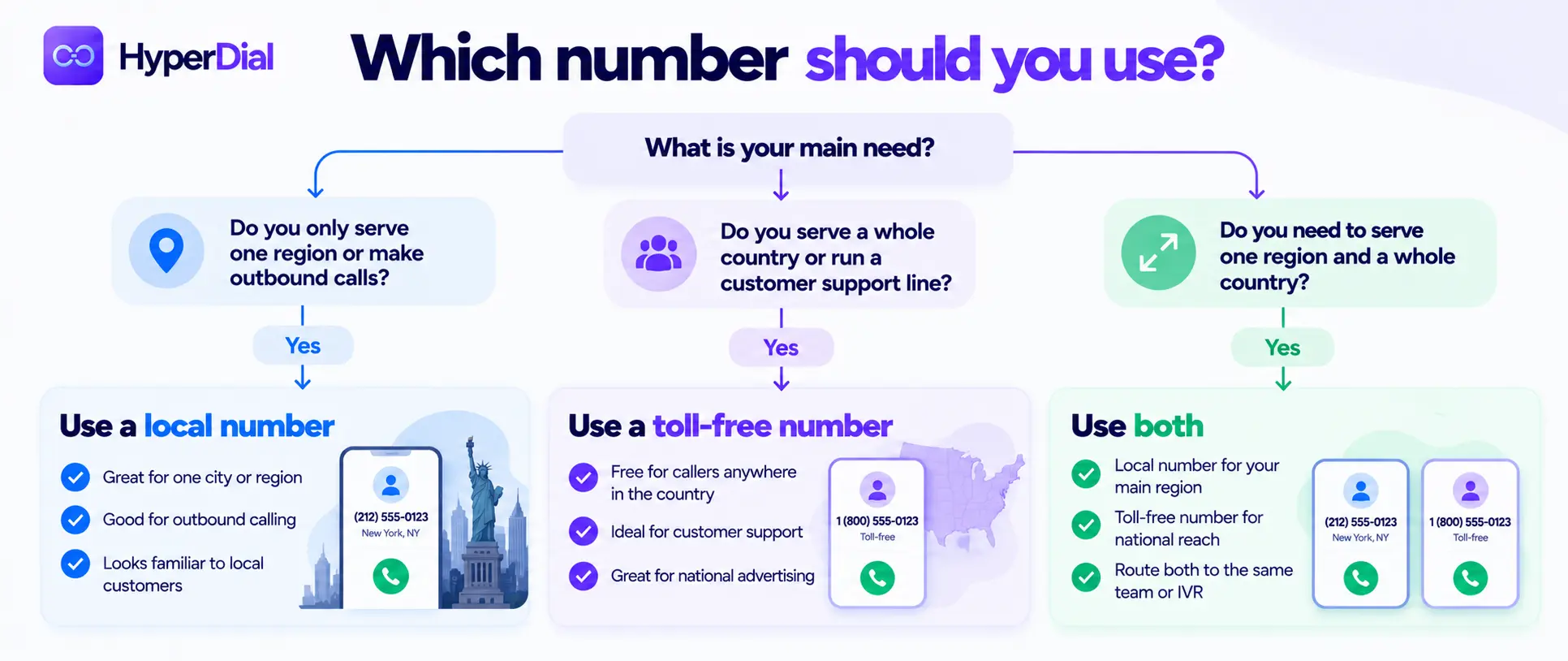
Should you use both a local and a toll-free number?
Yes, many businesses use both: a toll-free number for support and national ads, and local numbers for sales and regional marketing. Customers get the number that suits them, and all calls can still reach the same team. Follow these three steps:
- Get a toll-free number for support and national ads. Put it on your website, packaging and help pages so anyone in the country can call for free.
- Add local numbers for sales and each key region. Use them for outbound calls and local ads, so each market sees a familiar number.
- Route every number into one phone system. Send calls to the right team based on the number dialed, so customers get help no matter which number they use.
The most common mistake happens at step 3: teams set up each number on a different phone line or tool. Calls then land in separate places, and no one can see the full picture. HyperDial's call routing can route by the number dialed, the caller's region, or both.
How do international callers reach a toll-free number?
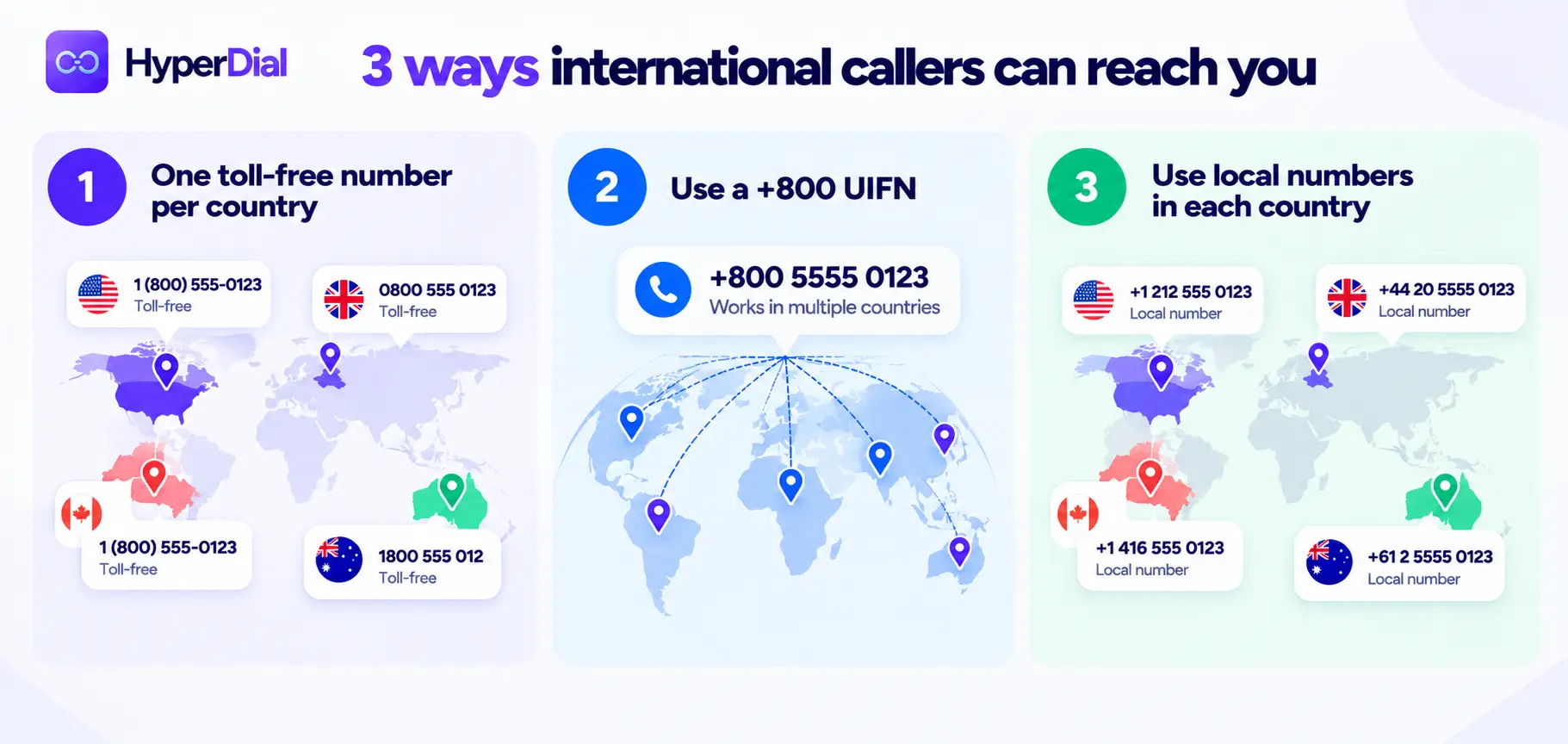
Most toll-free numbers only work inside their own country, so callers abroad usually can't dial them. Toll-free ranges are set up nationally, and a call from another country often won't connect. If you have customers in several countries, you have three options:
- Get one toll-free number per country: each market gets its own free number.
- Use a Universal International Freephone Number (UIFN): one number for several countries, made of the code +800 plus 8 digits, as defined by the ITU's UIFN service.
- Use local numbers in each country: callers pay a normal local rate, and the number works like any other call.
A UIFN can only be requested through a recognized phone operator, and HyperDial notes it must be live in at least two participating countries within 180 days of reserving it, as explained on its toll-free numbers page. Callers dial their own international prefix before the +800 number.
How much do local and toll-free numbers cost?
Local numbers usually cost less to run, because callers pay for their own calls, while toll-free numbers add the cost of every inbound minute. The exact price depends on the country, the provider and how many calls you get. These are the costs to compare:
- The number itself: a monthly fee for each local or toll-free number.
- Inbound minutes: you pay these on toll-free numbers, and rates vary by country.
- Outbound minutes: the cost of calls your team makes.
- Setup and paperwork: some countries ask for ID or business documents first.
- Porting: moving a number you already have to a new provider.
HyperDial bills numbers and minutes at cost, with no markup, on every plan. You can compare plans on the pricing page.
How does HyperDial help you use local and toll-free numbers?
HyperDial gives you local and toll-free numbers in one phone system, so every call reaches the right team no matter which number customers dial. Here's what's included, based on its business phone numbers page and number pages:
- Numbers in 130+ countries: local numbers in many markets, plus toll-free numbers where they're offered.
- Fast setup: numbers in some markets are ready in minutes, while markets that need ID checks take days.
- Routing by number: send each number to a queue, an IVR, a team or one agent.
- Local presence dialing: outbound calls show a number from the prospect's region.
- Number health alerts: HyperDial watches your numbers and warns you before one is flagged as spam.
- Free porting: bring the numbers you already have, and they keep working during the move.
- Billed at cost: numbers and minutes are itemized with no markup.
There are limits to know. Toll-free numbers aren't available in every country, and some countries need ID, a local address or business documents before a number goes live. Our guide on how to port a number explains the steps for moving an existing one.
What should you do next?
List who calls you and where they are. If most customers are in one region, or you make lots of outbound calls, start with a local number. Serving a whole country or running a support line? Add a toll-free number. To get both in one system, compare plans on the pricing page or try HyperDial free.
Sources


