
Can Customers Call a Toll-Free Number From Another Country?
Selling abroad? Your toll-free number probably won’t work for customers in other countries. Learn why, and how to give every market a number it can call for free.
This guide explains why toll-free calls stop at the border and which options do work. It also shows how to set up your numbers so every overseas customer can reach you.
Why don't toll-free numbers work from another country?
Toll-free numbers don't work from another country because the "business pays" billing only exists between carriers inside one country. The ITU calls this kind of number "freephone", and it standardizes the international version separately in Recommendation E.152, international freephone service.
Here's what happens behind the scenes. When someone dials a toll-free number at home, their carrier knows to bill the business instead of the caller. A carrier in another country has no such arrangement, so it either can't route the call or treats it as a normal international call. Three things usually decide the outcome:
- The caller's carrier: many networks simply don't route foreign toll-free ranges.
- The type of phone: mobile networks are often stricter than landlines, and some add charges.
- The number's setup: some businesses block international callers on purpose to control costs.
Dialing a country code in front of a toll-free number rarely fixes it. The number still belongs to a national range that only its home network recognizes.
Do international callers pay to call a toll-free number?
Yes, when the call connects at all, an international caller usually pays their normal international rate. The "free" part only applies inside the number's home country.
It helps to separate two different questions, because they have different answers:
Can the call connect? Often no. The caller may hear a failure tone or a message saying the number can't be reached.
Is the call free? Only if the business has set up a toll-free number that works in the caller's country. Otherwise, the caller pays, even if the number still connects.
That's why "it worked for one customer" doesn't mean it works for everyone. The same number can connect from one network and fail from another. HyperDial's toll-free numbers page notes that a business usually holds a separate toll-free number in each market it sells into.
What are your options for an international toll-free number?
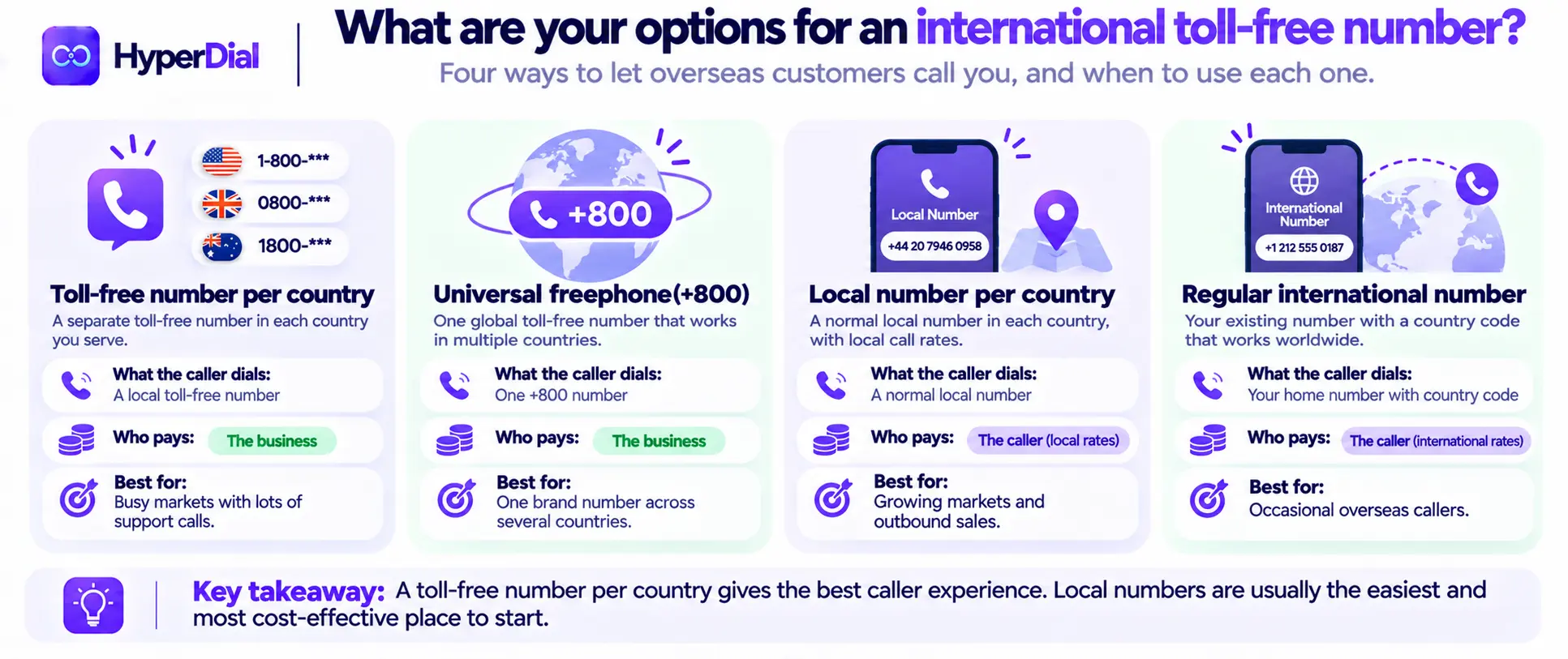
You have four main ways to let overseas customers call you, and most businesses combine two of them. The right mix depends on how many countries you serve and how much call volume each one brings:
Table 1: International toll-free number options compared
| Option | What the caller dials | Who pays | Best for |
|---|---|---|---|
| Toll-free number per country | A local toll-free number | The business | Busy markets with lots of support calls |
| Universal freephone (+800) | One +800 number | The business | One brand number across several countries |
| Local number per country | A normal local number | The caller, at local rates | Growing markets and outbound sales |
| Regular international number | Your home number with country code | The caller, at international rates | Occasional overseas callers |
A toll-free number per country gives the best caller experience, because customers dial a free, familiar number. Local numbers are usually the easiest place to start, because they're cheaper for the business and still cost the caller only a local rate.
What is a universal international freephone number?
A universal international freephone number (UIFN) is one toll-free number that can be dialed for free from several countries, using the global country code +800. According to the ITU's UIFN page, it has 11 digits: the 800 code plus an eight-digit subscriber number, and callers dial their international prefix first.
It sounds like the perfect global number, but it has limits. A UIFN only works in countries where it has been switched on, so it isn't truly worldwide. HyperDial's toll-free numbers page adds that a UIFN must be live in at least two countries within 180 days of reservation, or the reservation is cancelled.
Choose a UIFN if you want one memorable number on global packaging or ads, and your main markets support it.
Choose separate numbers per country if you need every caller, on every network, to get through reliably.
How do you set up an international toll-free number?
You set up an international toll-free number by choosing a number per market, routing them to your team and showing each customer the right one. Follow these three steps:
- List the countries your callers are in. Check your call logs, website visits and customer addresses, then rank markets by how many calls they bring.
- Get a toll-free or local number for each market. Use toll-free numbers in your busiest markets, and local numbers where volume is still small.
- Route every number to the right team and publish it. Send each country's calls to a team working during that country's hours, then show the matching number on each country's website and documents.
The most common mistake happens at step 3: printing one home-country toll-free number on a global website. Overseas customers try it, hear a failure tone, and assume you don't serve them. HyperDial's call routing can route by the number dialed or the caller's region, with business hours and holiday calendars per region.
Can one team answer toll-free numbers from several countries?
Yes, one team can answer every country's numbers from the same app, as long as the numbers sit in one account. Each number rings the right people, keeps its own hours and shows up separately in reports.
That means you don't need an office or a separate provider in every country. HyperDial's toll-free numbers and local phone numbers cover 130+ countries, and a team selling into several markets holds one account rather than one vendor per country.
What should callers do if a toll-free number won't connect from abroad?
Callers who can't reach a toll-free number from abroad should look for an international or local number from the same business. Most companies that serve overseas customers publish one. These are the usual places to check:
- The website footer or contact page, which often lists an "international callers" number.
- Account documents and emails, like invoices or booking confirmations.
- A callback form or live chat, so the business calls you instead.
- A messaging channel, such as WhatsApp, if the business offers one.
As a business, make those options easy to find. HyperDial's business messaging adds WhatsApp on the same customer thread as your calls. Its AI agent can answer overflow and out-of-hours calls in markets your team doesn't cover live.
Should you use toll-free or local numbers for international customers?
Use toll-free numbers where free calling helps customers pick up the phone, and local numbers everywhere else. Many businesses start local and add toll-free once a market grows. Here's a quick guide:
Choose a toll-free number in a country if that market brings steady support calls and free calling reassures customers there.
Choose a local number in a country if you're testing a new market, mostly make outbound calls, or want lower costs.
Use both if you support customers nationally but also call out to prospects in that country.
Each country has its own rules and documents for both number types. HyperDial's business phone numbers page lists what each region needs, and files KYC and registration steps on your behalf where a region requires them.
What should you do next?
Check where last month's calls came from and which countries your customers live in. Add a toll-free or local number for your top markets, route them to your team and publish the right number on each country's page. When you're ready, compare plans on the pricing page or try HyperDial free.
Sources


