
Who Pays for a Toll-Free Call? Caller vs Business Costs
Toll-free calls are free for your customers, but not for you: here’s what each side really pays, and how to keep your line affordable as calls grow.
Who pays for toll-free calls?
The called party, meaning the business that owns the toll-free number, pays for toll-free calls. That's why many countries call them "freephone" numbers, the same name the ITU uses in its standard for international freephone service (E.152).
Your phone provider then adds up the minutes customers spend on your toll-free line and bills them to you. HyperDial's toll-free numbers page puts it simply: the cost of the call is billed to the business instead of the person dialing.
Does the caller ever pay anything?
Sometimes, yes, even though the call charge itself goes to the business. The caller's own plan or location can still add a cost. Here's how it usually works for each type of caller:
Table 1: What different callers pay on a toll-free call
| Caller | What the caller pays | Who pays the call charge |
|---|---|---|
| Landline in the same country | Nothing | The business |
| Mobile on an unlimited plan | Nothing extra | The business |
| Mobile on a limited plan | Their own airtime minutes | The business |
| Caller in another country | Often can't connect | Not applicable |
The mobile case catches people out. A free call to your business can still use minutes from the caller's plan if their calling isn't unlimited. Most people won't notice, but it's worth knowing before you promise a call is "free for everyone."
International callers are the other gap. Most toll-free ranges only work inside their own country, so a business usually holds a separate toll-free number in each country it sells into. Our guide on local vs toll-free numbers explains when a local number serves callers abroad better.
What does the business pay for?
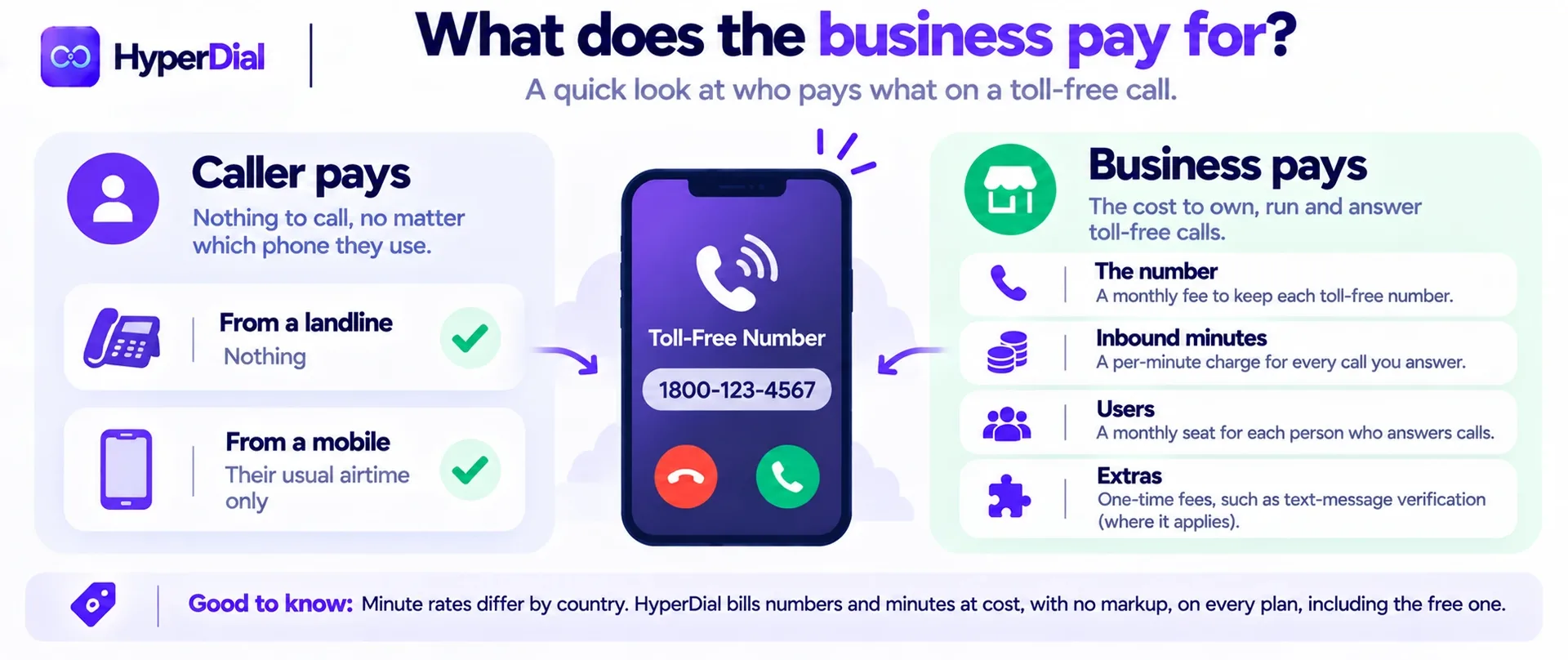
The business pays for the toll-free number itself and for every minute of every call it receives. Because callers pay nothing, costs rise as your line gets busier. Expect these costs with most providers:
- The number: a monthly fee to keep each toll-free number.
- Inbound minutes: a per-minute charge for every call you answer.
- Users: a monthly seat for each person who answers calls.
- Extras: one-time fees, such as text-message verification where it applies.
Minute rates differ from country to country. HyperDial bills numbers and minutes at cost, with no markup, on every plan including the free one. You can see the plan details on the pricing page.
How can a business keep toll-free call costs under control?
A business keeps toll-free costs under control by getting callers to the right person fast and by using the right number for each job. Follow these three steps:
- Route every call to the right person first time. Use a short phone menu and clear routing so callers don't sit on hold or get passed around, since every waiting minute is a minute you pay for.
- Use local numbers for outbound and regional calls. Keep the toll-free number for inbound calls, and make outbound calls from a local number, because callers to a local number pay standard rates themselves.
- Review your call data every month. Check total, answered and missed calls, plus your busiest hours, then adjust staffing and routing so fewer calls run long.
The usual mistake happens at step 1: a long phone menu feels like good service, but callers pay nothing to wait, and you pay for every second. HyperDial's call routing sends calls to a team, a queue or a phone menu (IVR), and lets you change where the number rings without changing the number.
Is a toll-free number worth what the business pays?
A toll-free number is worth it when free calling brings in more calls than it costs you. Any busy line will always cost more than a quiet one, so judge it by what those calls bring in. Use this quick guide:
Choose a toll-free number if customers call from all over the country and a free call helps them pick up the phone.
Choose a local number if most callers are nearby, or you mostly call customers rather than wait for them to call you.
Use both if you support customers nationally but sell in specific cities. HyperDial's local phone numbers work alongside a toll-free line on the same team.
What should you do next?
Check where your calls come from and how long they last. If most callers are nationwide and calls stay short, a toll-free line is an easy win. When you're ready, try HyperDial free or compare plans on the pricing page.
Sources


