
How much does a business phone number cost?
The rental is the smallest line on your phone bill, so here’s how to price a business number at the volume you’ll actually call.
Most price pages show the smallest of those lines first. We've helped enough teams compare quotes to know the cheapest rental rarely means the cheapest bill. This guide breaks down what you'll actually pay for, the costs people miss, and how to work out a real monthly figure before you buy.
Every fact in this guide links to its source, and we last checked them on 11 November 2026.
What do you actually pay for with a business phone number?
You pay for five things with a business phone number: the number, the users, the calls, one-off setup items, and taxes. Some providers bundle several of these into one plan price, and others bill each separately. This table shows what each line covers and how it's usually charged:
Table 1: The five parts of a business phone number bill
| Cost line | What it covers | How it's usually charged |
|---|---|---|
| Number rental | Holding the number itself | Monthly, per number |
| User seats | Each person who makes or takes calls | Monthly, per user |
| Call minutes | Time on calls, in and out | Included allowance, then per minute |
| One-off items | Porting, registration, special numbers | Once, at setup |
| Taxes and fees | Charges set by the country | Added to the bill |
The number is often the smallest line. Seats and minutes usually decide the total, which is why a plan with a cheap number can still cost more each month.
Which business phone number costs are easy to miss?
The costs that are easy to miss are the ones that only appear once you start calling. A quote at zero usage looks tidy, but real bills include these:
- Incoming minutes on toll-free numbers, because the business pays for calls, not the caller.
- Minutes beyond your allowance, which are billed per minute once you go over.
- Minimum user counts, where a plan needs two or more seats even if one person calls.
- Registration or compliance steps, which some countries require before a number can dial out.
- Porting fees, charged by some providers to move a number in or out.
- Taxes and regulatory charges, which vary by country and are often left off headline prices.
Of these, toll-free minutes catch the most people out. Our guide on who pays for toll-free calls explains why the cost lands on you.
Why does the type of number change what you pay?
The type of number changes what you pay because each type is billed differently, and some move the call cost onto your business. A local number and a toll-free number might rent for similar amounts, yet cost very different sums once calls start. Here's how the main types usually compare:
Local numbers: usually the cheapest to hold, and callers pay their normal rate to reach you. See what local phone numbers are for why they help with trust.
Toll-free numbers: free for the caller, so you pay for every incoming minute. Costs grow with call volume.
Mobile numbers: priced like local numbers in many markets, though some carry extra registration steps.
Vanity or memorable numbers: easy-to-remember digit patterns, which can cost more if a provider prices them as premium stock.
Number types and their ranges are set country by country. The ITU, the UN agency for telecommunications, keeps an index of national numbering plans if you want to see which types exist where. For a side-by-side view, read our guide on local vs toll-free numbers.
How do you work out the real business phone number cost each month?
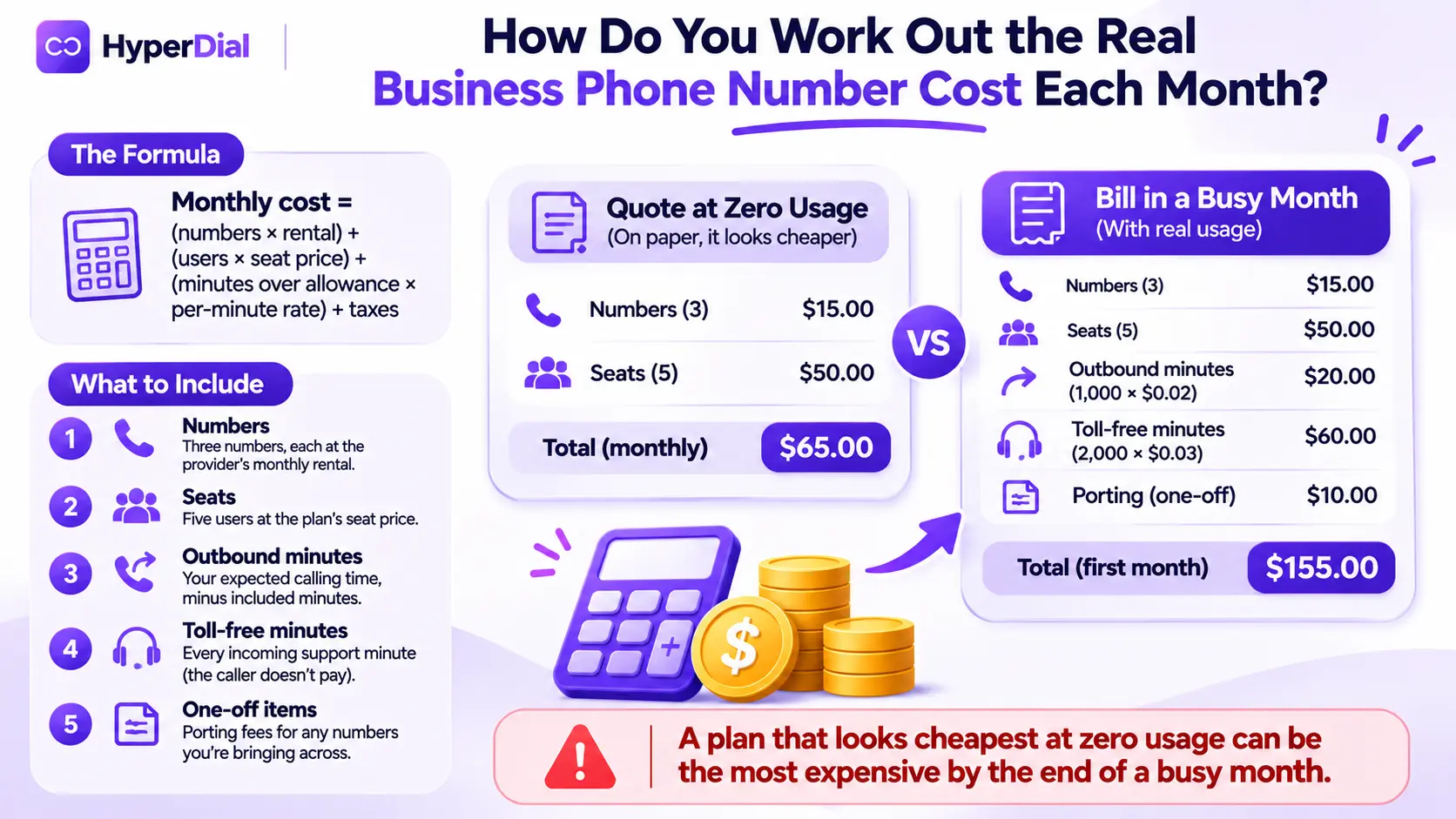
You work out the real business phone number cost by adding every line at the call volume you actually expect. Use this simple formula, then fill it in with each provider's current prices:
Monthly cost = (numbers × rental) + (users × seat price) + (minutes over allowance × per-minute rate) + taxes
Then add one-off items, such as porting or registration, to the first month. As an example, take a five-person sales team with two local numbers and one toll-free support line:
- Numbers: three numbers, each at that provider's monthly rental.
- Seats: five users at the plan's seat price, checking for any minimum.
- Outbound minutes: the team's expected calling time, minus the plan's included minutes.
- Toll-free minutes: every incoming support minute, because the caller doesn't pay.
- One-off items: porting fees for any numbers you're bringing across.
Run the same five lines for every provider you're comparing. You'll often find the ranking flips once real minutes go in.
The mistake we see most is comparing quotes at zero usage. A plan that looks cheapest with no calls can be the most expensive by the end of the first busy month.
How do you buy a business phone number without overpaying?
You buy a business phone number without overpaying by choosing the type first, pricing it at real usage, then buying on terms you can leave. Follow these three steps:
- Choose the number type and market first. Decide whether you need local, toll-free or mobile, and in which country or area code. A cheap number in the wrong market is money wasted.
- Price every option at your expected call volume. Ask each provider for rental, seat, minute and one-off charges in writing. Then run them through the formula above.
- Buy on terms that let you leave with your number. Check porting-out rules, notice periods and contract length before you sign. Then test the number with real calls before you publish it.
Step 3 matters more than it looks. A number printed on your website and invoices is hard to change, so the right to take it with you is part of its value. Our guide to what number porting is explains how that move works.
Is the cheapest business phone number always the best deal?
The cheapest business phone number isn't always the best deal, because the lowest rental can hide higher seat, minute or exit costs. Value means the number does the job you need at the lowest realistic total. Use this guide to decide:
Choose the lowest-priced option if you have one or two users, low call volume, and no need for toll-free.
Choose a plan with included minutes if your team calls out daily, and overage would quickly exceed the plan price.
Choose a provider with clear per-minute billing if your volume swings a lot, such as seasonal or campaign spikes.
Choose the provider that lets you port out freely if the number will appear on printed materials or ads.
Features count too. Voicemail, call recording, phone menus and call queues are sometimes sold as add-ons, which turns a cheap plan into an expensive one.
How does HyperDial price business phone numbers?
HyperDial bills numbers and minutes at cost on every plan, including a free Base plan with no expiry. You only add a per-user plan if you want included minutes and extra features.
Here's how the pricing works, as shown on HyperDial's pricing page:
- Base plan: free with no expiry and no card required. You pay only for the numbers you provision and the minutes you use, both at cost.
- Paid plans: priced per user, with included minutes that vary by region. Calling beyond them is billed at cost.
- Features on every plan: voicemail, call recording, phone menus (IVR), call queues and standard reporting, including on Base.
- Annual billing: up to 25% below monthly, and it includes free number porting.
- Itemized bills: HyperDial's business phone numbers page says numbers and minutes are itemized, with no per-region surcharge on the platform fee.
Toll-free numbers are billed at cost on every plan as well, and porting them in is free. US local numbers in any area code sit in the same account and are provisioned in minutes.
One honest limit: the pricing page doesn't publish a fixed price per number, because number costs vary by country. Numbers and porting are listed as "Talk to us", so you'll get the exact figure for your market on request.
What should you do next?
List the numbers you need, the people who'll use them, and the minutes you expect each month. Then ask two or three providers for every cost line in writing and run them through the formula above. To see how HyperDial compares, check the pricing page or try HyperDial free.
Sources


