
How Local Presence Dialing Works and When Sales Teams should Use it
A local number gets your call answered, but only the right setup gets you the meeting, so here’s how local presence works and when it’s worth turning on.
It works best when you actually serve those regions, keep numbers steady, and make sure callbacks reach a real person. This guide explains how it works, when it helps, when it doesn't, and how to set it up so it lifts meetings, not just pickups.
What is local presence dialing?
Local presence dialing is an outbound calling method that matches the caller ID a prospect sees to the prospect's own city, region or country. The rep dials as normal, and the dialer chooses which of your business numbers to display.
Three terms come up in every setup:
Caller ID: the number shown on the prospect's screen before they answer.
Number pool: the set of local numbers your business holds across the regions you call.
Number matching: the dialer rule that picks a number from the pool based on the prospect's area code or country code.
The idea is simple. People are more willing to answer a number that looks nearby than one from far away or one they can't place. Our guide to what local phone numbers are explains why area codes carry that trust.
How does local presence work?
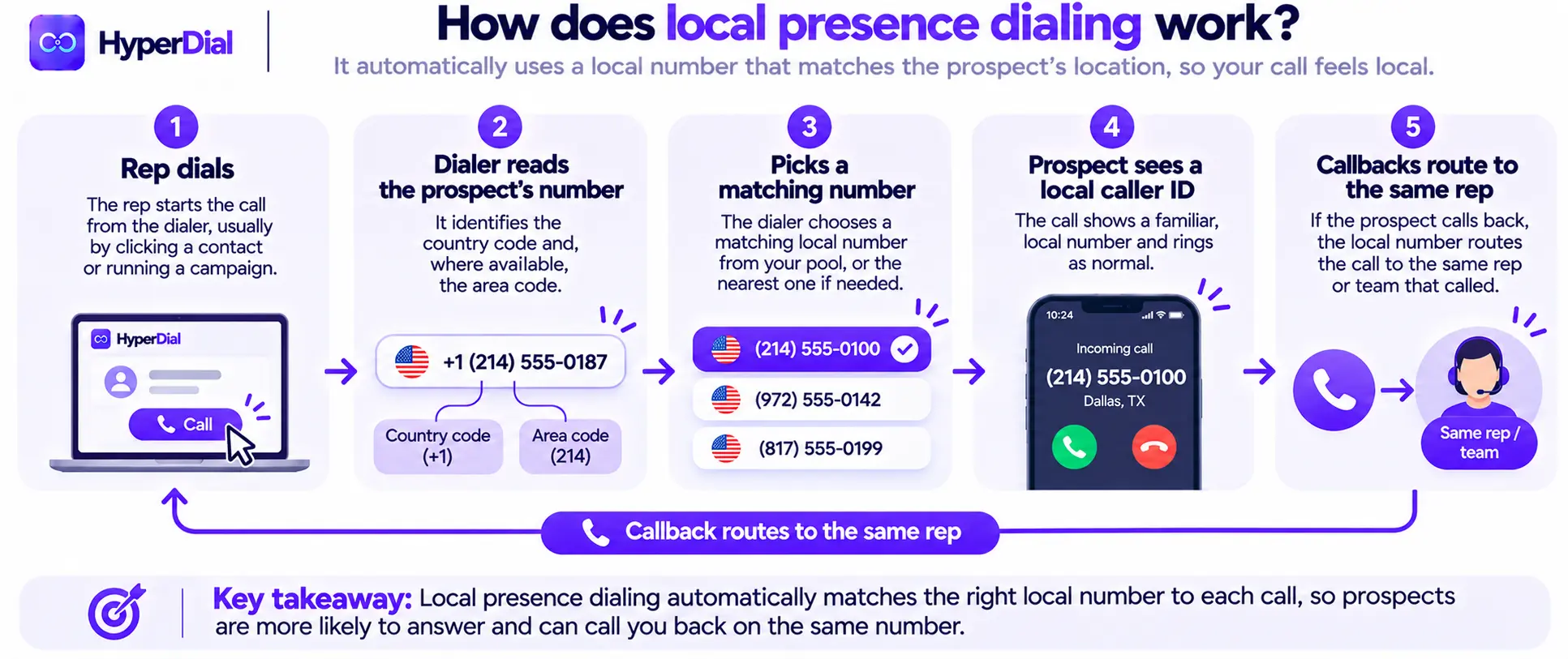
A local presence dialer works by reading where the prospect's number belongs, then placing the call from your closest matching number. Every call follows the same five steps:
- The rep starts the call from the dialer, usually by clicking a contact or running a campaign.
- The dialer reads the prospect's number and identifies its country code and, where one exists, its area code.
- The dialer picks a matching number from your pool, or the nearest one if you don't hold that exact area.
- The prospect sees a local caller ID and the call rings as normal.
- Callbacks come back to that local number and are routed to the rep or team that called.
Reps don't choose numbers or sort lists by region. The matching happens in the background, which is why most teams turn it on per campaign rather than per call.
What happens when a prospect calls back?
When a prospect calls back a local presence number, the call should reach the rep who called them, or that rep's team. This is the part most setups get wrong. Picture a callback landing on an empty line or a voicemail nobody checks. You lose the warmest lead of the day and teach the prospect not to trust the number.
Is local presence dialing the same as caller ID spoofing?
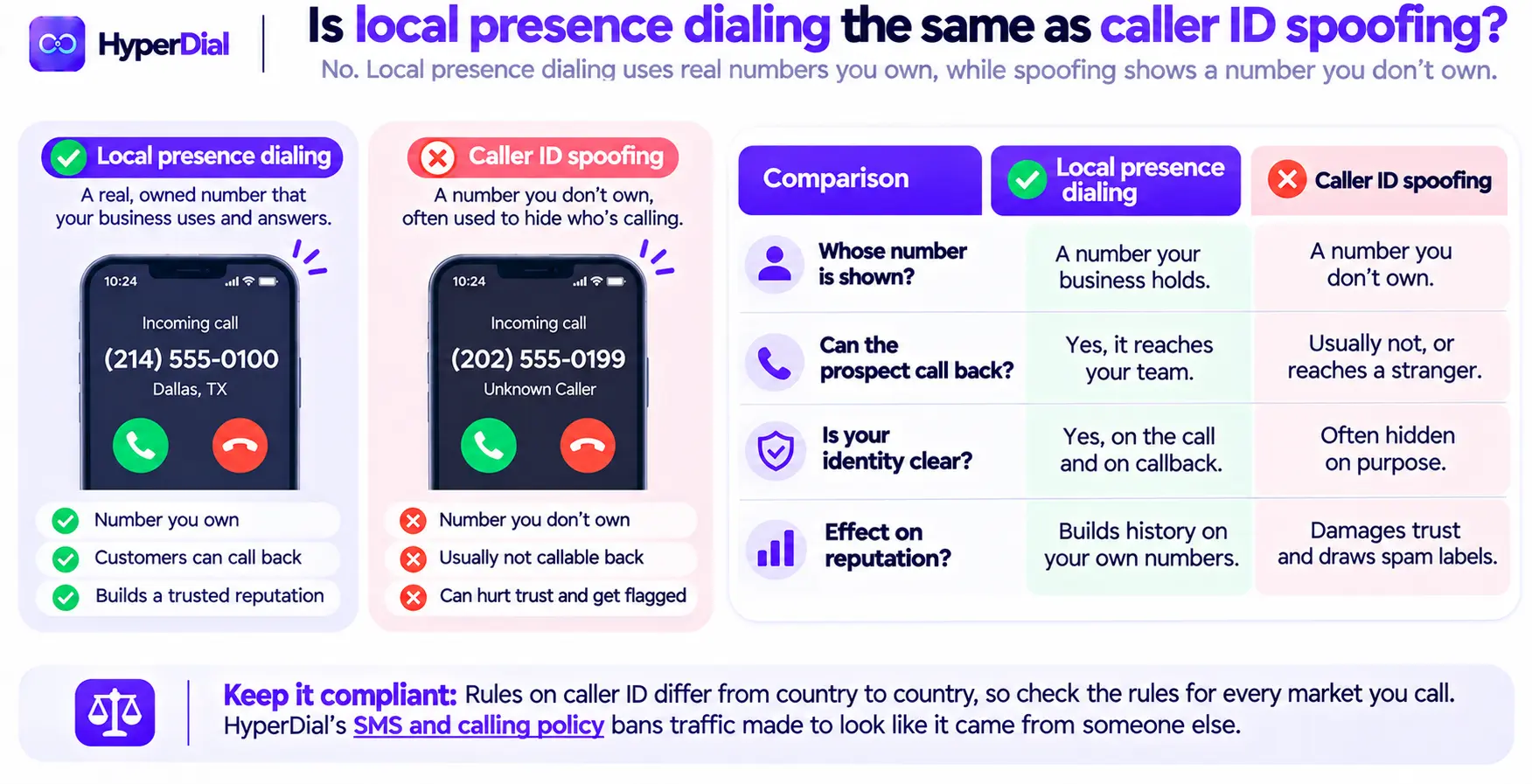
No, local presence dialing isn't spoofing, because it shows real numbers your business holds and answers. Spoofing shows a number the caller doesn't own, usually to hide who's calling. The difference is easy to see side by side:
Table 1: Local presence dialing vs caller ID spoofing
| Local presence dialing | Caller ID spoofing | |
|---|---|---|
| Whose number is shown | A number your business holds | A number you don't own |
| Can the prospect call back? | Yes, it reaches your team | Usually not, or reaches a stranger |
| Is your identity clear? | Yes, on the call and on callback | Often hidden on purpose |
| Effect on reputation | Builds history on your own numbers | Damages trust and draws spam labels |
Rules on caller ID differ from country to country, so check the rules for every market you call. HyperDial's SMS and calling policy bans traffic made to look like it came from someone else, and that's a sound line for any team to draw.
When should sales teams use local presence dialing?
Sales teams should use local presence dialing when they call prospects across several regions and genuinely serve customers in each one. It earns its place when an unfamiliar caller ID is the thing stopping calls from being answered. Use this guide:
Use local presence if you sell into several cities or countries and can serve customers in each of them.
Use local presence if your reps make outbound calls at volume, so every extra answer adds up.
Use local presence if you can route callbacks straight to the right rep or team.
Skip it if you sell in one city, since one local number already does the job.
Skip it if you mostly call existing customers, who know and save your main number.
Skip it if you'd be showing numbers from places you don't actually do business.
That last rule matters most. A prospect who learns your "local" office doesn't exist starts the conversation with less trust than if you'd called from your real number.
Does local presence dialing work outside area-code markets?
Yes, local presence dialing still works outside area-code markets, but the match happens by country rather than by city. Every phone number follows the ITU's E.164 international numbering plan, which starts with a country code. Many countries don't tie mobile numbers to a region at all. There, the trust signal is "a number from my country", not "a number from my city". In area-code markets, the match can go down to the city: HyperDial's US local phone numbers, for example, cover any US area code. Our guide on how to get a local phone number for another country covers the setup abroad.
Should you rotate local numbers or keep one per region?
Most teams should keep one steady local number per region and add a second only when volume calls for it. There are two common ways to run local presence, and they carry very different risks:
Table 2: Two ways to run local presence dialing
| Steady number per region | Large rotating pool | |
|---|---|---|
| How it works | One or two numbers per region, used every day | Many numbers, swapped call by call |
| Callbacks | Prospects recognize and save the number | Prospects see a new number each time |
| Reputation | Each number builds its own history | New numbers start with no history |
| Spam risk | Lower, with sensible volume per number | Higher, since fast rotation looks suspicious |
| Best for | Most B2B and regional sales teams | Very high volume across many regions |
Follow-ups get easier with a steady number. A prospect who sees the same local number on the second and third attempt starts to recognize it. Some will even call back on their own. Rotation still has a place: spreading calls across a few numbers in a busy region keeps any one number from carrying too much volume.
How do you set up local presence dialing?
You set up local presence dialing by choosing your regions and numbers, building the pool with callback routing, and testing it against your current caller ID. Follow these three steps:
- Choose your regions and get local numbers there. List the cities or countries where you have real prospects and customers. Get one local number for each.
- Build the pool and route callbacks. Turn on number matching for your outbound campaigns. Send every callback to the rep who called or to that region's sales team.
- Test it against your current caller ID. Split similar lists between local presence and your usual number for a few weeks. Then compare meetings booked per hundred dials.
The most common mistake happens at step 2: teams switch on matching but forget callback routing. Prospects who call back reach a dead line or a general queue, so the extra interest never turns into a conversation. Test a callback to every new number before the campaign starts.
How should you measure local presence dialing?
You should measure local presence dialing by meetings booked per hundred dials, not by answer rate alone. Answer rate tells you more people picked up, but not whether they stayed on the call. Track these four numbers together:
- Answer rate per number, to spot a number that's dropping.
- Early hang-ups, calls that end in the first few seconds.
- Callback rate, how often missed prospects call your local number back.
- Meetings per hundred dials, the result that actually matters.
Our guide on how to track unanswered calls shows how to read these trends in your call data.
What can local presence dialing not fix?
Local presence dialing can't fix the problems that happen before or after the caller ID shows up. A familiar number gets you a better first glance, and that's all. It won't help with these:
- Bad data: wrong numbers and outdated lists still waste dials.
- Spam labels: a flagged number shows a warning whatever its area code.
- Poor timing: calling when prospects are busy still goes unanswered.
- A weak opening: prospects still hang up if the first ten seconds don't earn their attention.
- Too many attempts: repeated calls from a local number still feel like pressure.
Pacing matters here too. A dialer that connects calls faster than reps can answer creates silent calls, which cancel out any trust a local number earns. Our guide to power dialers vs predictive dialers explains how pacing affects what prospects hear.
How does HyperDial handle local presence dialing?
HyperDial builds local presence into its dialer: you set the rule once per campaign, and it picks the matching number on every call. Numbers, matching and callback routing all live in one account.
Here's how the pieces fit:
- Local numbers: HyperDial's local phone numbers are available in 130+ countries, and they ring on your team's laptops and phones.
- Number matching: HyperDial for outbound offers local presence dialing from a number that matches the region, with a pool of numbers rotated rather than hammering one.
- Callback routing: call routing can route by the number dialed or the caller's region. A returning caller reaches the person who handled them last, where that helps.
- Pacing and retries: power and predictive pacing tuned to each campaign's real connect rate, plus voicemail drop and retry rules.
- Reporting: call analytics tracks campaign health from dialed to booked.
Local numbers work on every plan, including the free one. Numbers are billed at cost, so a test in a new region costs the price of the number.


