
Should a US Business Publish a Local Number or Toll-Free Number?
If your sales team calls from an 800 number, your prospects are screening you out.
The right choice depends on who calls you and why. This guide keeps it simple. It explains the difference, who pays for each call, and which number fits common types of business. Then it gives you three steps to decide.
Every fact in this guide links to its source. We last checked them on 18 November 2026.
Key takeaways
- Local numbers suit local businesses, sales teams and anyone who calls customers.
- Toll-free numbers suit nationwide support and order lines.
- With a toll-free number, you pay for incoming calls, not the caller.
- Many businesses use both, each for a different job.
What's the difference between a US local number or toll-free number?
The main difference is who pays for the call. With a local number, the caller pays their normal phone rate. For a toll-free number, your business pays, and callers on a landline pay nothing.
A local number has a normal area code, such as 312 for Chicago or 212 for New York. Toll-free numbers start with one of seven codes: 800, 888, 877, 866, 855, 844 or 833. That's according to the FCC's guide to toll-free numbers. All seven work the same way for callers.
This table shows how they compare:
Table 1: US local number vs toll-free number
| Question | Local number | Toll-free number |
|---|---|---|
| Who pays for incoming calls? | The caller | Your business |
| What does it look like? | A city's area code | 800, 888, 877, 866, 855, 844 or 833 |
| Good for calling customers? | Yes | Usually not |
| Good for a nationwide support line? | It works | Yes, the classic choice |
| What it says about you | "We're local" | "We serve the whole country" |
| What you pay | Number plus calls you make | Number plus every call you get |
Our guide on local vs toll-free numbers explains the difference in any country. This guide focuses on choosing in the US.
Who pays when a customer calls a toll-free number?
Your business pays when a customer calls your toll-free number. The FCC says people can dial a toll-free number "with no charge to the person placing the call."
There's one catch. The same FCC guide says mobile callers are charged for the airtime minutes they use, unless they have an unlimited plan. So "free to call" helps most with people calling from a landline.
So with a toll-free number, a busy support line means a bigger bill for you. With a local number, the caller pays their own normal rate, and you only pay for your number and your own calls.
Which number should your business publish?
The best number to publish depends on what kind of business you run. This table matches common US businesses to the number that usually fits them best:
Table 2: Which US number to publish, by type of business
| Type of business | Publish this | Why |
|---|---|---|
| Local service, such as a clinic, plumber or law firm | Local number | Customers want someone nearby |
| Business with several locations | A local number per location | Each area sees its own code |
| Online store selling nationwide | Toll-free number | Free, easy support line for everyone |
| Business-to-business sales team | Local numbers | Buyers answer local calls more readily |
| Software company with sales and support | Both | Local for sales, toll-free for support |
| Company outside the US selling into it | Local numbers in key cities | Looks local without a US office |
Notice the pattern. If you make the calls, or serve one area, choose local. But if customers across the country call you for help, choose toll-free.
Calling out is where toll-free numbers fall short. HyperDial's toll-free numbers page says toll-free numbers usually get fewer people picking up on outbound calls than local numbers. Our guide on local presence dialing shows how matching a customer's area code helps.
How do you choose between a local and a toll-free number?
You choose by looking at who calls you, giving each number one job, and checking the results. These three steps take most teams an afternoon.
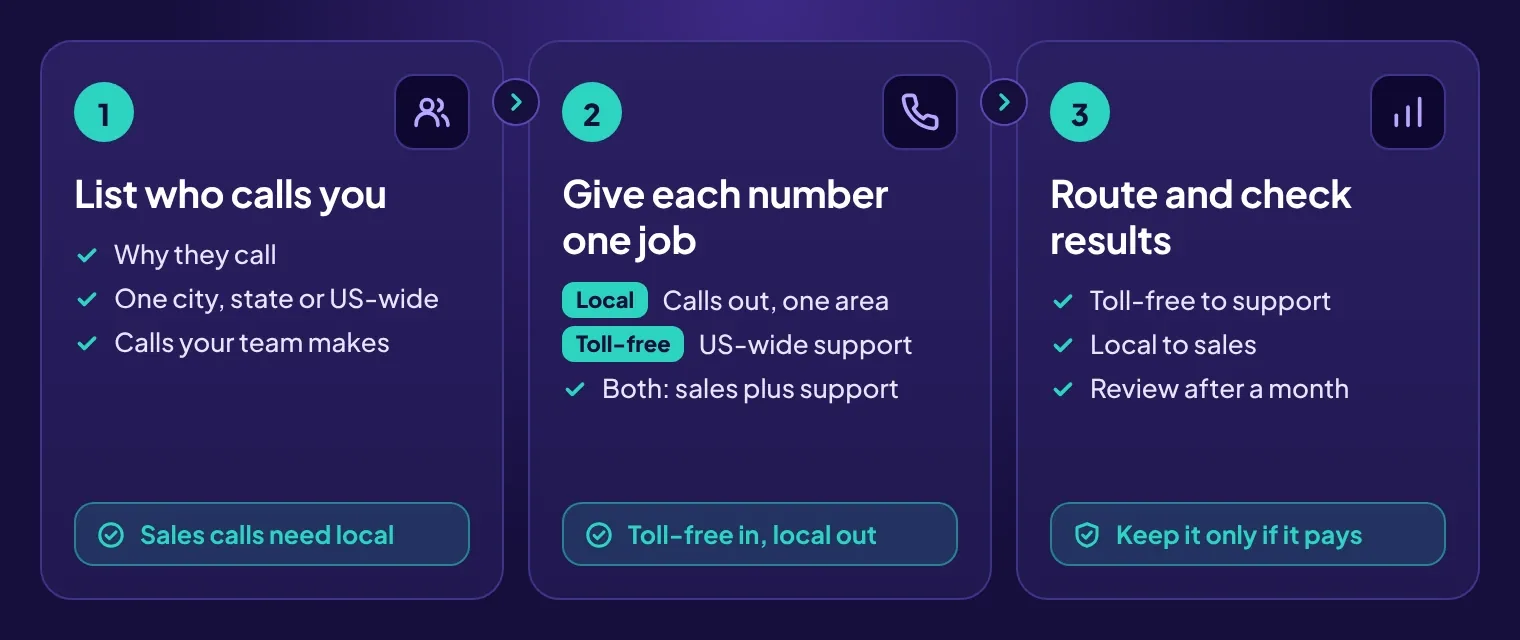
Step 1: List who calls you and why
Write down the main reasons people call your business. Maybe they want to buy, need help with an order, or book an appointment. Then note where they are: one city, one state or the whole country.
Also list the calls your team makes. If your sales team calls prospects, those calls need a local number. Our guide on how many phone numbers a business needs helps you count them.
Step 2: Give each number one clear job
Don't use one number for everything. Give each one a single job, using this simple rule:
Choose a local number if the number calls customers, serves one area, or is a direct line to a person.
Choose a toll-free number if the number takes support or order calls from across the US.
Choose both if you sell by phone and also run a nationwide support line.
The most common mistake is using a toll-free number for sales calls. People are less likely to pick up, and they may not know who's calling. Keep toll-free for calls coming in, and local numbers for calls going out. Our guide on separate phone numbers for sales and support shows how to split them.
Step 3: Send each number to the right team and check the results
Send each number's calls to the right team. For example, toll-free calls go to support and local calls go to sales. Our guide on call routing strategies shows how.
After a month, look at how many calls each number got, how many were answered, and what each cost. Keep the toll-free line if it brings in calls you'd otherwise miss. If a local number does the same job for less, drop it.
What does each type of number cost to run?
Both types of number have a monthly fee. The big difference is who pays for the minutes.
A local number costs a monthly fee plus the calls you make. Callers pay for their own calls to you.
A toll-free number costs a monthly fee plus every minute of every call you receive. So a busy line costs more each month.
Watch out for "free" toll-free offers. HyperDial's toll-free page warns that these often make their money back through higher prices per minute. Ask for the price per minute before you sign up.
HyperDial bills numbers and minutes at what the phone network charges, with no extra added, as the pricing page shows. Our guide on who pays for toll-free calls explains the costs in more detail.
Can you send texts from a local or a toll-free number?
Yes, you can text from both in the US, but each needs its own sign-up first. Texting from a local number needs 10DLC registration. This is the US sign-up system for businesses that text from normal local numbers.
Texting from a toll-free number needs a separate check called toll-free verification. HyperDial's toll-free numbers page says texts from unverified toll-free numbers get filtered or blocked. Since 1 January 2026, new checks must also include a business registration number, the country of registration and the type of business.
Either way, plan a little time before your first text goes out. You can usually start calling straight away.
How does HyperDial help with local and toll-free numbers?
HyperDial offers both US local and toll-free numbers in one account, so each can do its own job. Here's what you get, as described on HyperDial's US numbers page:
- Local numbers in any area code, ready in minutes.
- Toll-free numbers in all seven codes: 800, 833, 844, 855, 866, 877 and 888.
- Local presence, which shows a customer's own area code when you call them.
- A separate path for each number, so toll-free calls can go to support and local calls to sales.
- Fewer spam warnings, because calls to the US carry a digital check that shows they really come from you.
- Easy moves: bring your existing local or toll-free numbers with no break in service, free on yearly plans.
With HyperDial's numbers, you can point any number at any team or menu without raising a ticket. One honest limit: HyperDial's pages don't publish a per-minute price for toll-free calls, so ask for your rate before you launch.
What should you do next?
List who calls your business and why. If you make sales calls or serve one area, start with a local number. Add a toll-free number for a nationwide support or order line. Then send each number to the right team and check the results after a month. To see what's available, visit HyperDial's US numbers page, compare plans on the pricing page or book a demo.
Sources


