
How to Improve Outbound Call Connect Rates for Sales Teams
Your reps are dialing all day but barely talking to anyone? This guide shows how to get more prospects to pick up, from a cleaner list and a caller ID people trust to better timing and voicemails that get called back.
Picture a rep who makes 100 dials before lunch and speaks to five people. The script isn't the problem. Ninety-five calls never had a chance, and every one of them cost time, focus and lead budget. This guide shows you how to win those calls back.
You'll learn how to measure connect rate and spot what's dragging it down. Then you'll fix it lever by lever: list, caller ID, timing, cadence, voicemail and dialer.
What is an outbound call connect rate?
An outbound call connect rate is the share of dials that reach a live person. You work it out by dividing connected calls by total dials, then multiplying by 100. For example, 60 live answers from 1,000 dials is a 6% connect rate.
Teams often blur four related numbers, so define them before you measure anything:
Dial: every outbound attempt, whether or not anyone answers.
Connect: a dial that reaches a live person, not voicemail or a busy line.
Right-party connect: a connect with the person you actually meant to reach, not a colleague or a wrong number.
Conversation: a connect that lasts long enough for a real exchange, using a minimum talk time your team agrees on.
Connect rate tells you whether you're reaching people. Right-party connect tells you whether your data is any good. Conversation rate tells you whether people stay on the line. Fix them in that order, because no script works on a call nobody answers.
Why does connect rate matter so much?
Connect rate matters because every unanswered dial still costs rep time and lead spend, while producing nothing. When connect rate falls, your cost per meeting rises even if your reps are excellent on the phone.
It's also the quickest way to find where a campaign is failing. Compare connect rate with booked meetings for each campaign, and the pattern points you straight to the fix:
If connect rate is high but meetings are low, people are answering, so the problem is targeting, the offer or the opening.
If connect rate is low but meetings are high, the segment is strong, so the problem is your outreach setup: numbers, timing or cadence.
If both are low, start with the list, because bad data drags down everything after it.
Why are your outbound connect rates low?
Outbound connect rates are usually low because of the list, the timing, the number you call from or the way you follow up. Each cause leaves a clue in your call data:
Table 1: Common causes of low outbound connect rates
| Cause | What you notice | First fix |
|---|---|---|
| Stale or wrong numbers | Many invalid or wrong-person calls | Clean and verify the list |
| Slow follow-up | Fresh leads go cold | Call new leads first |
| Bad timing | Low answers at certain hours | Call in the prospect's local time |
| Unfamiliar caller ID | Low answers in new regions | Call from local numbers |
| Spam flags | Sudden drop on one number | Rest or rotate that number |
| Over-dialing | Falling answers on repeat leads | Cap attempts and cool off |
| Weak voicemails | Few callbacks after misses | Rewrite the first few words |
Look for the pattern across hundreds of calls, not a few bad days. A drop on one number points to that number. If every number drops at once, look at the list or your calling times.
How do you improve outbound call connect rates?
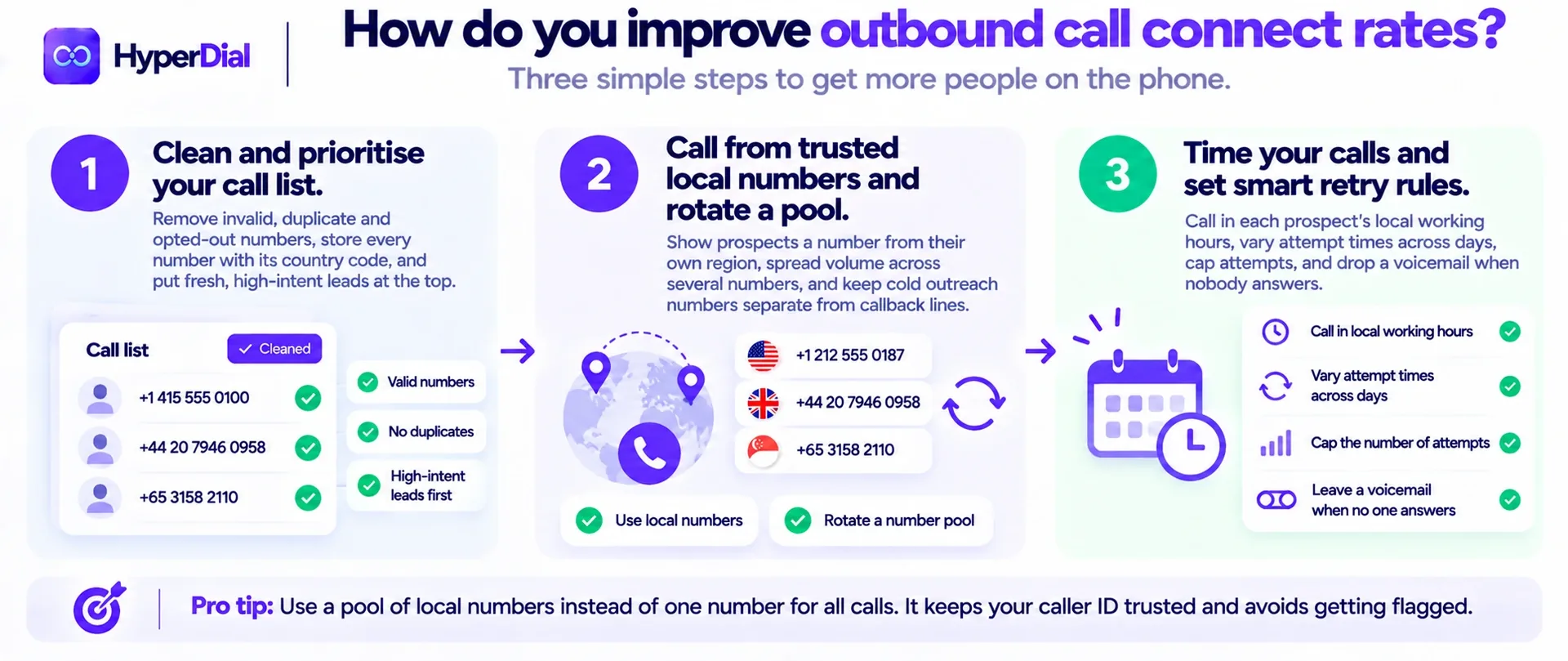
You improve outbound call connect rates by fixing the list first, then the caller ID, then the timing and cadence. Follow these three steps, then use the sections below to go deeper on each one:
- Clean and prioritize your call list. Remove invalid, duplicate and opted-out numbers, store every number with its country code, and put fresh, high-intent leads at the top.
- Call from trusted local numbers and rotate a pool. Show prospects a number from their own region, spread volume across several numbers, and keep cold outreach numbers separate from callback lines.
- Time your calls and set smart retry rules. Call in each prospect's local working hours, vary attempt times across days, cap attempts, and drop a voicemail when nobody answers.
The most common mistake happens at step 2: teams push every call through one number until it gets flagged. HyperDial's outbound calling page protects reputation by rotating a pool rather than hammering one number, with local presence dialing from a number that matches the region.
How do you build a call list that people actually answer?
You build a list people answer by calling the freshest, most interested leads first and keeping every number accurate. A dialer can only connect what the list gives it.
Speed comes first. Research published in Harvard Business Review on how fast companies respond to online sales leads found that most companies don't respond nearly fast enough. Someone who filled in a form ten minutes ago still remembers you, so they belong at the top of today's list.
Then work on the quality of the data itself. These habits keep a list healthy:
- Rank leads by intent and recency, so form fills and demo requests beat aged or bought lists.
- Segment by persona or region, so the right rep calls at the right local time.
- Store numbers in full international format, with the country code, as set out in the ITU's E.164 numbering plan.
- Remove invalid and wrong numbers quickly, before they waste more rep time and hurt your numbers' reputation.
- Use clear call outcomes, like wrong number, call back later or not interested, so the next attempt is handled correctly.
A useful test is right-party connect. If reps keep reaching the wrong person, no caller ID trick will save the campaign.
How do you make prospects trust your caller ID?
Prospects trust a caller ID that looks local, shows a recognizable business and hasn't been flagged by their network. Most people decide whether to answer in the second or two it takes to read the screen.
These habits protect your numbers and your answer rate:
- Call from a local number in the prospect's region, so the call looks like a nearby business.
- Show your business name using branded or registered caller ID where the network supports it.
- Rotate a pool of numbers and give each one rest days, instead of running every call through one line.
- Warm up new numbers gradually, starting with lower daily volume before you push them hard.
- Quarantine any flagged number at once, and stop dialing from it until it recovers.
- Register numbers where a market requires it, before the campaign starts.
Here's one move many teams miss: keep your cold-outreach numbers separate from the numbers customers already know. If a cold pool gets flagged, your existing customers and warm leads can still reach you. Use local numbers for calls you make, and toll-free numbers for calls you want to receive. HyperDial's toll-free numbers page notes that an unfamiliar national number is answered less often than a local one.
When is the best time to make outbound sales calls?
The best time to call is when your prospect is at work, free, and likely to pick up, in their own time zone. No single hour works for everyone, so let your own call data decide.
Start with a few sensible rules. Call inside the prospect's local business hours, not yours, and skip their public holidays. Test early morning, late morning and mid-afternoon windows against each other, and see how the lunch hour performs for your audience. Then keep doing more of what your numbers show works.
Vary the time on every attempt. If a lead didn't answer at 10am on Monday, try mid-afternoon on Wednesday. Calling at the same time every day just repeats the same miss.
Respect quiet hours too. Calls at odd hours annoy people, raise complaints and put your numbers at risk. HyperDial's outbound calling page says its retry rules treat a bad time of day differently from a bad lead.
How many times should you call a lead, and how?
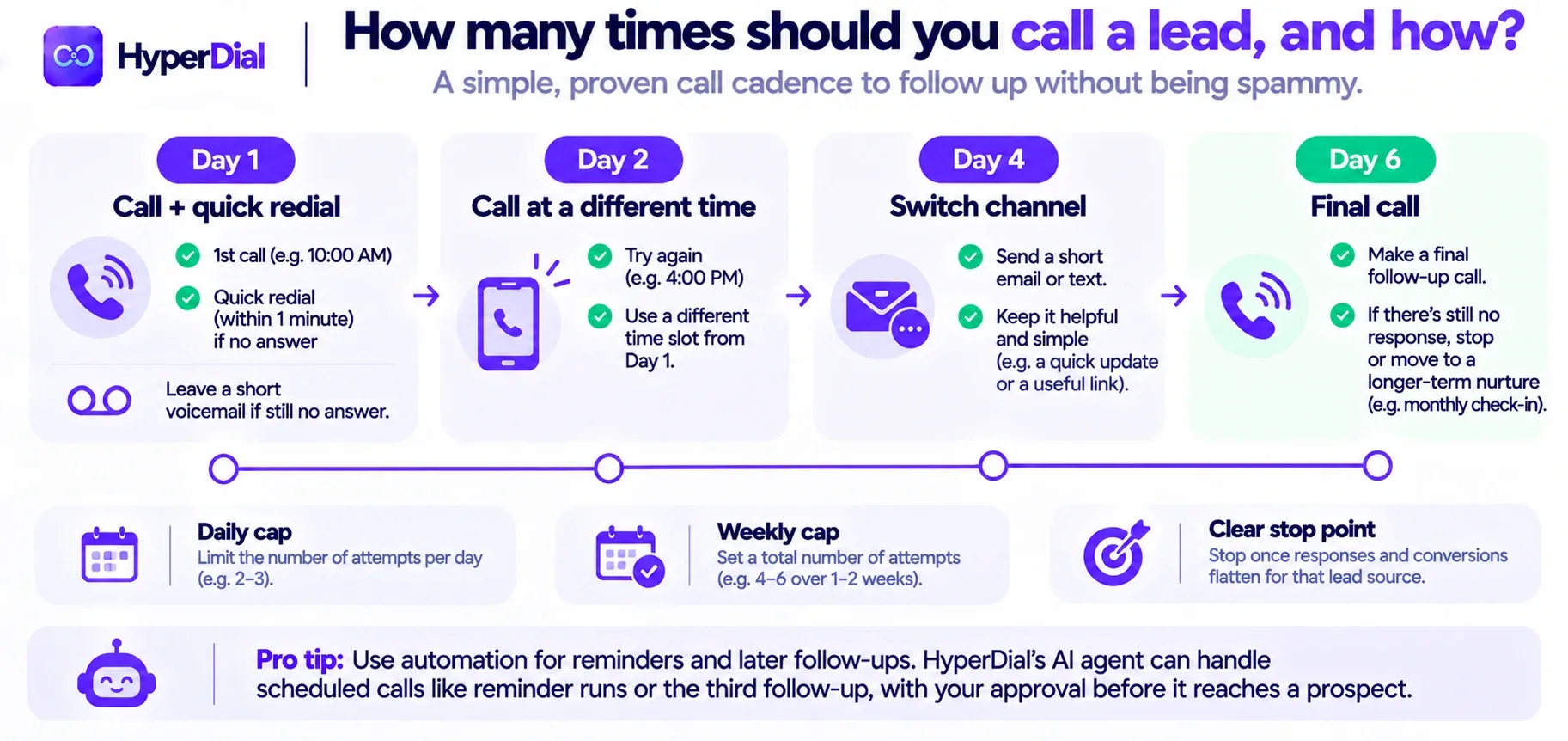
You should call a lead several times, spread across different days and times, then stop or switch channel once the attempts stop paying off. Too few attempts leave easy conversations on the table. Push too hard, though, and the calls look like spam and burn your numbers.
A good cadence usually has these parts:
- A quick second try: if a call isn't answered, some teams redial once within a minute, since people often miss the first ring.
- A busier first day: a few attempts while interest is fresh, then a tapering pattern over the following days.
- Daily and weekly caps: a maximum number of attempts, with a cooling-off gap between them.
- A channel switch: after several unanswered calls, send a short email or text before dialing again.
- A clear stop point: the attempt after which conversions flatten out for that lead source.
Find that stop point from your own reports, lead source by lead source. Inbound leads often reward a longer cadence than a cold list does.
Automation helps keep the cadence going without wearing out your reps. HyperDial's AI agent targets calls like reminder runs and the third follow-up attempt, and a manager approves every play before a prospect hears it.
Does a text before the call help?
A short text before a call can help, because the prospect expects your call and recognizes your business when it rings. It works best for leads who have already agreed to hear from you.
Keep it short and specific: who you are, why you're calling and roughly when. Then call when you said you would. Always follow consent and opt-out rules for messaging in each market. HyperDial's business messaging records an opt-out once and respects it on every channel afterwards, and applies quiet hours before a message leaves the queue.
How do voicemails turn missed calls into callbacks?
Voicemails turn missed calls into callbacks when they're short, specific and easy to act on. Phones often show a voicemail transcript, so the first few words carry the message.
Use this simple structure for every voicemail:
- Say your name and company in the first sentence.
- Give one clear reason for the call, tied to something the prospect cares about.
- Ask for one action, like a callback or a reply to your email.
- Say your number slowly, and repeat it once.
Record a few strong versions and use voicemail drop, so a rep doesn't spend a minute reading the same message every time. HyperDial's outbound tools include voicemail drop, so a no-answer costs seconds rather than a minute.
Make sure callbacks land somewhere useful. A prospect who calls back and reaches a dead line won't try again. HyperDial's call routing sends returning calls to the right team, with a callback option when everyone is busy.
Which dialer mode gives you the best connect rate?
The best dialer mode depends on how warm your list is and how many reps share it. Faster modes make more dials, but they don't change who answers, and a silent pause after "hello" makes a call feel automated. Use this quick guide:
Choose power dialing if your list is warm, your team is small, or every prospect matters, since a rep is ready on every call.
Choose predictive dialing if you have a large, cold list and enough reps to take answered calls without delay.
Choose one call at a time if each call needs research before the rep dials.
HyperDial tunes predictive and power pacing per campaign to that campaign's real connect rate. Our guide to power dialer vs predictive dialer shows how many more conversations each mode adds at different answer rates.
How can you tell if your numbers are being blocked?
You can tell your numbers are being blocked or flagged when the pattern of your calls changes suddenly, even though your list and team haven't. Networks rarely tell you directly, so watch for these warning signs:
- A sudden drop in answers on one number while others stay steady.
- Calls going straight to voicemail with little or no ringing.
- A spike in very short calls, where people hang up within seconds.
- More declined calls, including the "unwanted" signal defined in RFC 8197 as SIP response 607.
- Fewer callbacks from prospects who used to return your calls.
When you see these signs, rest the number, move its volume to the rest of your pool and slow your pacing. Then check whether the drop recovers over the next few days.
Which metrics should sales teams track?
Sales teams should track connect rate alongside the metrics that show list quality, trust and results. Together, they show exactly where calls are being lost:
Table 2: Outbound calling metrics and what they tell you
| Metric | What it tells you | Watch for |
|---|---|---|
| Connect rate | Are people answering? | Drops by number or hour |
| Right-party connect | Is your data accurate? | Many wrong-person calls |
| Speed to lead | How fresh are first calls? | Hours of delay on new leads |
| Average call length | Are calls real conversations? | Lots of very short calls |
| Callback rate | Do prospects trust you? | Falling callbacks |
| Meetings per 100 dials | Is calling paying off? | Gaps between campaigns |
Break every metric down by list, number, rep and hour, not just the team total. HyperDial's outbound page suggests comparing connect rate, talk time and booked meetings across campaigns. Its call analytics shows total, answered and missed calls, so you can spot a falling rate early.
What should a weekly connect rate checklist include?
A weekly connect rate checklist should cover the list, the numbers, the timing and the results, so small problems get fixed before they spread. Run through these points every week:
- Remove invalid, duplicate and opted-out numbers added since last week.
- Check speed to lead on new inbound leads.
- Review connect rate by number, and rest any that dropped sharply.
- Compare answer rates by hour, and move calls toward the best windows.
- Listen to a few voicemails and update weak ones.
- Confirm callbacks reach the right team.
- Compare meetings per 100 dials across campaigns.
What should you do next?
Pull last month's call data and work out connect rate by list, number and hour. Pick the weakest lever, whether that's the list, the caller ID or the timing, and fix it first. Measure again after two weeks. When you're ready to test local presence and number rotation on your own lists, compare plans on the pricing page or try HyperDial free.
Sources


