
Should You Choose a UK Local Number or a Toll-Free Number for Customer Support?
This guide helps you choose between a UK local number and an 0800 freephone number for customer support by comparing who pays, the cheaper 03 option and the UK rule on helpline costs.
A support number does two jobs. It tells customers who you are, and it decides who pays for the call. UK numbers also work a little differently from US ones. There's a third option, the 03 number, and a few number ranges that look cheap but cost callers more. This guide explains each option in plain words, so you can pick the right one for your support team.
Every fact in this guide links to its source. We last checked them on 20 November 2026.
Key takeaways
- A UK local number starts with 01 or 02 and ties your business to a place.
- A UK toll-free number starts with 0800 or 0808 and is free for callers.
- An 03 number costs callers the same as a local call but works nationwide.
- Avoid 084, 087 and 09 numbers for support lines, because UK law limits what you can charge.
What is the difference between a UK local number and a UK toll-free number?
The main difference is who pays for the call. With a UK local number, the caller pays their normal rate. For a UK toll-free number, your business pays and the caller pays nothing.
A UK local number is also called a geographic number. It starts with 01 or 02, and the first digits show a place. For example, 020 is London and 0161 is Manchester. Callers see the code and know roughly where you are.
A UK toll-free number is called a freephone number in the UK. It starts with 0800 or 0808 and isn't linked to any place. Ofcom, the UK telecoms regulator, says freephone calls are free from all consumer landlines and mobiles.
The table below compares the two side by side, with the 03 number added because many UK businesses use it.
Table 1: UK local, freephone and 03 numbers compared
| Feature | Local (01, 02) | Freephone (0800, 0808) | National (03) |
|---|---|---|---|
| Who pays | Caller, normal rate | Your business | Caller, normal rate |
| Linked to a place | Yes | No | No |
| Counts in call bundles | Yes | Not needed, it's free | Yes |
| Proof of address | Usually needed | Ask your provider | Ask your provider |
| Best for | One city or region | National consumer support | One national number |
How are UK numbers different from US toll-free and local numbers?
UK numbers differ from US numbers in three ways: the names, the 03 option and the costly ranges. If you know US numbers, these differences can trip you up.
"Toll-free" is called "freephone" in the UK
In the US, people say toll-free and think of 800, 888 or 877 numbers. British callers call the same idea freephone, and the numbers start with 0800 or 0808. Many UK callers will search for a "freephone number" rather than a "toll-free number". Use the UK word on your website and in your emails.
The UK has a middle option: 03 numbers
The US has no direct match for the UK 03 number. An 03 number works across the whole UK, like freephone. Callers pay for it, like a local number. Ofcom says 03 calls cost no more than a call to an 01 or 02 number. They must also count towards inclusive minutes. That makes 03 a good fit for support teams that want one national number without paying for every call.
Some UK numbers look cheap but cost callers more
UK numbers starting 084, 087 and 09 add a service charge on top of the caller's phone company charge. Ofcom's UK Calling guide explains that part of the price goes to the organisation being called. Older businesses used 0845 as a "local rate" number, but callers often pay more for it now. These ranges are a poor fit for support, and the next section explains why.
Which UK rule applies to customer support phone numbers?
UK law says customers calling you about something they've already bought can't be charged more than the basic rate. This rule is regulation 41 of the Consumer Contracts Regulations 2013. If a customer pays more, you must pay back the difference.
The government's guidance on these regulations (Section J) describes the basic rate simply. Calling you should cost no more than calling a friend or relative. The guidance lists which numbers meet the rule:
- Meet the rule: 01, 02 and 03 numbers, 0800 and 0808 freephone numbers, and 07 mobile numbers.
- Don't meet the rule: 09 premium numbers, and 084, 0871, 0872 and 0873 numbers.
- Also unsafe: 0870 numbers, because their cost changes with the caller's tariff.
So both a local number and a freephone number are legal for UK customer support. The rule covers calls after a sale. Sales lines can use other numbers, but the guidance says you must offer a basic-rate number for existing customers.
What does each number cost your callers and your business?
A local number costs your callers a little and costs you less. Freephone costs your callers nothing and costs you more. The details depend on each caller's phone plan and on your provider.
What callers pay
Most UK callers have bundles of inclusive minutes. Calls to 01, 02 and 03 numbers come out of those minutes. Outside a bundle, Ofcom says calls to 01 and 02 numbers cost between 3p and 65p a minute. Freephone calls cost consumers nothing at all, from landlines and mobiles alike.
This has changed over time. Freephone calls from mobiles only became free on 1 July 2015, as part of Ofcom's UK Calling changes. Before that, many mobile callers paid to call 0800 numbers. Some customers still remember this, so say "free from mobiles" next to your 0800 number.
One group is different. Ofcom says business phone users should check with their own provider about freephone charges. If your support line serves other businesses, freephone matters less.
What your business pays
With a local or 03 number, you usually pay a monthly fee for the number. Callers pay for their own calls. With a freephone number, you pay the monthly fee and also pay for every minute your customers spend on the line.
Long calls change the sums. A support line with long troubleshooting calls costs far more on freephone than a sales line with short calls. Before you choose, look at your average call length and monthly call count. Our guide on who pays for toll-free calls shows how that inbound cost works.
When should you choose a UK local number for customer support?
Choose a UK local number when your customers are close by, your budget is tight, or your team calls customers back often. A local code tells callers you're part of their area.
Your customers are mostly in one city or region
Local codes build trust with callers in that place. Think of a Leeds plumber or a Bristol dental practice with a matching local code. Customers see a familiar number and are more likely to call.
You call customers back from the same number
Support teams often return missed calls. A local number works in both directions, so the number customers saved is the number that calls them back. Freephone numbers are mainly built for incoming calls. Our guide on callback management shows how to run return calls well.
You want to control your phone costs
With a local number, callers pay for their own calls, usually from their bundle. Your cost stays close to the monthly number fee, even when calls run long. That suits small teams and support lines with long calls.
When should you choose a UK toll-free number for customer support?
Choose a UK toll-free number when you serve consumers across the whole UK and want calling you to feel easy. Free calls remove one more reason for a customer to wait or give up.
You support consumers across the UK
A national brand doesn't belong to one city. Freephone avoids picking one area code, and it reads as "this company serves everyone". It suits online shops, subscription services and utilities.
Your calls are long or your customers need extra help
Some support calls take a long time, like setting up a device or sorting out a bill. A free number means customers don't worry about the clock. It also helps people on pay-as-you-go plans or without inclusive minutes.
You print the number on packaging or adverts
A freephone number is easy to remember and doesn't change if you move offices. Put it on packaging, invoices and adverts, and it keeps working wherever your team sits. Our guide on international toll-free numbers covers freephone in other countries.
Is an 03 number a good middle option for customer support?
An 03 number is a good middle option when you want one national number without paying for every minute. Callers pay the same as a local call, and it counts in their bundle.
Public bodies use 03 numbers a lot. Ofcom uses 0300 numbers for its own contact lines, as its 03 numbers page shows. For a business, 03 says "national" without the cost of freephone.
There's one trade-off. An 03 number isn't free, so callers without inclusive minutes still pay. If your customers include many older or lower-income callers, freephone may still be kinder. HyperDial offers 03 numbers alongside local and freephone numbers, according to its UK numbers page.
How do you choose between a UK local and a toll-free number?
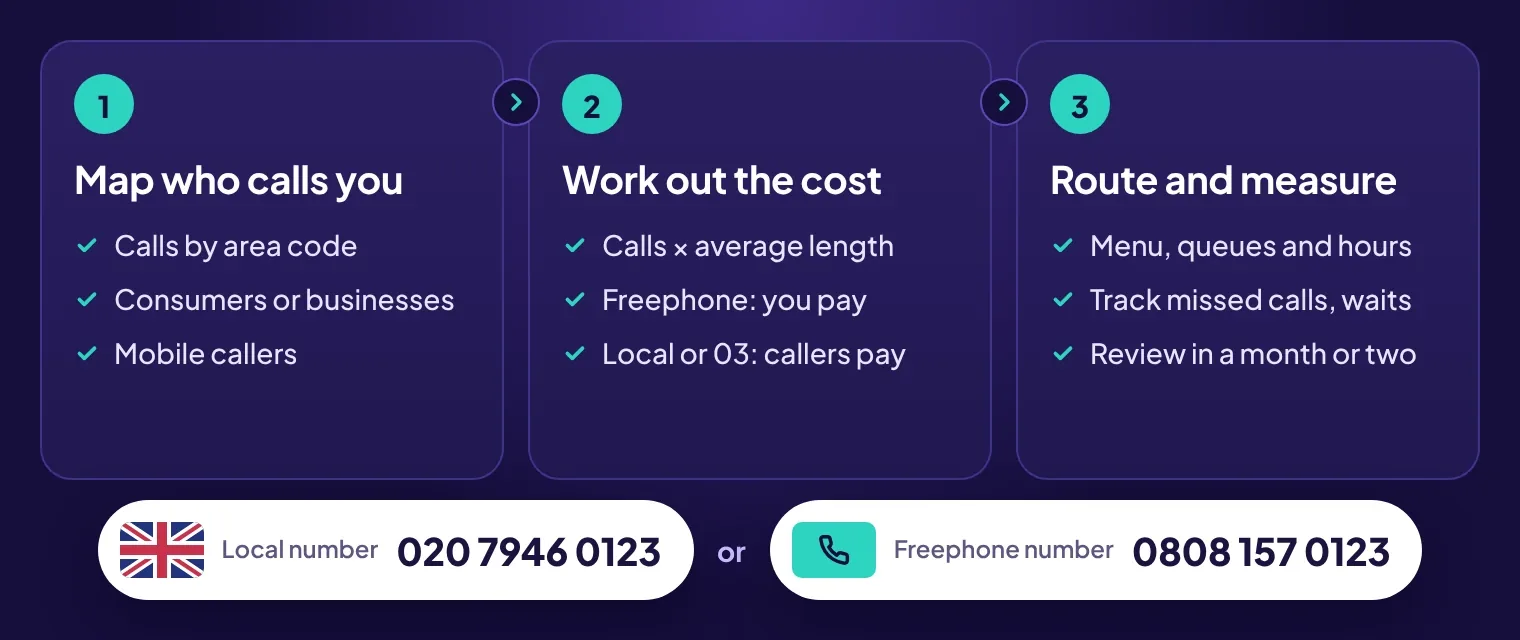
You can choose the right UK support number in three steps. Each step uses facts you can find in your own call data.
Step 1: Map who calls your support line
Look at where your callers are and who they are. Check last month's calls by area code, if you have them. Note whether callers are consumers or businesses, and whether they call from mobiles.
If most calls come from one region, a local number fits. Calls from all over the UK suit freephone or 03 better. When most callers are businesses, freephone matters less, because business users may pay to call it anyway.
Step 2: Work out the cost of each option
Next, multiply your monthly call count by your average call length. That gives your total inbound minutes. With freephone, you pay for all of them. On local or 03 numbers, callers pay instead.
Then weigh that cost against what free calls are worth to you. A subscription business losing customers over billing calls may find freephone worth every penny. Many small trade businesses won't. Compare options on HyperDial's pricing page, where numbers and minutes are listed separately.
Step 3: Route the number well, then measure
A good number can't help if calls go unanswered. Set up a menu, queues and opening hours before you publish the number. Our guide on reducing missed inbound calls has simple fixes.
Then measure for a month or two. Track calls, missed calls and wait times on each number. If freephone brings more calls but the team can't answer them, fix staffing before adding more numbers.
Can you use a UK local number and a toll-free number together?
Yes, many UK businesses use both a local number and a freephone number on one support team. Each number can do a different job, and the calls can still reach the same people.
Here are common ways to combine them:
- Freephone for customers, local for callbacks: customers call the 0800 number, and agents call back from a local number they can recognise.
- Local numbers per region, freephone nationally: shops in each city show a local number, and the website shows freephone.
- Freephone for consumers, 03 for businesses: keep free calls for consumers and give business customers a national number.
- Separate lines for sales and support: each line gets the number that suits its callers.
Our guide on separate phone numbers for sales and support explains how to split lines. In HyperDial, any number can point to any call flow and change without a support ticket, as the numbers page explains.
How does HyperDial support UK local and toll-free numbers?
HyperDial offers UK local, 03 and 0800 freephone numbers and runs them from one account. These details come from its UK numbers page and numbers page:
- Number types: local numbers such as 020 London and 0161 Manchester, 03 national numbers and 0800 freephone numbers.
- Routing: point any number at any call flow, with menus, queues and opening hours.
- Caller ID: presented correctly on every outbound call, so callbacks show a real number.
- Recording: call recording and transcription, with announcements you can set for consent.
- Porting: bring an existing UK number, free on annual plans, and keep taking calls until switch-over.
- Billing: numbers and minutes billed at carrier cost, with no margin added.
HyperDial asks for proof of address once per company, and can't issue local numbers without it. A London 020 number needs a verifiable address in the area. Our guide on UK addresses for virtual numbers explains why.
There are limits to know. HyperDial's terms of service (clause 8.1) say the service doesn't support emergency calls, so keep another phone for 999. Forwarded calls are charged as two legs (clause 12.2), so answering in the app costs less than forwarding to a mobile.
What should you do next?
Check where your support callers are and how long their calls last. Pick a local number for one region, freephone for national consumer support, or 03 for a national number at a lower cost. Then route it well and measure for a month. To start, see HyperDial's UK numbers, compare plans on the pricing page or book a demo.
Sources
- Ofcom, UK Calling (published 31 March 2022)
- Ofcom, What are 03 numbers? (13 September 2016)
- Ofcom, Call costs guide (updated 8 August 2023)
- UK Calling campaign (led by Ofcom), FAQs: changes on 1 July 2015
- Consumer Contracts (Information, Cancellation and Additional Charges) Regulations 2013, regulation 41
- Government guidance on the Consumer Contracts Regulations, Section J


