
How to Reduce Missed Inbound Calls When Agents are Busy
Busy agents don’t lose calls; dead ends do. This guide shows how to give every inbound call a next step so nobody hangs up unheard.
Many missed Inbound calls aren't a staffing problem. They come from routing that rings busy people, queues with no exit, and nobody owning the callback. This guide shows how to find where your calls slip through and build an overflow path that catches them.
Why do inbound calls get missed when agents are busy?
Inbound calls get missed when agents are busy because the phone system has nowhere useful to send the call next. The caller rings a fixed list of people, waits on hold with no end in sight, or lands in a voicemail nobody checks.
"Missed" also covers four different failures, and each one needs a different fix:
Table 1: The four types of missed inbound call
| Type of miss | What the caller experiences | Usual cause | First fix |
|---|---|---|---|
| All agents busy | Long ringing, then voicemail | Peak volume, no overflow | Backup group and queue callback |
| Ring, no answer | Rings out while someone is free | Agent away but still marked available | Ring only agents who are truly free |
| Abandoned in queue | Hangs up while on hold | Long, silent wait | Callback that keeps their place |
| After hours | Closed message or voicemail | No out-of-hours path | AI agent or on-call cover |
Split your missed calls into these four groups before you change anything. A team losing most calls in the queue needs callbacks, not more agents. Our guide on how to track unanswered calls shows how to separate them in your call data.
How do you find out when and why calls are missed?
You find out when and why calls are missed by looking at missed calls by hour, by type and by agent, not as one monthly total. Patterns show up fast once the data is split.
Track these four numbers:
- Missed calls by hour of day, to find your peaks.
- Abandon rate in the queue, the share of callers who hang up while waiting.
- Ring-no-answer by agent, to catch people marked available who aren't.
- After-hours share, the calls that arrive when nobody is scheduled.
For many teams, a few hours a day cause most of the misses. Telecom capacity planning has long been built around this peak, the "busy hour" described in the ITU's E.600 terms for traffic engineering. Plan cover for your busy hour, and the rest of the day usually takes care of itself.
How do you reduce missed inbound calls when agents are busy?
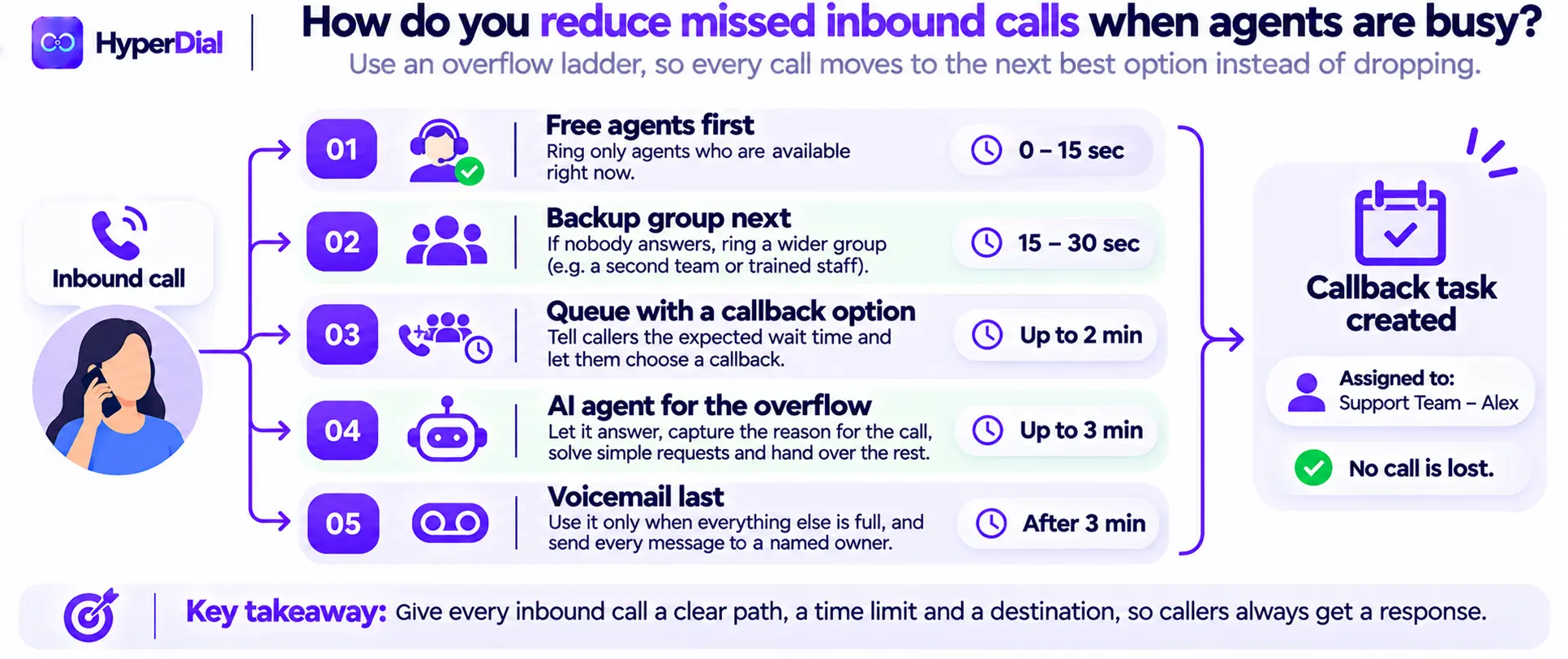
You reduce missed inbound calls when agents are busy by building an overflow ladder, so each call steps to the next option instead of dropping. Here's the order that works for most teams:
- Free agents first. Ring only people who are available right now, not a fixed list.
- A backup group next. If nobody answers in time, ring a wider group, such as a second team or trained staff from another department.
- A queue with a callback option. Tell callers roughly how long the wait is and let them choose a callback instead of holding.
- An AI agent for the overflow. Let it answer, capture the reason for the call, solve simple requests and hand over the rest.
- Voicemail last. Use it only when everything else is full, and send every message to a named owner.
Each rung should have a time limit and a destination. A call should never reach the end of the ladder and simply stop.
Should busy calls go to voicemail?
Busy calls should go to voicemail only as a last resort, because many callers hang up rather than leave a message. Those who do often leave half the details. A queue callback or an AI agent captures the caller's name, number and reason, so the person who calls back knows what to say.
Is a queue callback better than putting callers on hold?
Yes, a queue callback is usually better than hold, because the caller keeps their place without waiting on the line. They hang up, get on with their day, and the next free agent calls them back in turn. It's often the quickest way to cut abandoned calls.
How do you set up overflow so no inbound call is lost?
You set up overflow by mapping your peaks, building the ladder with a time limit on every rung, and giving every missed call an owner. Follow these three steps:
- Map when and why calls are missed. Pull two weeks of call data. Split misses by hour and by type: busy, ring-no-answer, abandoned and after hours.
- Build the overflow ladder with time limits. Set how long each rung rings, where the call goes next, and what happens outside business hours.
- Assign every missed call to an owner. Send each miss to a person or team with a callback target, and review the results every week.
The most common mistake happens at step 2: the ladder ends in voicemail, and nobody is responsible for it. Messages pile up, and callers who waited patiently never hear back. Route voicemail and missed-call alerts to a named team, not to whoever happened to be on the original ring list.
When should an AI agent answer, and when should a person?
An AI agent should answer when every person is busy or off shift, and hand the call to a person as soon as it needs judgment. The split is easy to set once you list your common call types:
Let the AI agent handle it if the caller wants something routine, like booking a meeting, confirming details or getting a document.
Let the AI agent capture it if the request needs a person but can wait, so it takes the details and books a callback.
Hand it to a person if the caller is upset, the issue is urgent, or the request falls outside the approved answers.
Keep it with a person if the call is sensitive, such as a complaint, a cancellation or anything involving money.
Callers should always know who they're talking to. An agent that says it's an AI at the start of the call keeps trust intact, even when the caller would rather wait for a person.
What should happen after an inbound call is missed?
After an inbound call is missed, the caller should get a callback from the same business number, from someone who knows why they called. The faster that happens, the more likely they're still interested.
A good missed-call routine covers these points:
- Call back quickly, ideally within the same hour during business time.
- Use the number they dialed, so they recognize it and pick up.
- Read the context first: the voicemail, the AI summary or the queue note.
- Try a second channel if they don't answer, such as a short message on the same conversation thread.
- Log the outcome, so the next person doesn't call them twice.
That last point stops a common problem. Two agents return the same missed call, and the customer feels chased rather than helped.
How does HyperDial help reduce missed inbound calls?
HyperDial reduces missed inbound calls by giving every call a named next step, from overflow rules to queue callbacks and an AI agent for the spikes. Its routing is built so that a call never drops silently.
Here's what covers each rung of the ladder:
- Overflow and callbacks: call routing sets overflow rules that name where a call goes. Callers can hold their place and get called back instead of waiting.
- Hours per queue: business hours and holiday calendars are set per queue and per region.
- AI agents for overflow: HyperDial's AI agents answer the overflow when the queue is deep, under the same routing rules. They hand over to a rep with the transcript.
- Support cover: HyperDial for support teams covers nights, weekends and the spike after a campaign send.
- Missed-call reporting: call analytics shows total, answered and missed calls, with a heatmap of the busiest hours.
Agents answer on a laptop or phone, so backup staff can join the overflow group from anywhere. Inbound lines can run on toll-free numbers or local numbers, such as US local numbers in any area code, in the same account.
What should you do next?
Pull two weeks of call data and split your missed calls by hour and by type. Fix the biggest group first: callbacks for abandoned calls, a backup group for busy hours, or an AI agent for after hours. When you're ready, compare plans on the pricing page or try HyperDial free.
Sources


