
What Does a Non-US Company Need Before Activating a US Busines Number?
Getting a US number takes minutes, but matching company records, texting registration and US calling rules decide whether you can actually use it.
Most of the delays we see don't come from the number itself. They come from a legal name that doesn't match a tax record, or a website with no consent wording. Teams that start texting before approval cause the rest. This guide lists what to prepare for each way you'll use the number, so nothing holds up your US launch.
Every fact in this guide links to its source, and we last checked them on 13 November 2026. Rules and fees change, so confirm the details with your provider and your own advisers. This isn't legal advice.
Key takeaways
- Calling-only numbers need the least. Many providers ask for no documents and no US address.
- Texting needs registration first, using your home country's company or tax ID, not a US one.
- Your details must match public records exactly, or registration gets rejected.
- US calling rules apply from abroad, including the Do Not Call registry and calling hours.
What does a non-US company need for each way it uses a US Business number?
What a non-US company needs depends on how it will use the number, because each use is checked by a different party. A number that only takes calls needs almost nothing, while texting and telemarketing bring in carriers, The Campaign Registry and US regulators. This table shows what to prepare for each use:
Table 1: What to prepare before activating a US number, by use
| How you'll use the number | What to prepare | Who checks it |
|---|---|---|
| Receive calls only | Account, payment, identity check if asked | Your provider |
| Make calls to businesses | The above, plus honest caller ID | Provider and carriers |
| Make sales calls to consumers | The above, plus Do Not Call access and calling-hour rules | US regulators |
| Text from a local number | Brand and campaign registration (10DLC) | The Campaign Registry and carriers |
| Text from a toll-free number | Toll-free verification | Carriers |
| Users based in the US | A registered location for emergency calls | Your provider |
Start by deciding which rows apply to you. A support line that only takes calls can usually go live the same day. Sales teams that call and text US consumers should allow time for registration and set up its compliance process before the first call.
Which company details must match before you register?
Your company details must match the official records for your business exactly, because registration checks compare what you submit against public or tax records. A missing "Ltd", an old address or a trading name instead of the legal name is enough to fail the check.
These are the details to gather and check before you submit anything:
Legal company name: the name your company is registered under, exactly as it appears on the record linked to your tax ID. Amazon Web Services' 10DLC brand registration guide says the name must be an exact match.
Tax ID or business registration number: for companies outside the US, the primary tax ID for your country. The same guide notes that in many countries this is the numeric part of your VAT number. Canadian companies use their corporation number rather than their CRA Business Number. A US Employer Identification Number (EIN) isn't required unless you already have one.
Country of registration: the two-letter ISO code for the country where your company is registered, such as GB, IN or AU.
Legal form: non-US organizations register as "Private for-profit", whatever their actual legal structure, according to the same guide.
Physical address: your registered business address, matching the public record.
Website and email: a live website on your own domain, and a verification email address whose domain matches your business. Shared inboxes and free email domains won't pass.
Put these into one document before you start, and copy from it every time. Most rejections come from small differences between two forms filled in on different days.
What do you need before texting US customers?
Before texting US customers from a local business number, you need 10DLC registration, which records your company and the purpose of your messages. 10DLC stands for 10-digit long code, the standard US local number used for business texting. Your provider submits the registration to The Campaign Registry, the industry hub that registers brands and campaigns for 10DLC messaging.
Brand registration
Brand registration tells carriers who is sending the messages. It uses the company details from the section above: legal name, tax or registration ID, country, address, website and a domain email for verification. This step usually passes quickly when every detail matches the official record.
Campaign registration
Campaign registration tells carriers what you'll send and to whom. Expect to describe the purpose of your messages, give sample messages, and show how customers agree to receive them. Prepare these before you apply:
- An opt-in method, such as a form on your website with a consent checkbox that isn't pre-ticked.
- A privacy policy that explains how you use phone numbers and that you don't share them for marketing.
- Sample messages that match the purpose you describe, including how to opt out.
- An opt-out process, so anyone who replies STOP stops receiving messages.
The mistake we see most is applying with a website that doesn't yet show the consent flow described in the application. Reviewers check the website, so build the opt-in form and privacy wording first, then register.
Toll-free numbers follow a separate process called toll-free verification. It asks for similar company and consent details, but it doesn't use 10DLC brand and campaign registration.
What do you need before calling US consumers?
Before calling US consumers, you need to follow the same rules a US company does. They apply to calls into the US wherever the caller is. Business-to-business calls carry fewer restrictions, but sales calls to consumers need three things in place.
Access to the National Do Not Call Registry
Telemarketers calling US consumers must check their lists against the National Do Not Call Registry and remove registered numbers. The Federal Trade Commission's announcement of 2027 registry fees says telemarketers must subscribe each year. As of 1 October 2026, the fee is $85 per area code, with the first five area codes free and an annual maximum of $23,425.
Calling-hour limits
The FCC's telemarketing rule, 47 CFR 64.1200, bars telephone solicitations to residential subscribers before 8 a.m. or after 9 p.m. in the called person's local time. For a team abroad, that means planning shifts around US time zones, not your own working day.
Honest caller ID
US carriers check outbound calls using STIR/SHAKEN, a framework of standards that verifies the caller's identity as calls pass between networks. Calls from a number you're authorized to use, showing your real business, are much less likely to be flagged. Our guide on why a business number gets marked as spam covers how to protect your number's reputation.
Some US states also require every party to agree before a call is recorded. If you record calls, play a recording announcement on calls into the US.
Does a non-US company need a US address or US entity?
A non-US company usually doesn't need a US address or a US entity to activate a calling-only US number. Many providers issue local numbers to foreign companies directly, and texting registration accepts your home country's company or tax ID.
The exception is location for emergency calls. Under the FCC's 911 dispatchable location rules providers of internet-based phone service must send a caller's location with 911 calls. Where that isn't possible automatically, they must collect a registered location before service begins. If any of your users will work from the US, expect to give a US address for each of them.
Some providers also set their own address rules for certain numbers or features, so ask before you buy. Our guide on business phone number availability lists the questions worth asking in any country.
How do you prepare a non-US company for a US business number?
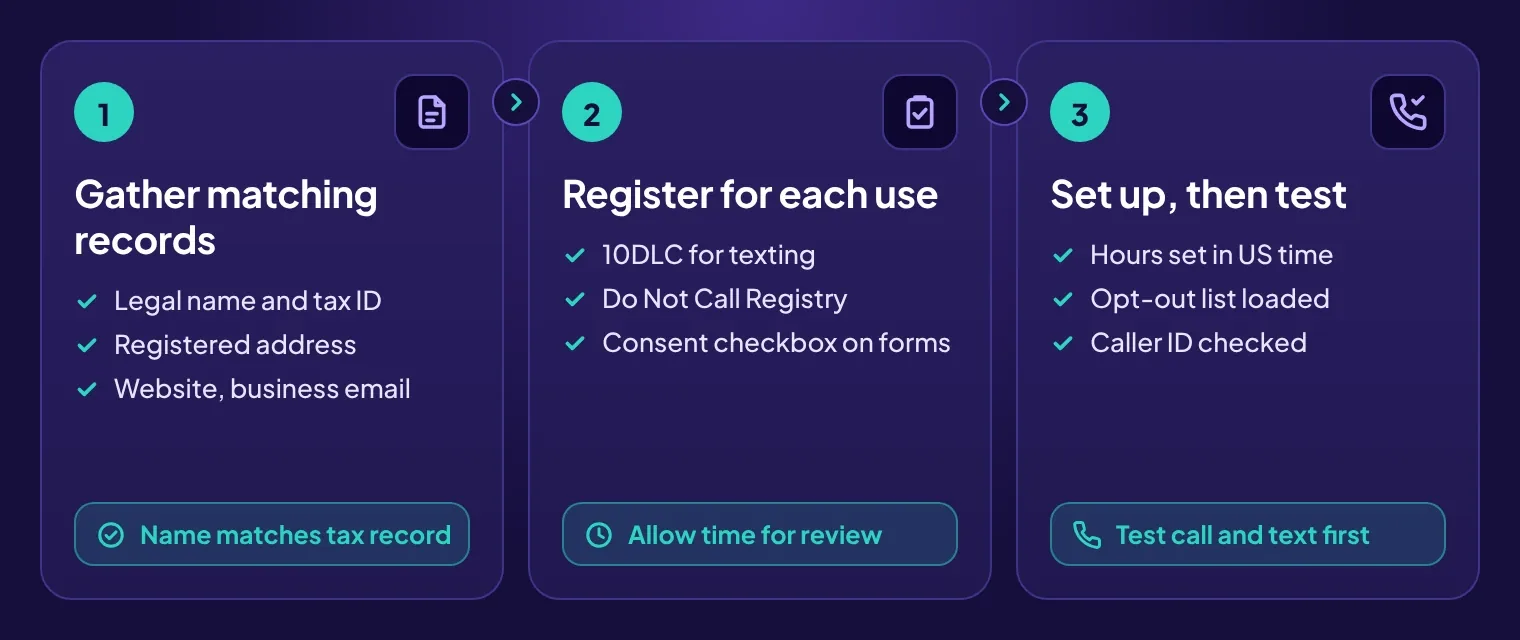
You prepare by gathering matching company records and registering for each use before you need it. Then you set up the compliance basics before the first call or text. Follow these three steps.
Step 1: Gather your company records in one place
Start with the official record of your company: your registration certificate or tax record. Copy your legal name, company or tax ID, registered address and country code exactly as they appear there. Add your website address, a business email on your own domain, and the name of the person who will verify the account.
Check each detail against the public register before you use it. If your registered address has changed, update the official record first, because registration checks compare against the register, not against what you type. Keep this document as the single source for every form you fill in.
Step 2: Register for each use before you launch
List every way you'll use the number: taking calls, making calls, texting, or sales calls to consumers. Then complete what each one needs. Submit 10DLC registration as soon as you know you'll text, and allow time for the review. Subscribe to the Do Not Call Registry before any consumer sales calls.
At the same time, prepare your website. Add a consent checkbox to any form that collects phone numbers, publish a privacy policy that covers text messages, and write the sample messages you'll submit. Registration reviewers look for all three, so they should be live before you apply.
Step 3: Set up the account, then test before going live
Create the account, complete any identity checks, and choose your area code. Set business hours in US time, add your recording announcement if you record calls, and load your opt-out list so it applies from day one. Our guide on how to get a local phone number for another country covers the general setup steps.
Before you publish the number, call it from a US phone and check what your outbound caller ID shows. Send a test text once registration is approved, and check that STOP replies are handled. Then add the number to your website and listings.
Why do registrations from non-US companies get rejected?
Registrations from non-US companies get rejected mostly because a detail doesn't match the official record, or because the website doesn't show what the application describes. These are the common reasons and their fixes:
Table 2: Common rejection reasons for non-US companies
| Reason | What it looks like | Fix |
|---|---|---|
| Name mismatch | Trading name or missing suffix | Use the exact registered legal name |
| Wrong identifier | Wrong number or format for your country | Use your country's primary tax or company ID |
| Address mismatch | Old or trading address | Match the public register, or update it first |
| Email domain mismatch | Free email or shared inbox | Use a named person on your own domain |
| No consent on website | Form without an opt-in checkbox | Add unticked consent and privacy wording |
| Weak sample messages | No company name or opt-out | Name your business and include STOP wording |
A rejection usually sends the application back for review after you fix it, so a mistake costs time. Checking these six points before you submit is the fastest way to a clean approval.
How does HyperDial help a non-US company activate a US number?
HyperDial issues US local numbers to companies anywhere, with no documents and no US address needed for calling-only numbers, and handles texting registration for you. These details come from HyperDial's US local numbers page:
- Calling-only numbers live in minutes: no documents and no US address when you won't text from the number.
- 10DLC filed on day one: HyperDial files your brand and campaign with The Campaign Registry, and approval follows the registry's timeline.
- Caller ID checks: every outbound call carries STIR/SHAKEN attestation, and HyperDial monitors number reputation.
- Recording announcements: in two-party consent states, a configured announcement plays before recording.
HyperDial's business phone numbers page adds that each region has a compliance step before your first dial, filed on your behalf where required. Registration status is visible for each number. Under HyperDial's calling and SMS policy, Do Not Call lists are screened before dialing. Calling windows are applied, caller ID spoofing isn't allowed, and an opt-out applies across every channel.
One honest limit: subscribing to the National Do Not Call Registry is the telemarketer's own obligation. If your team makes sales calls to US consumers, confirm how your registry access and HyperDial's screening work together before you start.
What should you do next?
Open your company's official registration record and copy your exact legal name, tax or company ID and address into one document. Then list how you'll use the US number: calls, texts or sales calls to consumers. Check your website for a consent checkbox and privacy wording before you register. When you're ready, choose a number on HyperDial's US local numbers page or try HyperDial free.
Sources


