
How Do You Check Whether a Business Phone Number is Available in a Target Country?
Just because a provider lists a country doesn’t mean you can get a number there: check the number type, local stock and required documents before you promise a launch date.
Most teams only check the second one. A provider's coverage map might show a country as available. That doesn't mean a number can be activated for your business, at your address, in the timeframe you need. This guide walks through the checks we'd run before promising a launch date to anyone.
Every fact in this guide links to its source, and we last checked them on 11 November 2026.
What does business phone number availability actually mean?
Business phone number availability means you can get, activate and use a number of the right type, in the right place, for your business. It's not one yes-or-no answer. Instead, there are four questions that each need a yes:
Table 1: The four checks behind "is a number available?"
| Check | The question to answer | Where to find out |
|---|---|---|
| Number type exists | Does the country issue local, mobile or toll-free numbers to businesses? | The country's numbering plan |
| Provider coverage | Does your provider have numbers in that city or area code? | The provider's number search or sales team |
| Eligibility | Can a business like yours hold it, from your location? | The provider's requirements for that market |
| Readiness | Which documents are needed, and how long does activation take? | The provider, in writing |
A number can pass the first two checks and still fail the third. That's the gap that catches most teams out.
How do you find out which number types a country offers?
You find out which number types a country offers by checking its national numbering plan, which every country publishes. The ITU, the UN agency for telecommunications, keeps an index of national numbering plans for every country and territory, listed with its country code.
A numbering plan tells you which number ranges are geographic (tied to a city or region), which are mobile and which are toll-free or premium. That matters, because the right number type depends on what you want customers to see. These are the types you'll usually choose between:
Local or geographic numbers: tied to a city or region, so they look nearby to callers.
Mobile numbers: used in markets where people expect business contacts on a mobile.
Toll-free numbers: free for the caller, and usually limited to callers inside that country.
National or non-geographic numbers: one number for the whole country, without a city code.
Our guide to what local phone numbers are explains why the type you pick changes how callers react.
What should you ask a provider before buying a number?
Before buying a number, ask your provider exactly what you'll get and what you'll need to supply, and get the answers in writing. A sales page saying "available in 100+ countries" tells you very little about your specific case. These are the questions we'd ask:
- Which number types do you offer in this country? Local, mobile, toll-free or national.
- Do you have stock in the city or area code we need? Not just somewhere in the country.
- What can the number do? Receive calls, make calls, show as caller ID, or send texts.
- Can a business located outside the country hold it? Some numbers need a local address.
- Which documents do you need, and in whose name? Identity checks, company registration or proof of address.
- How long from order to first call? Ask for the realistic range, not the best case.
Question 3 is the one people forget. In some markets, a number type can receive calls but not make them, or can make calls but can't send texts. Find out before you print it on anything.
Why can a number show as available but still not be activated?
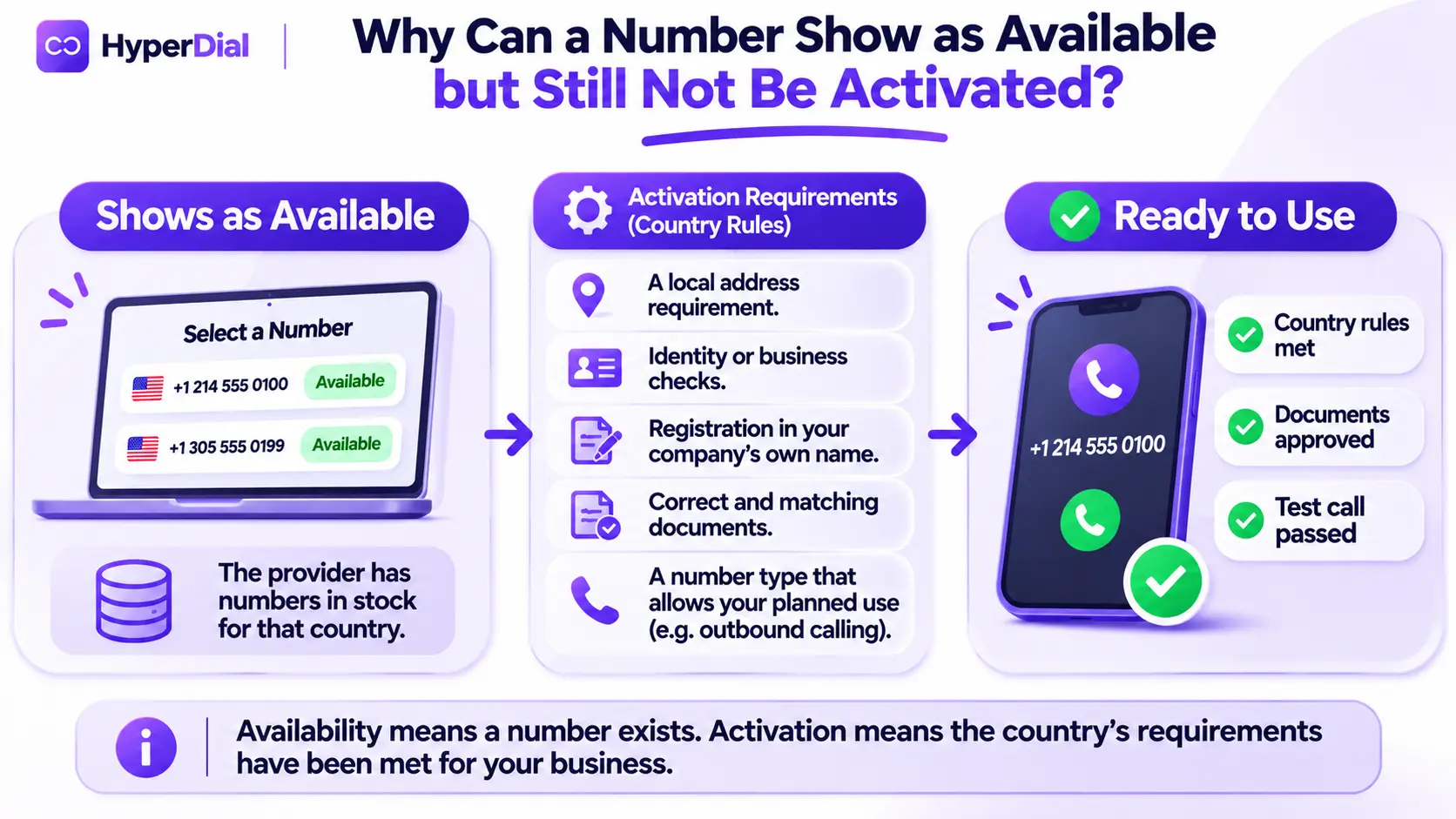
A number can show as available but still not be activated because the country's rules require something you haven't supplied yet. Availability on a map means the provider has numbers. Activation means the country's rules have been met for your business.
The most common blockers are:
- A local address requirement for businesses based outside the country.
- Identity or business checks that must be completed before activation.
- A registration in your company's own name, not the provider's.
- Missing or mismatched documents, such as a name that doesn't match your registration.
- A number type that doesn't allow the use you planned, such as outbound calling.
HyperDial's local numbers page puts it plainly. When activation is slow, the delay is almost always an outstanding document rather than the carrier. That's why the documents question belongs before you buy, not after.
How do you check business phone number availability step by step?
You check business phone number availability by confirming the number type exists, getting your provider's written answers, then provisioning and testing. Follow these three steps:
- Check the country's numbering plan and rules. Confirm the number type you want exists for businesses, and note any address or registration rules for foreign companies.
- Get the provider's answers in writing. Ask for the exact city or area code and what the number can do. Get the documents required and the realistic activation time too.
- Provision the number and test it from inside the country. Once it's live, place a call from a phone in that country and check what the caller sees. Test calls out as well if you need them.
The mistake we see most happens at step 2: teams accept "yes, we cover that country" as the answer and announce a launch date. Then the document check takes longer than the campaign does. Get the full list of requirements first, and plan your launch around the slowest one.
How do you choose between number types once you know what's available?
You choose between number types by matching what callers in that country expect to what your team needs the number to do. Use this quick guide once you know what's on offer:
Choose a local number if your customers are in one city or region and you want to look nearby.
Choose a toll-free number if you serve the whole country and want calls to be free for customers.
Choose a mobile number if customers in that market usually contact businesses on mobiles, and the type allows business use.
Choose a national number if you want one number for the whole country without favoring any city.
Many businesses use more than one: a toll-free number for support and local numbers for sales. Our guide on local vs toll-free numbers explains the trade-offs.
How does HyperDial show which numbers are available?
HyperDial shows availability by letting you pick a country, then a city or area code, and it tells you what each market needs before you buy. Numbers are available in 130+ countries from one account.
Here's how it works:
- Search: on HyperDial's local phone numbers page, you pick a country, then a city or area code.
- Markets not listed: you tell HyperDial the market, and it confirms what's available and what it needs before you buy.
- Requirements: HyperDial's business phone numbers page says each region has a compliance step before your first dial. HyperDial files it on your behalf where the region requires it.
- Status: registration status is visible for each number in your account.
- Speed: US local numbers in any area code are provisioned in minutes, while other markets vary by country.
- Billing: numbers and minutes are billed at cost and itemized, with no per-region surcharge on the platform fee.
Toll-free numbers are set up per market, because each country has its own ranges.
What should you do next?
Pick the country you're launching in and look up its numbering plan to see which number types exist. Then send your provider the six questions above and ask for written answers. When you're ready to search for a number, compare plans on the pricing page or try HyperDial free.
Sources


