
Business Phone Number vs Personal Phone Number: Which should you Use?
Still taking work calls at dinner on your personal number? See when it’s time to get a business number, and how to add one to the phone you already own without losing a single customer.

If you're like most founders, you started with your own mobile number. It was free, it was already in your pocket, and your first customers didn't mind. Then the calls kept coming: at dinner, on weekends, on holiday. Suddenly your personal phone is your business phone, and you can't switch it off.
You don't need a second phone to fix this. A business number can ring in an app on the phone you already carry. This guide helps you decide when to make the switch and how to do it without losing a single customer.
In this guide, you'll learn:
- The real differences between a business and a personal number
- What you risk by using your personal number for work
- When it's time to switch
- How to get a business number in three steps, with no second phone
- What to do if customers already have your personal number
What is the difference between a business phone number vs personal phone number?
A business phone number belongs to your company and is used only for work, while a personal phone number belongs to you and follows you everywhere. Both can ring on the same phone, but they behave very differently. This table shows how:
Table 1: Business phone number vs personal phone number
| What changes | Business phone number | Personal phone number |
|---|---|---|
| Who owns it | The business | You |
| Who has it | Customers and partners | Friends, family, banks, apps |
| Business hours | Yes, it stops ringing after hours | No, it rings all the time |
| Shared with a team | Yes, it can ring several people | No, only you |
| Routing and menus | Yes | No |
| Recording and reports | Yes | Rarely |
| If someone leaves | The number stays | The number leaves with them |
The biggest difference is ownership. Your personal number belongs to one person, so every relationship built on it belongs to that person too. A business number belongs to the company, which means the customers who call it stay with the company, whoever answers.
What are the risks of using your personal number for business?
Using your personal number for business puts your privacy, your time and your customer relationships at risk. It works when you're starting out, but the problems grow as the business does:
- Your privacy goes public: your number ends up on websites, invoices, ads and lists you don't control.
- You can never switch off: work calls arrive at dinner, at night and on holiday.
- Customers follow the person: if a team member leaves, their clients and their number go with them.
- You look smaller than you are: a personal voicemail greeting doesn't build much trust.
- Missed calls go nowhere: with no backup or routing, nobody else can pick up.
- Your records get messy: work and personal calls mix in one log and one bill.
Is your personal number a security risk?
It can be, because your personal number is often the key to your other accounts. Many banks, email providers and apps send one-time login codes to your mobile number. The more places that number is published, the easier it is for someone to target it.
Standards bodies take this seriously. NIST's digital identity guidelines class login codes sent over the phone network as "restricted", and tell services to watch for warning signs like a SIM change or a number being ported away (NIST SP 800-63B). Keeping your personal number off your marketing means fewer strangers know the number that unlocks your accounts.
What are the benefits of a business phone number?
A business phone number gives you privacy, control over your time and tools a personal line doesn't have. Here's what you gain:
- Privacy: customers get a number that isn't tied to your personal life or accounts.
- Business hours: calls ring only when you're working and go to voicemail after hours.
- A professional first impression: a business greeting and a proper number build trust.
- Team-ready setup: the number can ring one person today and a whole team tomorrow.
- Smart routing: calls go by time, caller or team, with a backup when nobody answers.
- Records you can use: call logs, recordings and reports in one place.
That last point grows in value over time. Once every call is logged in one place, you can see when customers call, how many you miss and who handles them. Our guide to call logs shows what to look for.
Should your business number be local or toll-free?
Your business number should be local if your customers are mostly in one area, and toll-free if you serve a whole country. Here's a quick way to choose:
Choose a local number if most customers are in one city or region, or you make a lot of outbound calls.
Choose a toll-free number if you serve a whole country and want calls to be free for your customers.
Choose both if you want a local feel in your main markets and one free number for everyone else.
HyperDial offers local phone numbers in 130+ countries and toll-free numbers you can route to a queue, team or agent. Our guide to local vs toll-free numbers compares them in detail.
When should you switch to a business phone number?
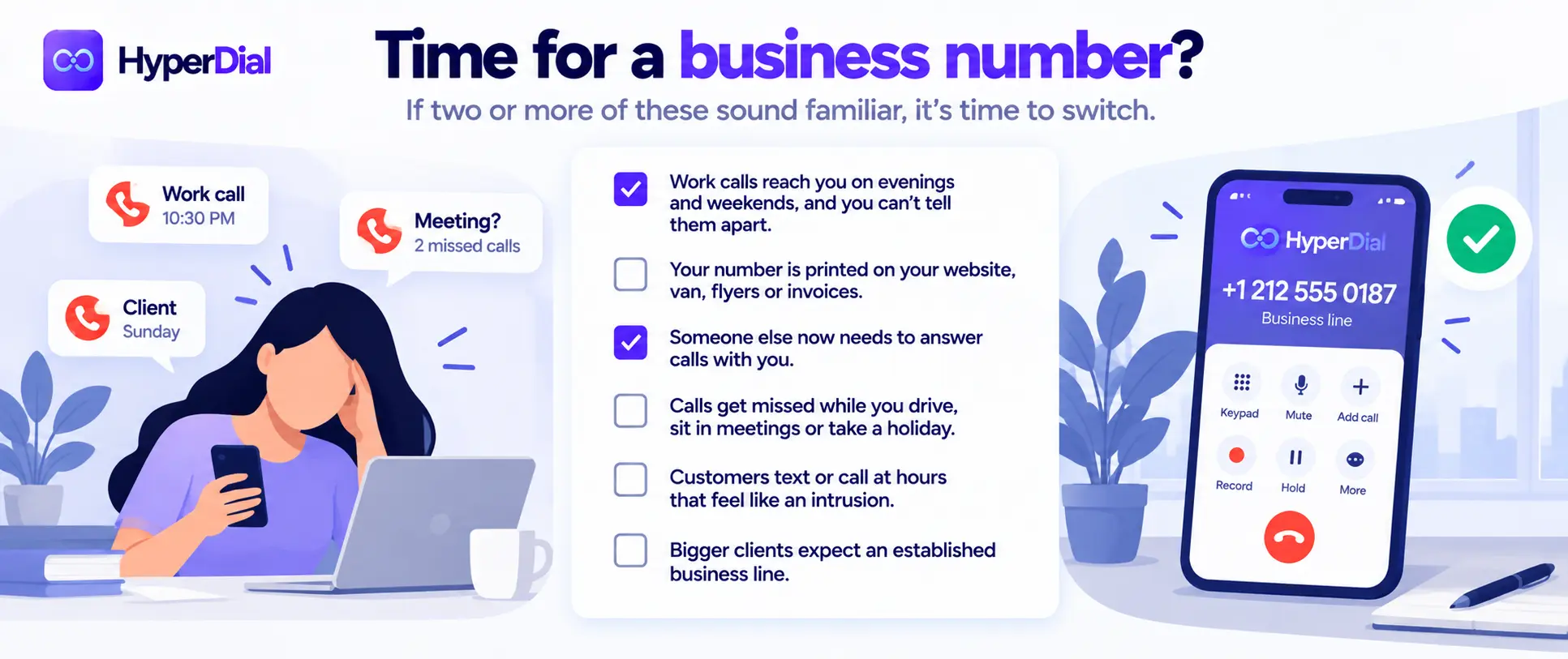
You should switch to a business phone number when your personal phone starts working against you instead of for you. These are the signs most people notice first:
- Work calls reach you on evenings and weekends, and you can't tell them apart.
- Your number is printed on your website, van, flyers or invoices.
- Someone else now needs to answer calls with you.
- Calls get missed while you drive, sit in meetings or take a holiday.
- Customers text or call at hours that feel like an intrusion.
- Bigger clients expect an established business line.
If two or more of these sound familiar, it's time. The switch takes less time than most people think, and it doesn't mean buying a second phone.
How do you get a business phone number without a second phone?
You get a business phone number without a second phone by choosing a cloud phone provider, picking a number, and using its app on the phone and laptop you already have. Follow these three steps:
- Pick the right number. Choose a local number in the area your customers are in, or a toll-free number if you serve a whole country. If customers already know a number, ask about porting it instead.
- Set it up on your devices. Install the provider's app on your phone and sign in on your laptop, so the business line rings next to your personal one.
- Set your hours and greeting. Add your business hours, record a short greeting and choose where calls go after hours, then call the number once to test it.
The most common mistake happens at step 3. People skip business hours and end up exactly where they started, with work calls at midnight. Setting hours on day one is what gives you your evenings back.
With HyperDial, your work number "rings in the app alongside your personal number, not instead of it," and business hours decide when it rings at all, as explained on the local numbers page. It also rings on your laptop, the way a softphone does.
What if your customers already have your personal number?
If customers already have your personal number, you can either bring that number into the business or move people to a new one over a few weeks. Both work, and the right choice depends on how widely the number is known.
Option 1: Make your current number the business number. Port your mobile number to a business phone provider, so customers keep dialing it, then get a new personal number for friends and family. This makes sense when the number is already on your website, vehicles and marketing. Porting rules depend on your carrier and number type, and HyperDial's guide on how to port a number walks through the steps.
Option 2: Get a new business number and move people over. Keep your personal number private again, and start sharing the new number everywhere. Most people make the move in four simple moves:
- Update your public details: website, email signature, invoices, ads and online listings.
- Tell your regular customers: send a short message saying where to reach you now.
- Change your personal voicemail: ask business callers to use the new number.
- Give it a few months: then stop answering unknown work calls on your personal line.
How much does a business phone number cost?
A business phone number usually costs a monthly fee per number or per user, plus the minutes you use. Your personal number feels free because you already pay for it, but you pay in other ways: privacy, time and calls nobody else can take. Compare these costs before you choose:
- Per-user price: most cloud phone systems charge for each person who makes or takes calls.
- Number fees: local and toll-free numbers can carry their own monthly fee.
- Call minutes: outgoing and toll-free calls may be charged by the minute.
- Extras: recording, reports, texting and AI features cost more on some plans.
Keeping business calls on a business line also puts them on a separate bill. That makes bookkeeping simpler, and your accountant can tell you how phone costs are treated where you're based. HyperDial bills numbers and minutes at cost, and you can compare plans on the pricing page.
How does HyperDial help you separate business and personal calls?
HyperDial gives you a business number that lives in an app, so you can keep one phone and two separate lives. Here's what's included:
- Numbers in 130+ countries: local and toll-free numbers in the markets you serve.
- Rings alongside your personal number: on your phone and laptop, not instead of it.
- Business hours and voicemail: the work line stops ringing outside your hours.
- Routing for a team: route by number dialed, set backups and offer callbacks with call routing.
- Calls and messages together: texts and WhatsApp sit on the same thread as the call, through messaging.
- Recording and transcripts: every call recorded and transcribed with HyperDial voice.
- Security: data encrypted in transit and at rest, with role-based access, as listed on the security page.
There are honest limits too. HyperDial is built for business calling, so it won't replace your personal mobile plan, and number types and paperwork vary by country.
What should you do next?
Count how many places your personal number appears today: your website, invoices, ads and listings. If the list is long, pick a business number in the area your customers are in and set your business hours from day one. When you're ready, try HyperDial free or compare plans on the pricing page.
Sources


