
How to get a virtual phone number for your business? steps, documents and costs
Discover how to get a virtual phone number, choose the right type for your business, and start connecting with customers worldwide.
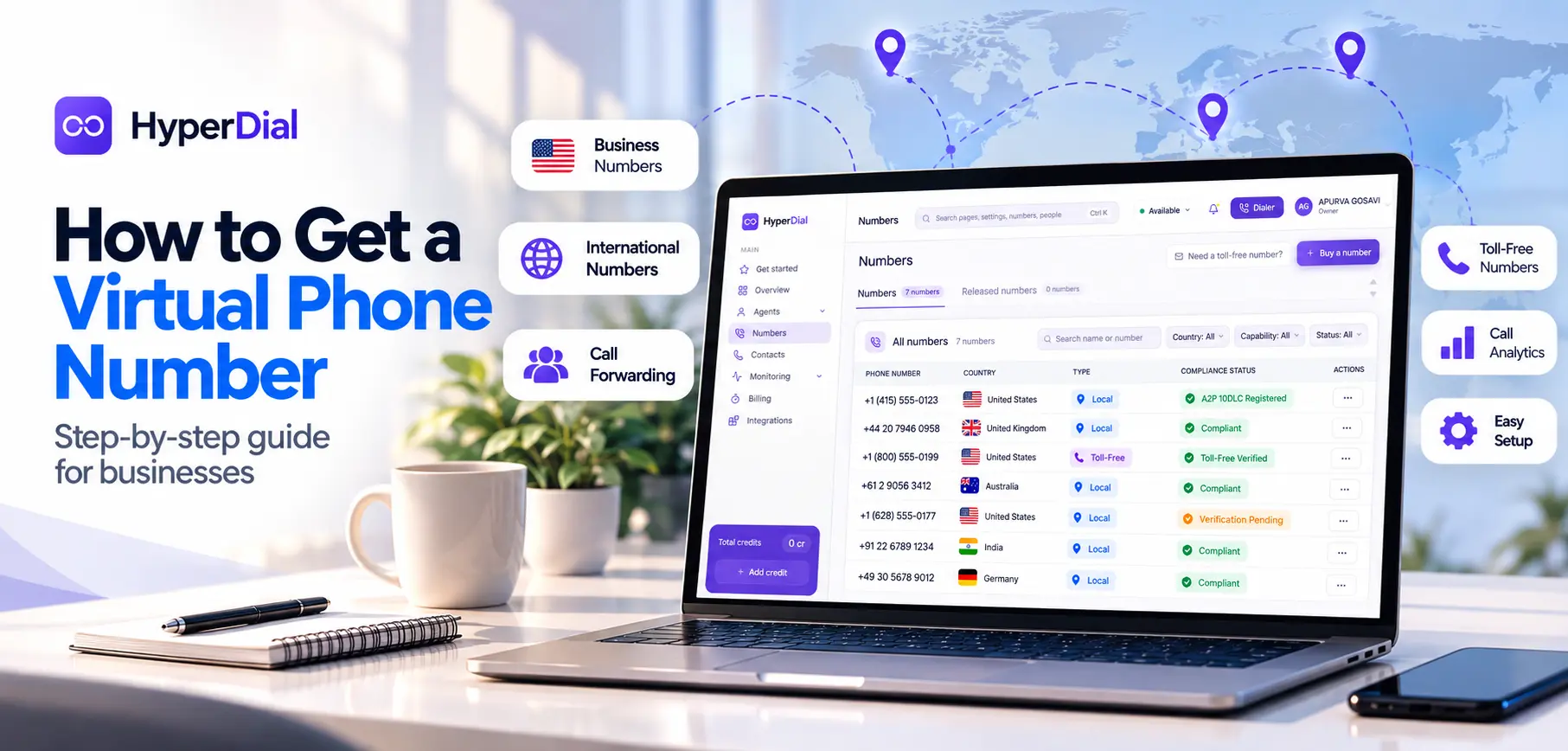
To get a virtual phone number, choose a provider with numbers in your callers' country and pick a local, toll-free or mobile number. Then submit that country's verification documents and route the number to your team's apps.
What is a virtual phone number?
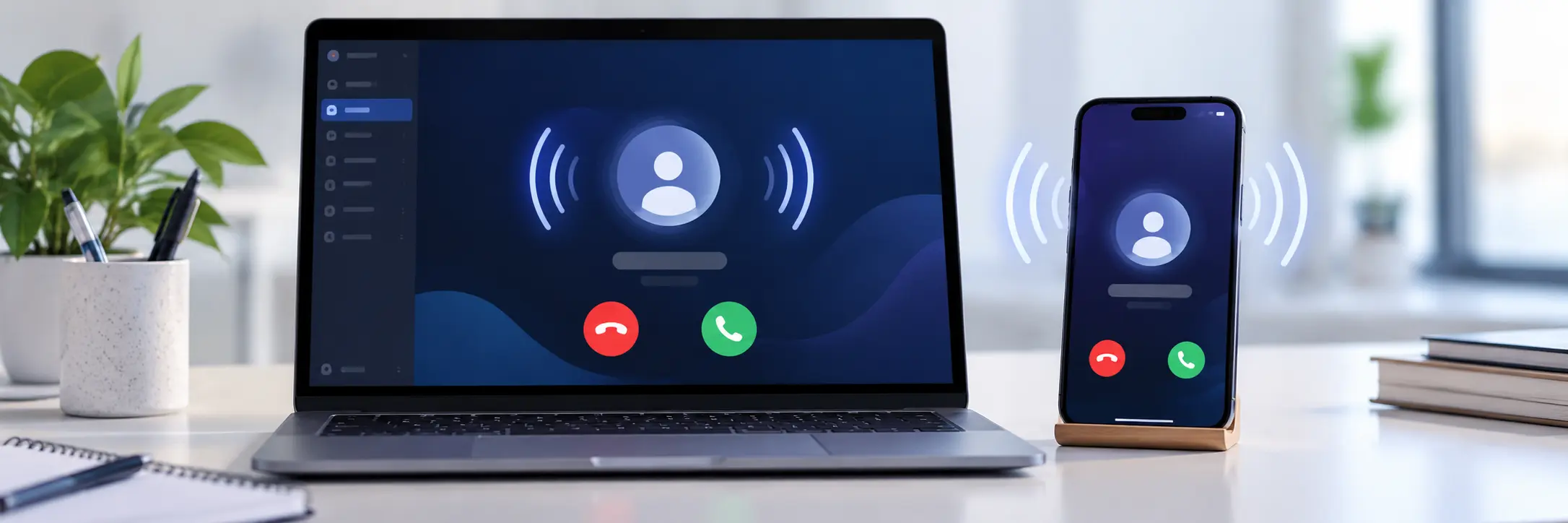
A virtual phone number is a real, dialable phone number that a provider routes over the internet to apps, desk phones or other numbers, rather than to one SIM card or physical line. Callers dial it like any other number. The difference is on your side: the same number can ring a laptop, a mobile app and three colleagues at once.
Two terms come up whenever you shop for one:
VoIP (Voice over Internet Protocol)
The technology that carries voice as data over an internet connection instead of a phone line.
DID (Direct Inward Dialing)
The telecom name for a number that rings straight through to a person, team or call flow without a switchboard.
How do you get a virtual phone number?
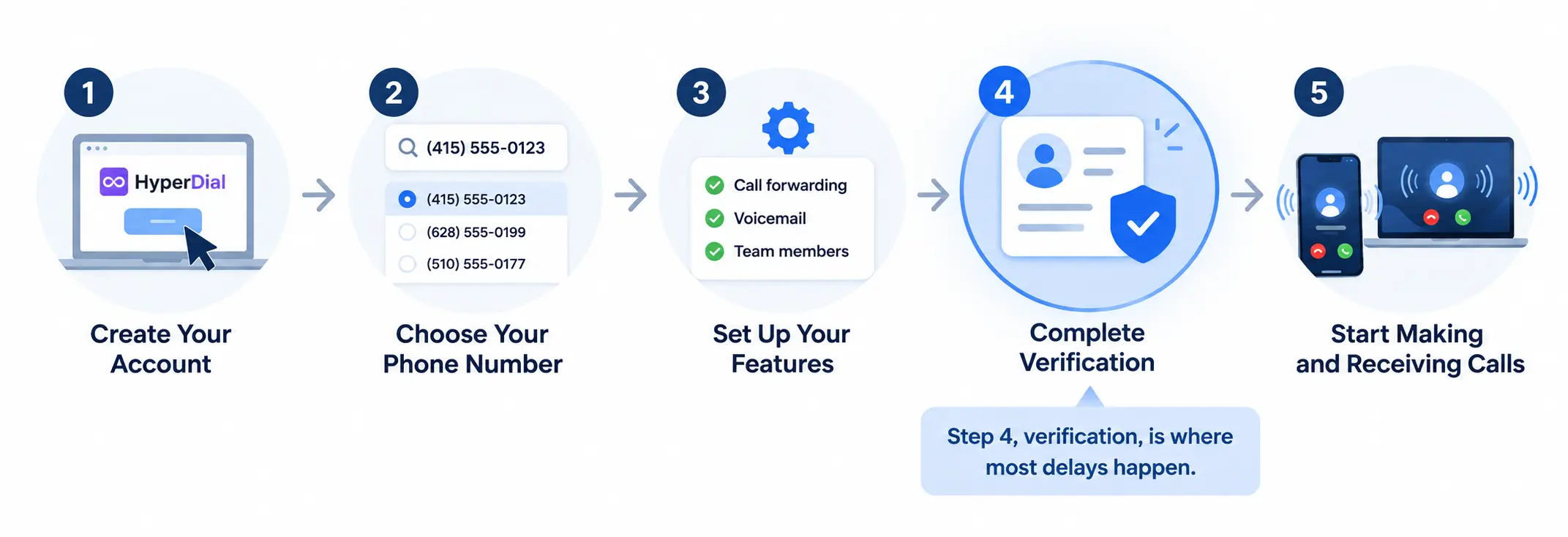
Getting a virtual phone number takes five steps, and most delays happen at step 4. Have your business registration and address proof ready before you start.
- Decide where your callers are and which number type they expect. A Mumbai customer expects a +91 number; a US customer expects a local area code or an 800 number.
- Choose a provider that holds numbers in that country. Providers can only issue numbers in countries where they have carrier agreements, so check the country list before comparing features.
- Pick the number. Choose a city area code for a local number, or a toll-free prefix such as 800 or 1800 for a support line.
- Submit the verification documents. Most countries require proof of who the business is and where it is based. A missing document is the most common reason a number takes weeks instead of days.
- Route the number and test it. Assign the number to a person, a team queue or an IVR menu, then place test calls in and out before you publish it.
Which type of virtual phone number should you get?
The right type of virtual phone number depends on who pays for the call and what the caller should see. A local number looks like a nearby business, a toll-free number is free for the caller, and a mobile number can usually send and receive texts.
Types of virtual phone numbers and when to use each
| Number type | Who pays for the call | Best for |
|---|---|---|
| Local (geographic) | Caller, local rate | Sales and local presence |
| Toll-free | Business | Customer support lines |
| Mobile | Caller, mobile rate | Calls plus text messages |
| National (non-geographic) | Caller, standard rate | One number for a whole country |
| Vanity | Depends on base type | Memorable brand numbers |
Should you get a toll-free virtual number or a local one?
A toll-free virtual number suits inbound support, because the caller isn't charged. Local numbers suit outbound sales, because people answer local area codes more readily than unfamiliar prefixes. Many teams run both: a toll-free number on the website and local numbers for reps who dial out.
What documents do you need to get a virtual phone number?
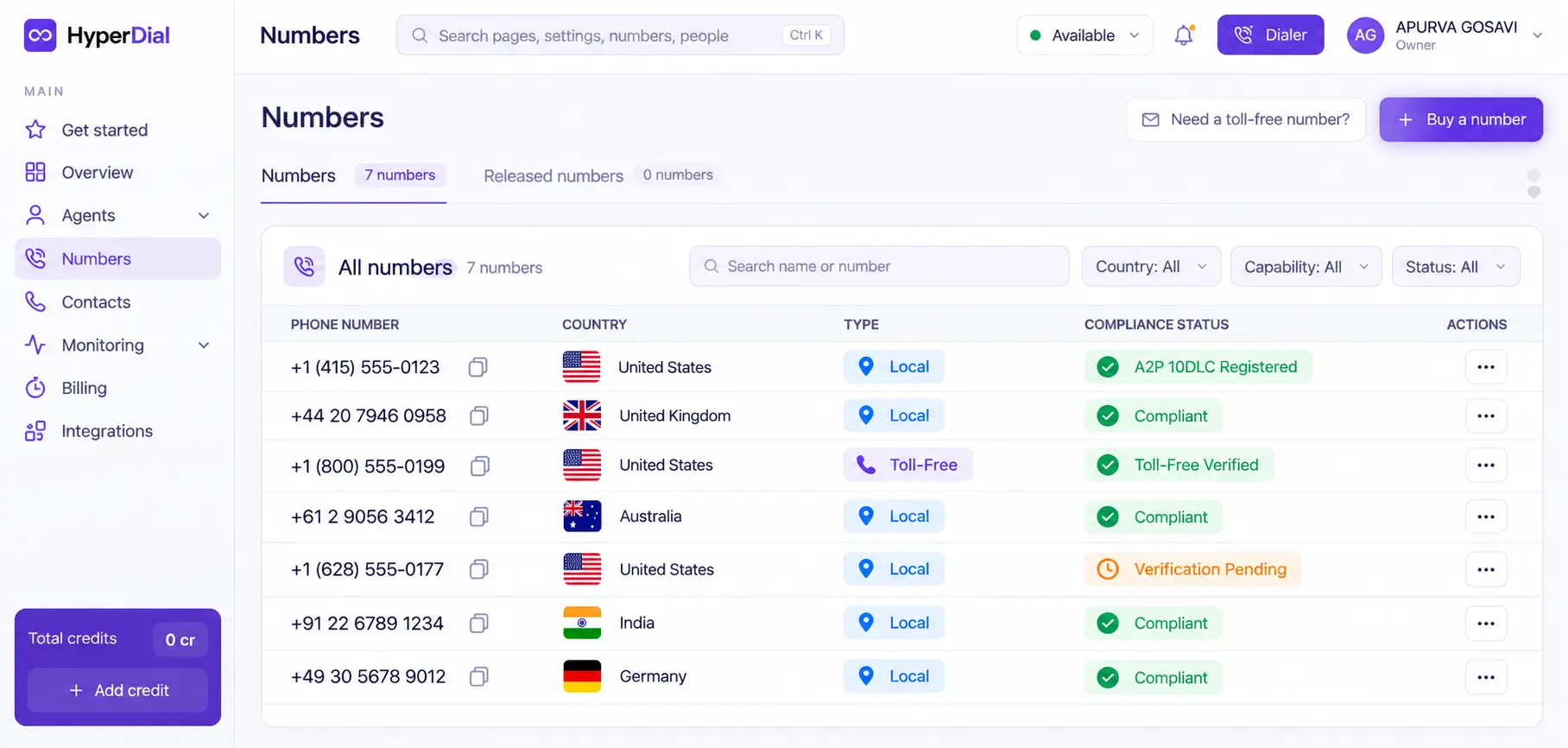
Most countries require a provider to verify the business before it issues a virtual phone number, and the documents differ by country. The table shows what HyperDial's numbers and porting page lists for each of the five countries it covers, as of October 2026.
Verification required before a virtual number is issued, by country
| Country | Number types | Verification required |
|---|---|---|
| India +91 | Local, toll-free | KYC and DLT registration |
| United States +1 | Local, toll-free | 10DLC for business texting |
| United Kingdom +44 | Local, toll-free | Proof of address |
| Singapore +65 | Local, toll-free | KYC |
| UAE +971 | Local | KYC |
Two of these rules change what you can do with the number, not just how long it takes to get one.
Can a virtual number in India be used for sales calls?
Indian rules decide which number a business may use for each kind of call. Since 12 February 2025, the Telecom Regulatory Authority of India (TRAI), the national telecom regulator, has barred senders from using ordinary 10-digit numbers for telemarketing.
Commercial calls in India now come from two dedicated ranges:
- 140 series: promotional calls, such as sales and offers.
- 1600 series: service and transactional calls, such as reminders and account updates.
A +91 virtual number still works for inbound calls, answering customers and calling people who expect to hear from you. Cold outreach needs the 140 series instead. Business texting also needs DLT registration, the Distributed Ledger Technology system Indian carriers use to record approved senders and message templates. HyperDial's India numbers handle the DLT entity, header and template registration, with KYC documents collected once and filed with the carrier.
Do you need 10DLC for a virtual number in the US?
10DLC (10-digit long code) is the US registration system for businesses that send text messages from ordinary local numbers. Brands and their messaging campaigns register with The Campaign Registry, and unregistered business texts can be filtered by carriers. 10DLC covers texting only, so a number used only for calls doesn't need it, as HyperDial's US numbers page notes.
How long does it take to get a virtual phone number?
A virtual phone number can be live in minutes or take a couple of weeks, depending on the country and whether you are moving an existing number. The country's verification step sets the pace, not the provider's software.
Typical time to get a virtual number live with HyperDial (from HyperDial's country pages, October 2026)
| Situation | Typical time |
|---|---|
| New US local or toll-free number | Minutes |
| New India number | Days, once KYC is complete |
| Porting an existing number | Set by the carrier you're leaving |
Porting means moving a number you already own to a new provider. Your old provider keeps the number working until the agreed cutover date, so customers can still reach you while the move is in progress.
Can you get a virtual phone number for free?
You can get a free virtual phone number for personal use, but free options rarely fit a business team. Google Voice, for example, issues a free number to users in the US and asks for an existing phone that can receive a text code during sign-up.
Free personal numbers usually share these limits:
- One person per number: a team can't share the line or see each other's calls.
- No business verification: the number isn't registered to your company, so texting rules like 10DLC aren't covered.
- Limited countries: most free services issue numbers in one or two countries only.
- No integrations: calls aren't logged to a CRM such as Salesforce, HubSpot or Zoho.
Some business platforms offer a free plan and charge only for the numbers themselves. HyperDial's Base plan, for example, has no per-user fee and does not expire, and numbers and minutes are billed at cost, per the HyperDial pricing page.
How much does a virtual phone number cost?
A virtual phone number costs three things added together: a monthly fee for the number, a per-user fee for the calling software, and usage charges for minutes and texts. Toll-free numbers usually cost more than local ones, because the business pays for each inbound call.
Before you compare providers, check these four items on each price list:
- Number rental: the monthly charge per number, which varies by country and type.
- Seat price: the monthly fee for each person using the software.
- Minutes and texts: whether calling is included or billed per minute, and to which countries.
- Porting fee: whether moving your existing number costs extra.
Prices vary by country and change often, so compare current price lists rather than published averages. HyperDial plans and pricing list the seat price per plan and bill numbers and minutes at cost.
Why do new virtual numbers get marked as spam?
New virtual numbers get marked as spam when carriers can't verify who is calling or when a number dials many people who don't answer. Labels such as "Spam Likely" in the US come from carrier analytics and reduce answer rates immediately.
Three things lower the risk:
STIR/SHAKEN attestation
A caller ID authentication framework that lets US carriers verify the calling number belongs to the caller. HyperDial applies it to outbound US calls.
Number health monitoring
Tracking how each number is labeled so you can act before answer rates fall. HyperDial tracks number health and warns you before a number is marked as spam.
Calling the right people
Honoring opt-outs and calling people who expect to hear from you does more for a number's reputation than any setting.
What are the limitations of a virtual phone number?
A virtual phone number depends on an internet connection, so call quality drops when the connection does. That is the trade-off for being able to answer on any device.
Check these limits before you replace an existing line:
- Internet dependence: a weak or busy connection means choppy or dropped calls.
- Emergency calls: ask how your provider handles emergency services before relying on a virtual number as your only line.
- Verification lead time: countries that require KYC can't issue a number the same day.
- Calling rules by series: in India, a regular +91 number can't be used for telemarketing.
- Text verification codes: some services won't send one-time codes to every number type, so test before relying on one.
How do you choose a virtual phone number provider?
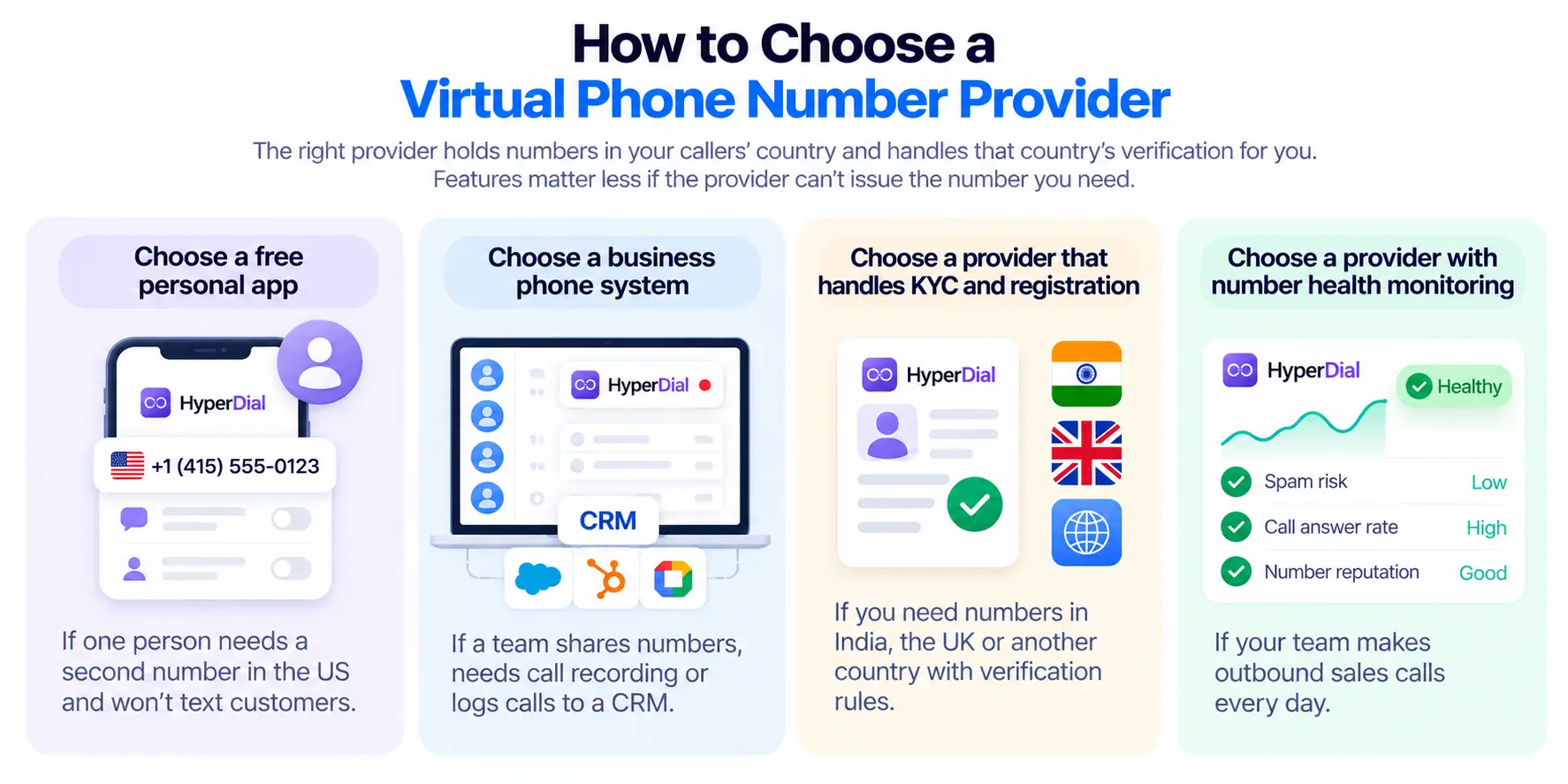
The right virtual phone number provider is the one that holds numbers in your callers' country and handles that country's verification for you. Features matter less if the provider can't issue the number you need.
Use this decision list:
| Choose a free personal app | if one person needs a second number in the US and won't text customers. |
| Choose a business phone system | if a team shares numbers, needs call recording or logs calls to a CRM. |
| Choose a provider that handles KYC and registration | if you need numbers in India, the UK or another country with verification rules. |
| Choose a provider with number health monitoring | if your team makes outbound sales calls every day. |
HyperDial fits the last three cases. Numbers come with call recording, transcription and routing, and calls sync with Salesforce, HubSpot and Zoho. One limit to know: toll-free numbers aren't offered in the UAE, where porting is available on request.


