
How to Reduce Call Abandonment Rate When Customers are Waiting
Your callers don’t hang up at random, so find the second they give up and fix what happens just before it.
We've looked at a lot of queue data with support and sales teams, and the pattern is surprisingly consistent. Fixing abandonment is less about hiring and more about finding the exact moment callers give up, then changing what happens just before it. This guide shows how to measure that moment and what to do about it.
Every figure in this guide links to its source, and we last checked them on 10 November 2026.
What is call abandonment rate and how do you calculate it?
Call abandonment rate is the share of callers who hang up before reaching an agent. To calculate it, divide abandoned calls by calls offered to the queue, then multiply by 100.
For example, 60 abandoned calls out of 1,200 offered is a 5% abandonment rate. The number only means something if you define it the same way every week, so settle three rules before you start tracking:
Where the clock starts: decide whether you count from the moment the call enters the phone menu or the moment it joins the agent queue. Counting from the menu catches people who give up on long menus too.
Short abandons: most teams leave out very short hang-ups, such as misdials, below a cutoff of a few seconds. Pick a cutoff, write it down and never change it quietly.
Transfers: count each customer once. A call transferred between teams can otherwise be counted as abandoned twice.
Report both versions side by side: gross abandons (every hang-up) and net abandons (excluding short ones). Our guide on how to track unanswered calls shows how to pull this from your call data.
Why do customers hang up while waiting for an agent?
Customers hang up while waiting for an agent mainly because the wait feels open-ended, unexplained or wasted. David Maister's classic essay The Psychology of Waiting Lines set out why, and it maps neatly onto a phone queue:
- "Uncertain waits are longer than known, finite waits." Callers who hear nothing about the wait assume the worst.
- "Unexplained waits are longer than explained waits." A short message saying why lines are busy makes the same wait easier to accept.
- "Occupied time feels shorter than unoccupied time." Looping music with nothing to do makes every minute drag.
- "Anxiety makes waits seem longer." Callers with an urgent problem give up fastest.
Capacity matters too, of course. If calls arrive faster than agents can answer, the queue grows whatever you say to people. Still, check when your callers leave before you hire. If many give up in the first minute, wait information will help more than another agent.
When do your callers give up?
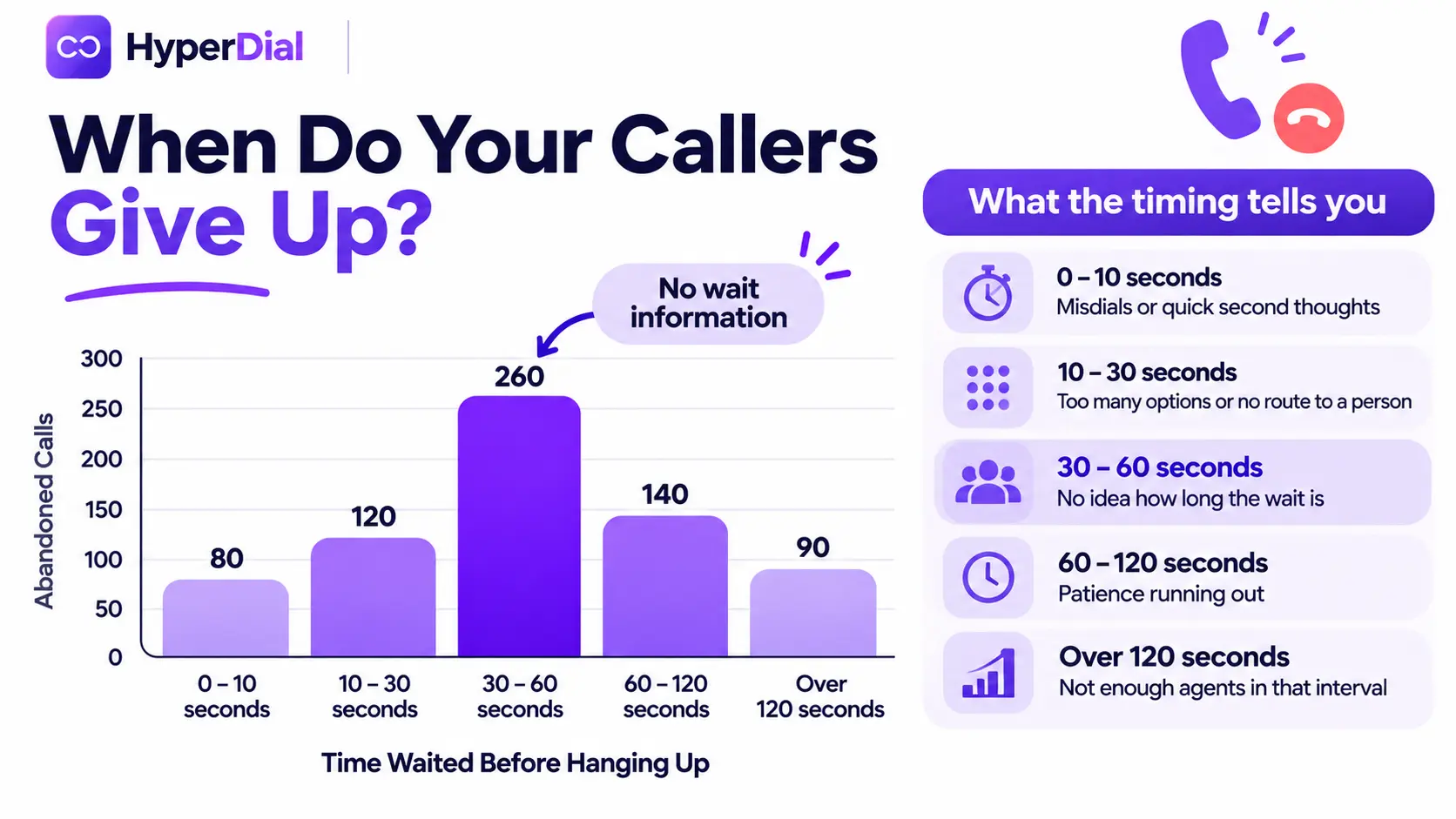
Your callers give up at a predictable point, and finding it tells you which fix to try first. Export your abandoned calls, group them by how long each caller waited, and look for where the numbers pile up:
Table 1: What your abandonment timing points to
| When callers hang up | What it usually means | Fix to try first |
|---|---|---|
| In the first few seconds | Misdials or quick second thoughts | Exclude from net rate, then monitor |
| During the phone menu | Too many options or no route to a person | Shorten the menu |
| In the first minute of queuing | No idea how long the wait is | Announce the wait or queue position |
| After a few minutes | Patience running out | Offer a callback early |
| Only at peak times | Not enough agents in that interval | Staff to the busy interval |
Most teams find one or two of these rows doing most of the damage. Fix those first, then check the curve again a fortnight later.
What actually reduces call abandonment?
Call abandonment drops when callers know what's happening, have a way out that isn't hanging up, and reach a person sooner. These five changes do most of the work.
Tell callers how long they'll wait
Announce the estimated wait or their position in the queue, early and honestly. A caller who hears "you're fourth in line" can decide to stay. Hear nothing, and most callers leave. Never round the estimate down to keep people holding, because a broken promise loses more trust than a long wait.
Offer a callback that keeps their place
A queue callback lets the caller hang up and get called back in turn, without losing their place. Offer it early, before the point where your abandon curve spikes, not after several minutes of hold music. Then honour every callback quickly. An unreturned callback is just an abandoned call with a delay.
Staff to the busy interval, not the daily average
Daily averages hide the problem. A team that looks fully staffed across the day can still be short for one half hour every morning. Telecom traffic engineering has long planned capacity around this peak, the "busy hour" described in the ITU's E.600 terms for traffic engineering. Look at calls in 15 or 30 minute intervals, and move breaks, training and meetings out of the busiest ones.
Shorten the path to the queue
Every menu layer is a chance to give up. Keep the phone menu to a few clear options, put the most common reason first, and always offer a way to reach a person. Our guide to what IVR is covers how to design menus callers finish.
Add overflow before the queue gets long
Decide in advance what happens when the queue passes a set wait time. Options include a backup group of trained staff from another team, or an AI agent that answers simple requests and books the rest. Overflow should kick in automatically, not when a supervisor happens to notice.
How do you reduce call abandonment rate step by step?
You reduce call abandonment rate by measuring when callers give up, fixing the cause that timing points to, and returning every abandoned call. Follow these three steps:
- Measure your rate and your abandon curve. Calculate gross and net abandonment for the last two weeks. Then group abandoned calls by seconds waited and by time of day.
- Fix the cause your curve points to. Announce wait times if callers leave early, and add callbacks if they leave mid-wait. Move staff if they leave only at peaks.
- Return every abandoned call and review weekly. Call back abandoned callers from the number they dialed and track how many you reach. Recheck the curve each week.
The mistake we see most happens at step 2: teams switch on callbacks without planning who will make them. Callback requests pile up at the busiest time, nobody returns them, and customers call back angrier than before. Give callbacks a named owner and a target time before you offer them.
What should you avoid when lowering abandonment?
You should avoid any change that lowers the abandonment number without helping the caller. Abandonment is easy to game, and gamed numbers hide lost customers. Watch for these:
- Forcing callers to voicemail after a set time: the call stops counting as abandoned, but the customer still waits.
- Disconnecting long waits: a "please call back later" message just moves the problem to tomorrow.
- Raising the short-abandon cutoff: the rate falls on paper while real callers are left out.
- Offering callbacks nobody returns: the abandoned call simply moves from the queue to a list.
A fair test is to track abandonment alongside callbacks completed and repeat calls from the same number. If abandonment falls while repeat calls rise, nothing has really improved.
How does HyperDial help reduce call abandonment?
HyperDial reduces call abandonment by giving every queued caller a next step: a callback, an overflow route or an AI agent, instead of an endless hold. Its routing is built so that a call never drops silently.
Here's what covers each fix:
- Callbacks: call routing lets callers hold their place and get called back instead of waiting on the line.
- Overflow: overflow rules name where a call goes next, and business hours and holiday calendars are set per queue.
- AI agents: HyperDial's AI agents answer the overflow when the queue is deep, under the same routing rules. They hand over to a rep with the transcript.
- Peak visibility: call analytics shows total, answered and missed calls, with a heatmap of the busiest hours.
- Support cover: HyperDial for support teams covers nights, weekends and the spike after a campaign send.
Inbound lines can run on toll-free numbers or local numbers, including US local numbers in any area code, all in one account.
What should you do next?
Pull two weeks of queue data and group your abandoned calls by seconds waited and time of day. Find the row in the table above that matches your spike, and fix that first. When you're ready, compare plans on the pricing page or try HyperDial free.
Sources


