
Power Dialer vs Predictive Dialer What's the Difference?
The wrong dialer either wastes your reps’ time or drops calls on your customers. This guide shows which one fits your team, with simple math to prove it.
Picture two outbound teams with the same call list. One team gets a live person on almost every call they take, but spends a lot of time listening to phones ring. The other team barely waits between conversations, but some people who answer hear a short silence, or a recorded message, before anyone speaks. What separates them is one choice: power dialer vs predictive dialer.
Pick the wrong one and you either waste your reps' time or annoy the people you're calling. In the US, the wrong setup can also break the FTC's Telemarketing Sales Rule, which limits how many answered calls a dialer can drop. If you're new to dialers, our guide to what a dialer is covers the basics first.
In this guide, you'll learn:
- What a power dialer and a predictive dialer are, and how each one works
- The key differences, side by side
- How many more conversations a predictive dialer really adds, with simple math
- The US rules each type must follow
- Which dialer fits your team, and how to switch between them
What is a power dialer?
A power dialer is an outbound calling tool that dials one number for each rep and moves to the next number as soon as the last call ends. The rep is always on the line when someone answers, so the person hears a real voice right away.
Here's how a power dialer works:
- The rep starts a session. The dialer loads the call list, often straight from the CRM.
- The dialer calls the first number. If nobody answers, it skips to the next one.
- The rep talks to whoever picks up. The rep is already connected, so there's no delay.
- The rep wraps up. The rep adds notes or picks an outcome, and the call is logged.
- The dialer calls the next number. This repeats until the list is done.
Power dialers often include voicemail drop, which leaves a pre-recorded message with one click so the rep can move on. A close cousin is the progressive dialer, which works the same way but places the next call automatically with no click from the rep.
What is a predictive dialer?
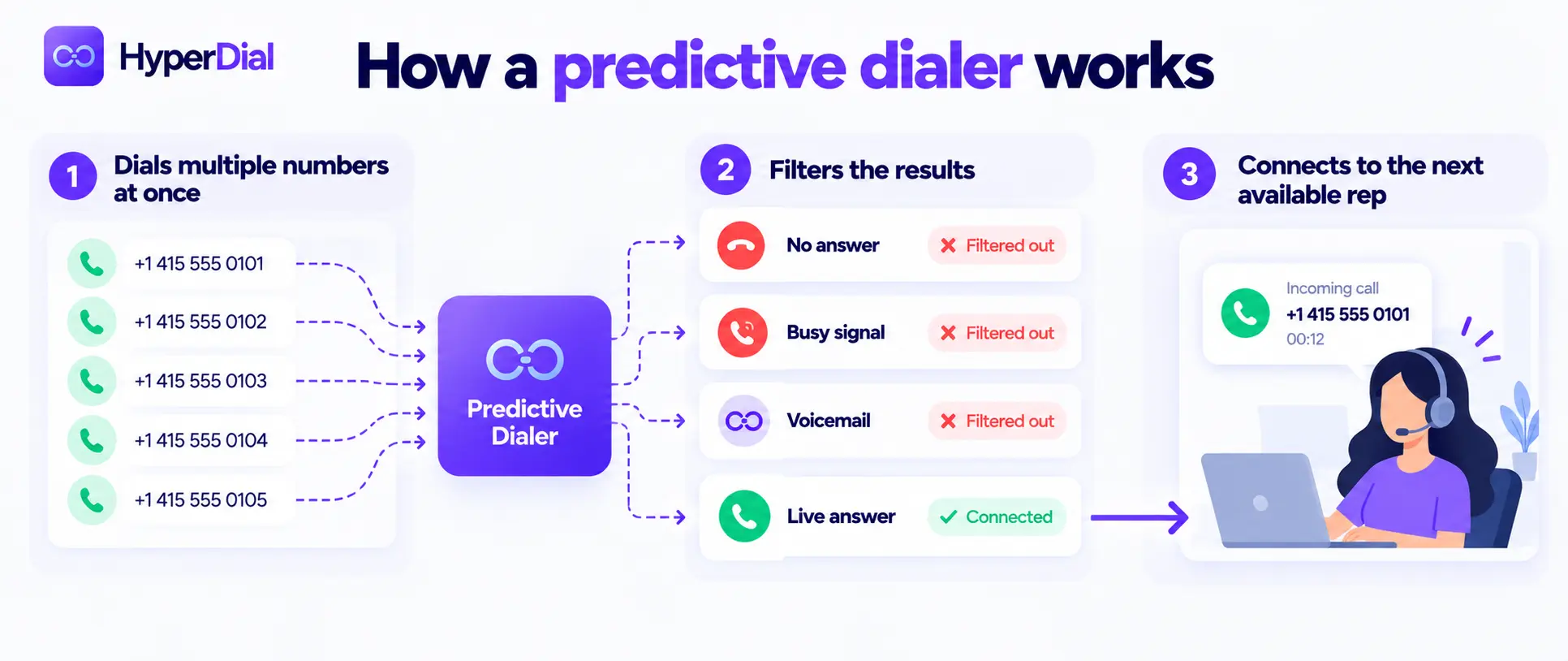
A predictive dialer is an outbound calling tool that dials several numbers at once and predicts when reps will be free. It sends answered calls to the next available rep and drops the rest, such as no-answers, busy signals and voicemails.
Here's how a predictive dialer works:
- It watches the numbers. It tracks how often people answer and how long calls last.
- It dials ahead. If only 1 in 5 people usually answers, it may dial about 5 numbers for each rep who's about to be free.
- It filters the results. Unanswered, busy and voicemail calls never reach a rep.
- It connects the live answers. Each person who answers goes to the next free rep.
- It adjusts its speed. If too many people answer at once, it slows down. If reps sit idle, it speeds up.
The risk is in step 4. When more people answer than there are free reps, someone hears silence and the call may be dropped. That's called an abandoned call, and US rules limit how often it can happen.
What is the difference between a power dialer and a predictive dialer?
The main difference is how many numbers each dialer calls for every free rep: a power dialer calls one, and a predictive dialer calls several. That single choice changes speed, call quality, rep experience and legal risk. The table below shows the differences.
Table 1: Power dialer vs predictive dialer
| Power dialer | Predictive dialer | |
|---|---|---|
| Calls per free rep | One | Several |
| Who controls the pace | The rep | The dialer |
| What the person hears | A rep, right away | Sometimes a short pause |
| Dropped calls | Almost none | Possible, must be limited |
| Time to prepare | A few seconds between calls | Very little |
| Best team size | Any size, ideal for small teams | Larger teams |
| Best call type | Complex, high-value calls | Short, simple calls |
| Legal risk in the US | Lower | Higher |
There are also a few other dialer types you'll see. A preview dialer shows the rep the contact's details and waits for a click before calling. Then there's the parallel dialer, which calls a few numbers at once for one rep and connects the first person who answers. Both sit between power and predictive dialing.
How many more calls does a predictive dialer make?
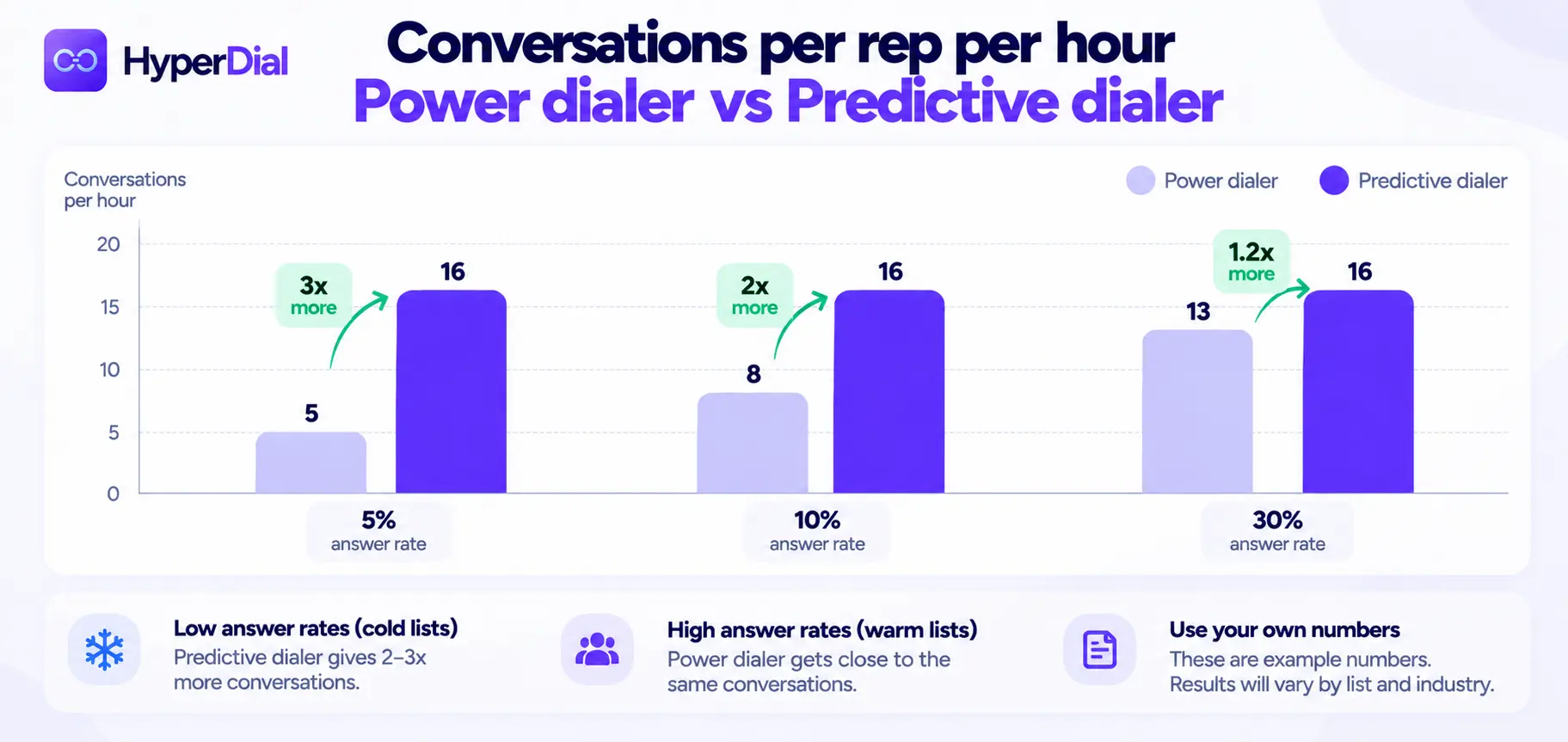
A predictive dialer can give each rep two or three times more conversations per hour, but only when few people answer. When answer rates are high, the gap gets much smaller. The math below shows why.
For this example, we assume each unanswered call takes about 25 seconds, each conversation takes 3 minutes, and notes take 30 seconds. With a predictive dialer, we assume the rep waits about 15 seconds between conversations. These are example numbers, so plug in your own.
Table 2: Example conversations per rep per hour
| Answer rate | Power dialer | Predictive dialer | Predictive gain |
|---|---|---|---|
| 5% | About 5 | About 16 | About 3x |
| 10% | About 8 | About 16 | About 2x |
| 30% | About 13 | About 16 | About 1.2x |
The lesson is simple: a predictive dialer pays off most on big, cold lists where few people pick up. On warm lists, like leads who asked to be called, a power dialer gets close to the same number of conversations with no dropped calls. Voicemail drop on a power dialer also helps, because each unanswered call costs seconds instead of a full minute.
What are the pros and cons of each dialer?
Each dialer trades something away to get its main benefit. Power dialers trade speed for quality, and predictive dialers trade some quality for speed.
Power dialer pros:
- Better first impression: people hear a rep the moment they answer.
- Time to prepare: reps can check notes and the CRM between calls.
- Lower legal risk: with one call per rep, dropped calls are very rare.
- Works for small teams: even one rep can use it well.
Power dialer cons:
- Slower on cold lists: reps spend more time waiting on unanswered calls.
- Lower ceiling: each rep can only make one call at a time.
Predictive dialer pros:
- More conversations per hour: reps spend most of their time talking.
- Less manual work: no-answers, busy signals and voicemails are filtered out.
- Built for scale: works well for large teams and very long lists.
Predictive dialer cons:
- Possible silence or dropped calls: people may hear a pause before a rep joins.
- Little time to prepare: the next call arrives right after the last one ends.
- Stricter rules: you must track and limit abandoned calls.
- Spam flags: high call volume from a few numbers can get them labeled as spam.
What US rules apply to power and predictive dialers?
In the US, the main rule for dialers is the limit on abandoned calls in the FTC's Telemarketing Sales Rule. It matters most for predictive dialers, because they dial ahead of reps. To stay inside the rule's safe harbor, a dialer must:
- Abandon no more than 3% of answered calls, measured per campaign, or over each 30-day period for longer campaigns.
- Connect a rep within 2 seconds after the person finishes saying hello. If not, the call counts as abandoned.
- Play a recorded message with the seller's name and phone number when no rep is free.
- Let unanswered calls ring for at least 15 seconds or four rings before hanging up.
- Keep records that show the dialer met these rules.
For example, if 1,000 people answer during a campaign, no more than 30 of those calls can be abandoned.
Two other rules apply to both dialers. Don't call numbers on the National Do Not Call Registry for sales unless an exception applies. And robocalls with recorded or artificial voices need prior express written consent under FCC rules.
The word "autodialer" also has a narrow legal meaning. In Facebook v. Duguid (April 1, 2021), the US Supreme Court ruled that a device only counts as an autodialer under the TCPA (Telephone Consumer Protection Act) if it uses a random or sequential number generator. Some states use broader definitions, so check with your legal team. This section is general information, not legal advice.
Which dialer should you choose?
The right dialer depends on your team size, how many people on your list usually answer, and how complex each call is. Use this guide:
Choose a power dialer if you have a small or mid-size team, your calls are complex or high-value, or your list is warm and many people answer.
Choose a predictive dialer if you have a large team, a long cold list with a low answer rate, short calls, and someone who watches your abandon rate.
Choose a preview dialer if each call needs research first, like big B2B deals or account renewals.
Choose both if your team runs different campaigns. Use predictive for big, cold lists and power for follow-ups and warm leads.
Here's how this looks for common teams:
- B2B sales teams: power dialer, because each conversation matters and reps need context.
- Large call centers selling simple products: predictive dialer, because volume drives results.
- Collections and reminders at scale: predictive dialer, with careful abandon-rate limits.
- Real estate and insurance agents: power dialer, because many calls are follow-ups.
- New teams of one to five reps: power dialer, because predictive pacing needs more reps to work well.
How do you switch from a power dialer to a predictive dialer?
You switch safely by testing predictive dialing on one campaign, setting a strict abandon limit, and comparing results with your power dialer. Follow these three steps:
- Pick one big, cold campaign to test. Keep warm leads and follow-ups on the power dialer.
- Set a low abandon limit and turn on local numbers. Start well under the 3% limit, and call from numbers that match each region.
- Compare results after two weeks. Look at conversations per hour, meetings booked, abandon rate and how many calls get flagged as spam.
The most common mistake happens at step 2: teams set the dialer to its fastest speed on day one. Abandoned calls jump, people complain, and numbers get flagged as spam before the team has any useful data.
How does HyperDial handle power and predictive dialing?
HyperDial includes both power and predictive dialing, so you can choose per campaign instead of buying two tools. Here's how it works, based on HyperDial's voice calling page:
- Power dialing: one call per rep, placed the moment the rep hangs up.
- Predictive dialing: paced across the whole team when connect rates justify it.
- Pacing from real data: speed is set from each campaign's real connect rate, not a fixed multiplier.
- Your own abandon limit: you set the ceiling, and the dialer slows down instead of dropping people when reps can't keep up.
- Voicemail drop and retry rules: a no-answer costs seconds, and retries treat a bad time of day differently from a bad lead.
- Local presence: calls come from a number that matches the region you're calling.
- Live coaching: managers can listen, whisper to a rep or join a call, as shown on HyperDial's manager tools page.
There's an honest limit too. HyperDial's outbound page says spam flagging "is a real risk on any dialler," so number reputation still depends on pacing, local presence, 10DLC registration and rotating numbers. You can also run HyperDial beside your current dialer to compare results.
What should you do next?
Look at last month's calls and find two numbers: your answer rate and your average call length. If fewer than 1 in 10 people answer and calls are short, test predictive dialing on one campaign. Otherwise, a power dialer will likely serve you better. To try both modes on your own lists, compare plans on the pricing page or try HyperDial free.
Sources


