
AI SDR vs human SDR: which should your sales team use?
AI SDRs reply in seconds and never miss a follow-up, while human SDRs win on judgment and trust. This guide shows what each does best, what each really costs, and how to use both together.
The question sounds simple, but it hides a bigger one. You're not really choosing between a robot and a person. Instead, you're deciding which parts of sales development a machine should do, and which parts still need human judgment.
This guide explains both options in plain words. You'll see where each one wins and what each really costs. You'll also learn how the two work together, and how to decide for your team.
Every fact in this guide links to its source. We last checked them on 19 November 2026.
Key takeaways
- AI SDRs win on speed, volume and follow-up. They reply in seconds and never forget a task.
- Human SDRs win on judgment. Discovery, objections and trust still need a person.
- Compare cost per qualified meeting, not the monthly price.
- Most teams do best with a hybrid, where AI warms up buyers and people close the conversation.
What is an SDR?
An SDR, or sales development representative, is the person who finds and qualifies new buyers before they meet a salesperson. They start conversations, ask a few early questions and book a meeting. An account executive then runs the sale.
A typical SDR day is full of small, repeated tasks. They research prospects, send emails, make calls, follow up, update the CRM and chase people who went quiet. Only part of the day is spent actually talking to buyers.
That gap is the reason AI SDRs exist. In Salesforce's State of Sales report, sales reps said they spend 70% of their time on non-selling tasks. The report surveyed 5,500 sales professionals in 2024.
What is an AI SDR?
An AI SDR is software that does some or all of an SDR's early sales tasks on its own. It can reply to leads, ask qualifying questions, follow up and book meetings, without a person doing each step by hand.
"AI SDR" means different things depending on the product. Some write and send emails. Others chat with website visitors. A third kind, an AI voice agent, talks to people on the phone. They all share one idea: they do the repetitive first steps so people don't have to.
Most AI SDRs do these jobs:
- Reply fast: answer a new lead within seconds, day or night.
- Qualify: ask set questions, like team size or timeline, and score the answers.
- Follow up: send reminders and check-ins on schedule, every time.
- Book meetings: put a call straight into a rep's calendar.
- Log everything: save notes and transcripts to the CRM.
An AI SDR doesn't think like a person. It follows rules and patterns, and it works best when your process is clear. If your team can't explain what a good lead looks like, the AI can't either.
How do an AI SDR and a human SDR compare?
An AI SDR and a human SDR are good at different parts of the same job. The table below puts them side by side.
Table 1: AI SDR vs human SDR at a glance
| What matters | AI SDR | Human SDR |
|---|---|---|
| Reply speed | Seconds | Depends on who is free |
| Working hours | All day, every day | Office hours |
| Volume | Very high | Limited by time |
| Follow-up | Never misses a step | Can slip when busy |
| Time to get started | Setup and playbooks first | About 3 months to ramp |
| Discovery and deep questions | Weak | Strong |
| Hard objections | Weak | Strong |
| Building trust | Limited | Strong |
| Cost model | Platform and usage | Salary, tools and training |
Human ramp time comes from the Bridge Group's 2025 SDR report, a survey of 351 B2B companies. It found the average SDR ramps in 3 months and stays about 1.9 years. That means a team often hires, trains and replaces SDRs every couple of years, which adds cost an AI SDR doesn't have.
Where does an AI SDR beat a human SDR?
An AI SDR beats a human SDR on work that is fast, repetitive and follows clear rules. Here are the five places it wins most clearly.
Speed to lead
When a buyer fills in a form or calls, they're interested right now. A human SDR may be in a meeting, at lunch or asleep. By the time they reply, the buyer may have moved on.
An AI SDR replies in seconds. It can answer the call, ask a couple of questions and offer a meeting while the buyer is still keen. That speed alone can turn more leads into conversations.
Volume
A human SDR can only work so many leads in a day. They have to choose who gets attention, so some leads wait or get skipped.
An AI SDR can handle many leads at once without getting tired. Every lead gets a reply, not just the ones a rep had time for.
Follow-up that never slips
Most deals need several touches before a buyer replies. Busy reps forget follow-ups, especially for leads that seem cold. Those forgotten leads are often the ones that would have said yes later.
An AI SDR follows the same steps every time. Reminders go out on schedule, and nobody falls through the cracks. Our guide on callback management shows why on-time follow-up matters so much.
Working outside office hours
Buyers call and fill in forms in the evening, on weekends and from other time zones. A human team can't cover every hour without shifts.
An AI SDR can answer at 2am as easily as at 2pm. It can qualify the buyer and book a meeting for the next morning. For more ways to cover these hours, see our guide on handling business calls after hours.
Repetitive admin work
Logging calls, updating the CRM and writing notes take a big part of an SDR's day. That's the 70% non-selling time the Salesforce report found.
An AI SDR can do this admin automatically. It saves the transcript, the answers and the outcome to the right record. Your human reps then get more time to actually sell.
Where does a human SDR still win?
A human SDR still wins wherever the conversation needs judgment, empathy or creative thinking. These are the five areas where people stay ahead.
Discovery
Discovery means finding out what's really going on in a buyer's business. A buyer may say they need a cheaper tool, when the real problem is that their team misses calls. Good SDRs notice that and dig deeper.
An AI SDR can ask set questions, but it struggles to spot what the buyer isn't saying. Real discovery needs follow-up questions that come from listening, not from a script.
Hard objections
Some objections are easy, like "What does it cost?" Others are messy, like "We tried something like this and it failed." Handling those takes understanding, honesty and sometimes a story from another customer.
A human SDR can read the mood and adjust. An AI SDR either gives a set answer or hands the call over. For anything unusual, a person does better.
Big deals with many people
Larger sales often involve several people: a manager, a finance lead, an IT team. Each one cares about different things. Getting all of them on board takes planning and patience.
A human SDR can map who matters and tailor the message for each person. This kind of selling is where AI SDRs are weakest.
Trust and relationships
People buy from people they trust, especially on bigger or longer deals. A buyer who has spoken to the same person several times feels known. That relationship can carry a deal through delays and doubts.
An AI SDR can be polite and helpful, but it can't build that kind of bond. For relationship-heavy sales, a person should own the conversation.
Learning from the market
Human SDRs hear what buyers say every day. They notice new complaints, new competitors and changes in what people want. That feedback helps marketing and product teams.
An AI SDR records conversations, but someone still has to read them and spot the patterns. Tools that summarize calls help, but the insight still needs a person.
Is an AI SDR cheaper than a human SDR?
An AI SDR is usually cheaper per conversation, but the monthly price isn't the right way to compare them. What matters is how much each one costs for every qualified meeting it books.
A human SDR costs more than a salary. You also pay for benefits, tools, training, a manager's time and the months before they're fully productive. The average SDR ramps in 3 months and stays about 1.9 years, per the Bridge Group. So you'll also pay to hire and train replacements.
An AI SDR has different costs. You pay for the platform and usage, plus time to set it up, write its playbooks and check its work. It also needs clean data. If your CRM is messy, the AI will make messy decisions faster.
The fairest comparison uses one simple formula:
- Add up the total monthly cost for each option, including tools and people's time.
- Count the qualified meetings each one booked that month.
- Divide the cost by the meetings. That's your cost per qualified meeting.
Then go one step further. Check how many of those meetings turned into real sales opportunities. A cheap meeting that never turns into a deal isn't cheap at all.
Which should you use for your type of sales?
The right choice depends on how your team sells. This table shows which option fits common sales situations.
Table 2: AI SDR vs human SDR by type of sales
| Type of sales | AI SDR fit | Human SDR fit | Best choice |
|---|---|---|---|
| Inbound leads from forms and calls | Strong | Medium | AI first, human for hot leads |
| High-volume, small deals | Strong | Weak | Mostly AI |
| Large deals with many buyers | Weak | Strong | Mostly human |
| Reminders and renewals | Strong | Medium | AI with human backup |
| After-hours and other time zones | Strong | Weak | AI |
| New market or new product | Weak | Strong | Human |
New markets are a good example of where people matter. When you don't yet know what buyers care about, you need humans to learn it. Once the pattern is clear, AI can take over the repeat work.
What does a hybrid AI and human SDR team look like?
A hybrid team lets AI handle the first steps and hands buyers to a person the moment they're ready. Each side does what it's best at. Here's how a buyer moves through it:
- A buyer reaches out. They call, fill in a form or reply to a message.
- The AI SDR answers right away. It greets them and asks a few qualifying questions.
- The AI sorts the lead. Good fits move forward, and others get a polite next step.
- A human takes over when intent is real. The rep gets the transcript and context, so the buyer doesn't repeat themselves.
- The human runs discovery. They dig into the real problem and set up the sale.
The handover in step 4 is where many teams go wrong. If the rep gets a cold transfer with no notes, the buyer has to start again. A good hybrid setup passes the full conversation along, so the person picks up exactly where the AI stopped.
The AI doesn't disappear after the handover. It can still send reminders, log calls and follow up on no-shows. The human rep then spends their time on conversations, not admin.
How do you decide between an AI SDR and a human SDR?
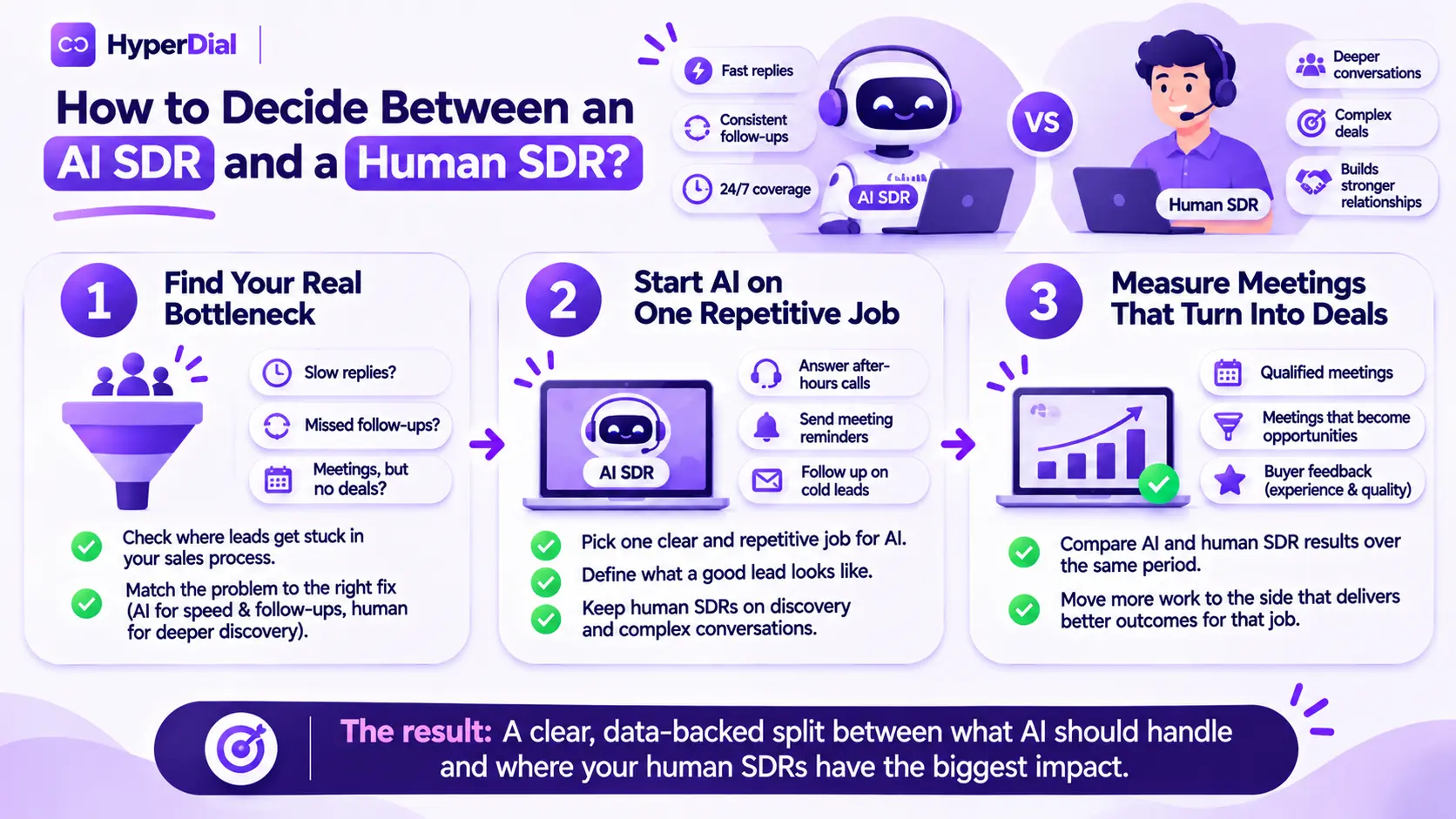
You can decide in three steps. Start with your real problem, test AI on one job, and measure results that matter.
Step 1: Find your real bottleneck
Look at where leads get stuck today. Are new leads waiting hours for a reply? Do follow-ups get missed? Or are meetings happening, but going nowhere?
Each problem points to a different fix. Slow replies and missed follow-ups point to AI. If meetings aren't turning into deals, that points to better human discovery. Don't buy a tool until you know which problem you're solving.
Step 2: Start AI on one repetitive job
Pick one clear, repetitive job, like answering inbound calls after hours or sending meeting reminders. Write down exactly what a good lead looks like and when the AI should hand over to a person.
Keep your human SDRs on discovery and hard conversations. Starting small lets you see how buyers react before you trust the AI with more.
Step 3: Measure meetings that turn into deals
Don't judge an AI SDR by how many messages it sends. Activity is easy to fake. Instead, track qualified meetings, meetings that turn into opportunities, and how buyers felt about the conversation.
Compare those numbers with your human SDRs over the same month. Then move more work to whichever side gets better results for that job. HyperDial's call analytics show outcomes per agent and campaign, which makes this comparison easier.
What are the risks of using an AI SDR?
The biggest risk of an AI SDR is letting it run without clear rules or a person checking its work. These are the risks to plan for:
- Annoying buyers: too many messages, or messages that sound robotic, can hurt your brand.
- Wrong answers: an AI that guesses outside its script can give buyers bad information.
- Hiding that it's AI: some regions have rules about telling people they're talking to an AI. Being open is the safer choice everywhere.
- Bad data: if your contact lists and CRM are messy, the AI will act on wrong information.
- Set and forget: an AI SDR needs regular review, just like a new team member.
Each risk has a simple fix. Write clear playbooks, tell buyers when they're talking to AI, keep your data clean and review conversations every week.
How does HyperDial's AI voice agent work alongside your SDRs?
HyperDial's AI voice agents handle the repetitive phone work and hand real buying intent to your reps. These details come from HyperDial's AI voice agents page:
- Answers every call, including after hours, so no inbound lead waits.
- Qualifies inbound buyers and books meetings straight into a rep's calendar.
- Runs reminder and renewal calls on a schedule you set.
- Hands over warmly: the rep gets the transcript and context, not a cold transfer.
- Records, transcribes and scores every call, like any other call on HyperDial.
- Tells callers it's an AI agent.
The agent also has clear limits, by design. It runs only plays you've approved, and nothing goes live until it's approved. If a buyer asks something outside the playbook, asks for a person, or shows complex intent, it hands over instead of guessing.
Your human SDRs keep working in the same system. HyperDial's voice calling gives reps power dialing, local presence and live coaching. Calls sync with CRMs such as Salesforce, HubSpot and Zoho CRM, as listed on the integrations page. One limit to know: the agents page focuses on inbound calls, reminders and renewals. It doesn't describe the AI doing cold outbound prospecting.
What should you do next?
Find the one place leads get stuck today, like slow replies or missed follow-ups. Move that single job to an AI agent, keep your reps on discovery, and compare qualified meetings after a month. To start, see HyperDial's AI voice agents, compare plans on the pricing page or book a demo.
Sources


