
Which Documents May be Needed to Activate a UK Phone Number?
This is a plain checklist of the documents UK phone providers may ask for, what each one must show, and how to get your UK number approved the first time.
The exact list depends on two things: the type of number and your provider. UK rules don't publish one fixed checklist for every provider. Instead, Ofcom, the UK telecoms regulator, expects providers to check who they're giving numbers to. Each provider then sets its own list.
This guide explains which documents may be asked for, what each one must show, and how to get approved the first time. Is your main question the address itself? Our guide on whether you need a UK address for a virtual number covers that in detail.
Every fact in this guide links to its source. We last checked them on 23 November 2026.
Key takeaways
- Proof of address is the document most providers ask for.
- City numbers need the most proof, because Ofcom links them to an area.
- Ofcom expects "know your customer" checks, so providers verify your business too.
- Names must match exactly across every document and form.
Why do UK providers ask for documents before activating a number?
UK providers ask for documents because Ofcom expects them to know who they're giving numbers to. The aim is to stop scammers getting UK numbers and using them to trick people.
In November 2022, Ofcom published a good practice guide to help prevent misuse of phone numbers. It says providers should run "know your customer" checks before giving numbers to business customers. Providers should also understand how each number will be used, the guide says.
The guide is guidance, not a new law. Even so, Ofcom says it links to rules providers must already follow, and it applied from the day it was published. That's why most providers now ask for documents before a number goes live.
City numbers have an extra rule. Ofcom's Numbering Plan (section B3.1.1) links 01 and 02 numbers to a geographic area. So providers usually check your address before giving you a London or Manchester number.
Which documents may be needed for a UK phone number?
Most UK providers ask for a mix of documents and typed details. Here's what each item is and what it usually must show:
Proof of address: a recent document showing your name and full address, like a utility bill or a bank statement. Some providers also accept an insurance certificate or a tenancy agreement. Most reject P.O. boxes and screenshots.
Company registration details: your legal company name and registration number. UK companies use their Companies House number. Overseas companies usually use the number from their home country's register.
Proof of identity: a passport, national ID card or driving licence. Individuals usually need this. Some providers also ask for ID from the person signing up for a business.
Business website: a live website that shows your business name. A "coming soon" page or a social media profile is often rejected.
Contact person: the name, phone number and work email of someone senior who looks after your numbers. Ofcom's guide lists this among its basic checks.
Use case: a short, plain description of how you'll use the number, like "inbound customer support" or "outbound sales calls". Vague answers like "business use" often get sent back.
Some providers ask for all six. Others ask for only two or three. Ask for the exact list before you order, so you can gather everything at once.
Which documents does each UK number type need?
Each UK number type has different document needs, and city numbers need the most. The table below shows what providers commonly ask for. Rules vary, so treat it as a guide, not a promise.
Table 1: Common document needs by UK number type
| Number type | Address rule | Common documents |
|---|---|---|
| City (01, 02) | UK address, often in the area | Proof of address, company details |
| National (03) | Often any address | Company details, contact person |
| Freephone (0800, 0808) | Often any address | Company details, contact person |
| Mobile (07) | Often any address | Company details or ID |
City numbers carry the strictest checks because of Ofcom's area rule. Some providers accept any UK address. Others, including HyperDial, want a verifiable address in that city's area, according to its UK numbers page.
If you don't have a UK address yet, a national 03 or freephone 0800 number is often the faster start. Our guide on UK local vs toll-free numbers explains how those numbers compare for customer support.
What do UK providers check beyond your documents?
Beyond your documents, UK providers may check public records and fraud databases to confirm your business is real. Ofcom's good practice guide lists these as extra "know your customer" checks.
Here are checks the guide suggests providers can run:
- Companies House: confirming your details match the register and that no director is disqualified.
- Fraud databases: checking fraud-risk lists such as Cifas.
- Financial registers: checking the Financial Conduct Authority register, where your business needs permission.
- Place of business: confirming your location matches what you told them.
- Intended use: checking that the number of lines you want fits how you'll use them.
You don't need to send anything extra for most of these checks. But the details you give must match public records. A company name typed slightly differently from Companies House can slow your application down.
The guide also says providers should check again when you ask for more numbers. A request for a handful of lines gets a lighter check than a request for hundreds.
How do you prepare documents for a UK phone number?
You can prepare documents for a UK phone number in three steps. Getting them right the first time is the fastest way to go live.
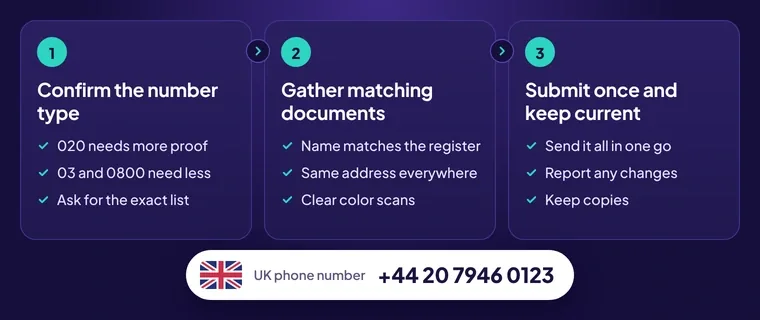
Step 1: Confirm the number type and the provider's list
Decide which number type you need first, because it changes what you'll be asked for. A London 020 number needs more proof than an 03 or 0800 number.
Then ask your provider for its exact list. Check which documents count as proof of address, how recent they must be, and whether they must be in English.
Step 2: Gather documents that match exactly
Collect each document and check that every name and address matches. Your company name should match Companies House or your home register, letter for letter. The address should match across your bill, your form and your website.
This is where most applications go wrong. A bill in a director's personal name, or an old trading name, can get the whole request sent back. Use clear scans in color, with all four corners showing.
Step 3: Submit once, then keep your details current
Send everything in one go, with a clear use case. Then keep your details up to date. If your address, company name or contact person changes, tell your provider, because the checks may need to be repeated.
Keep copies of what you sent. You'll need similar documents if you add numbers later or move to another provider.
What documents do you need to port a UK number?
To port, or move, an existing UK number, you usually need a recent bill and your exact account details. You'll also sign a letter giving the new provider permission to move it.
HyperDial's porting guide lists what it needs:
- A recent bill: from your current provider, showing the account number and service address.
- The account holder's name: matching your current provider's records exactly.
- A Letter of Authorisation: HyperDial creates it, and you sign it.
- Confirmation the number is free to move: not mid-contract or under a port freeze.
Why do UK number applications get rejected?
UK number applications usually get rejected because details don't match, or because a document doesn't prove what it needs to. Most rejections are easy to avoid.
Here are the most common reasons:
- Name mismatch: the company name differs between the form, the bill and the register.
- Wrong address area: the address isn't in the area of the city number you asked for.
- Old or wrong documents: the bill is too old, or it's a mobile phone bill or screenshot.
- P.O. box or mailbox address: many providers won't accept these as a real address.
- Vague use case: "business calls" doesn't explain how you'll use the number.
- No live website: the site is missing, parked or doesn't name your business.
How does HyperDial handle verification for UK numbers?
HyperDial checks your business once and confirms which documents work before you order a UK number. These details come from its UK numbers page:
- Number types: city numbers across major UK dialing codes, 03 national numbers and 0800 freephone numbers.
- Proof of address: collected once for your business, not for every number.
- City numbers: can't be issued without proof of address.
- Checked before you pay: HyperDial confirms which document clears your address before you order.
- Porting: free on annual plans, with your number taking calls until switch-over.
- Billing: each UK number billed at carrier cost.
The UK numbers page doesn't say how long the address check takes, so ask the team if you're working to a deadline. Its numbers page shows the other countries and number types available.
According to the same guide, UK ports take about 5 to 10 working days. Don't cancel your old service before the port is live, or you could lose the number. Our guide on what number porting is explains each step.
What should you do next?
Pick the UK number type you need, then ask your provider for its exact document list. Gather documents where every name and address matches, and send them in one go. If you don't have a UK address yet, start with an 03 or 0800 number. To begin, see HyperDial's UK numbers, compare plans on the pricing page or book a demo.
Sources


