
The top 10 telephony providers in 2026
We put ten voice providers through the same six-week test — provisioning, latency, webhooks and the invoice at the end of it. Here is what came back, and how to run the comparison yourself.
- Read time
- 6 min

Buying telephony in 2026 is no longer a question of who can carry a call. Everyone can. The question is what happens in the ninety seconds around it: how fast a number is provisioned, whether a webhook fires when a call is answered, what a failed leg costs you, and who picks up when a route goes dark on a Friday night. We spent six weeks putting ten providers through the same set of tasks and scored what came back.
How we compared the ten
Each provider got the same brief: provision a local number in three countries, place a hundred outbound calls, answer fifty inbound ones, and hand every recording to a transcription job. We timed each step with curl and read the logs rather than the marketing pages. Where a vendor offered a private route, we tested both the default and the upgrade.
- Time to a working number, from signup to first ring
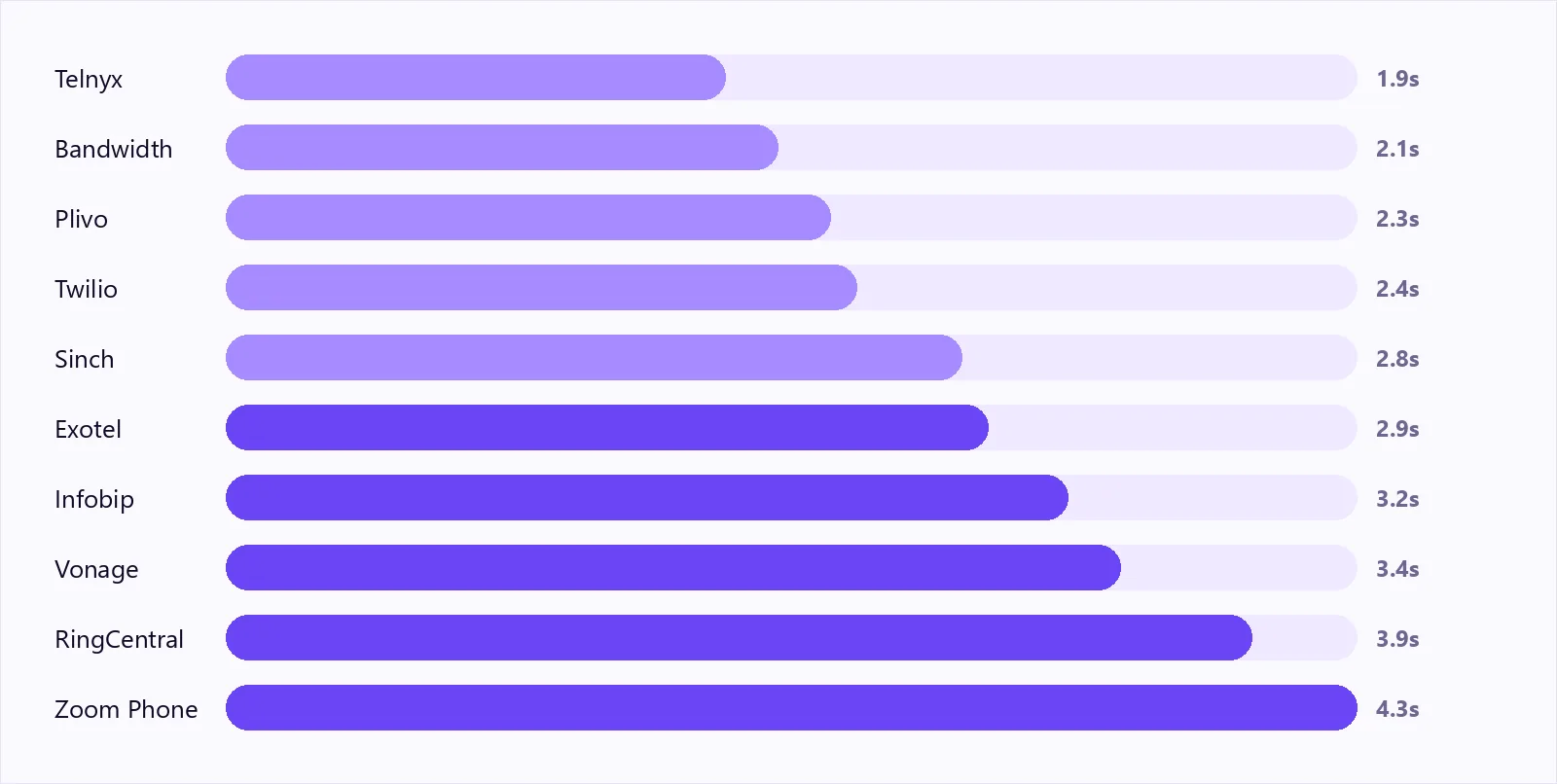
- Median answer latency on a warm route
- Webhook delivery, including retries on a 500
- Cost of a failed or unanswered leg
- Support response on a P1, out of business hours
- Regulatory paperwork for local presence in India and the EU
What we left out on purpose
- Contact-centre seats. A dialler and a carrier are different purchases, and bundling them hides the price of each.
- Anything we could not measure ourselves, including:
- uptime claims with no public status history
- “AI-powered” routing with no documented behaviour
- Enterprise pricing behind a sales call — if we could not sign up and pay for it, it is not in the table.
The ten, ranked
The short version is the table. The longer version, provider by provider, is under it. Read the last column first — it is the only one that changes which vendor you should shortlist.
| # | Provider | Best for | Entry price | Where it wins |
|---|---|---|---|---|
| 1 | Twilio | Teams that build | $0.013/min | The widest API surface, and the docs everyone else copies |
| 2 | Telnyx | Latency-sensitive voice | $0.010/min | Owns its network, so a private route is a config flag |
| 3 | Plivo | High-volume outbound | $0.008/min | Price per minute at scale, without a rebuild |
| 4 | Bandwidth | US enterprise | $0.009/min | Carrier of record, so escalations end with them |
| 5 | Vonage | Omnichannel | $0.014/min | Voice, SMS and chat behind one contract |
| 6 | Sinch | Global reach | $0.012/min | Aggregation across regions most vendors resell |
| 7 | Infobip | Emerging markets | $0.011/min | Coverage where local presence is the hard part |
| 8 | Exotel | India and SEA | $0.006/min | Local numbering and compliance done properly |
| 9 | RingCentral | Cloud PBX | $20/user/mo | A phone system, not a toolkit |
| 10 | Zoom Phone | Bundled UCaaS | $10/user/mo | Cheapest route if the meetings already live there |
1. Twilio — the default, and still hard to beat
Twilio remains the provider you can hire for. Every second engineer has shipped against it, the SDKs are current, and the failure modes are documented. You pay for that: it is rarely the cheapest line on a bill, and the console has grown into something you navigate rather than read.
2. Telnyx — the network is the product
Telnyx owns the carrier layer, which shows up as latency you can predict and a private route you can switch on without a procurement cycle. The trade is a smaller ecosystem: fewer tutorials, fewer people who have already solved your problem.
We moved one region for latency and stayed for the routing controls. The dashboard is worse. The calls are better.
Platform lead, 200-seat sales team
3. Plivo — priced for volume
If your bill is dominated by outbound minutes, Plivo is the shortest path to a smaller one. The API is close enough to Twilio's that a migration is measured in days, and the gap shows up mostly in the edges: fewer managed add-ons, thinner tooling around recordings.
4. Bandwidth — the carrier of record
Bandwidth is the layer several vendors on this list are quietly reselling. Going direct means escalations end with the people who own the route, which matters more than any feature the day something breaks in the middle of a campaign.
5. Vonage — one contract, every channel
Vonage earns its place when voice is one of four channels rather than the whole product. Consolidation has a real price in per-minute terms, and a real payoff in the number of vendor reviews you sit through each year.
6. Sinch — reach without a dozen contracts
Sinch is aggregation done at a scale most teams cannot replicate. Coverage is the pitch; the caveat is that quality varies by corridor, so test the three routes you actually use rather than the map.
7. Infobip — strongest where the paperwork is hardest
Infobip's advantage is regulatory rather than technical: local presence, sender registration and number provisioning in markets where those steps take weeks if you do them yourself.
8. Exotel — built for India first
For Indian numbering, DLT registration and regional routing, Exotel is not a compromise but the reference. Outside South and Southeast Asia the case thins quickly.
9. RingCentral — a phone system, not a toolkit
RingCentral is the answer when the requirement is desk phones that work rather than an API to build on. Per-seat pricing makes it predictable and, past a few hundred seats, expensive.
10. Zoom Phone — cheapest if you are already there
Zoom Phone is a rational default for a company whose meetings, chat and webinars already sit in one place. It is a bundle decision, not a telephony decision, and it is fine to make it on those terms.
What a pricing page will not tell you
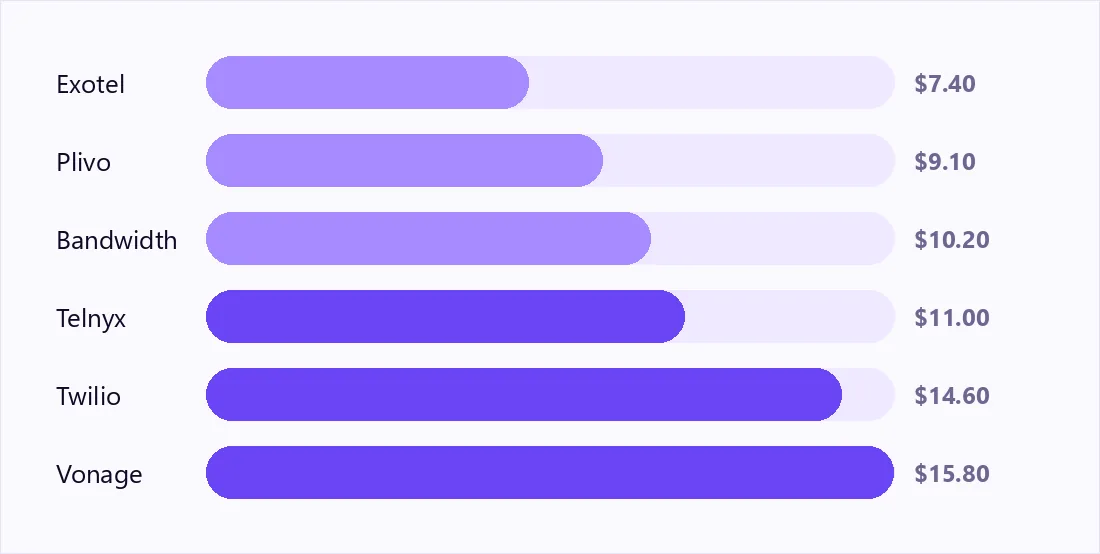
Three of the ten quoted a per-minute rate that doubled once we added the recording, the transcription and the failed legs we still paid for. The line to compare is not the rate — it is the cost of a hundred real conversations, end to end.
Regional coverage
Every vendor claims global coverage. Ask instead which corridors they own and which they buy, then test the two that carry your volume. A provider that is excellent in North America and resold in South Asia is two different products on one invoice.
Number portability
Porting is the switching cost nobody prices in. Before signing, get the port-out process in writing, including how long a number stays reachable after you leave. If that answer is vague, treat the contract as longer than it looks.
Run a two-week bake-off before you sign
- Pick the two corridors that carry most of your volume.
- One where you are strong today.
- One where calls already fail more than you would like.
- Provision a number on each shortlisted provider and point it at the same webhook.
- Run the same script for ten working days, at the hours you actually dial.
- Compare answer latency, webhook delivery and the invoice — in that order.
If you only have one week
Drop the second corridor and keep the ten days. A shorter test on one route beats a longer one that never reaches the hours you actually dial.
The measurement itself is unglamorous. A loop, a timer and a log file will tell you more than any comparison post, including this one:
#!/usr/bin/env bash
# Place 100 calls and record how long each one takes to be answered.
for i in $(seq 1 100); do
  start=$(date +%s%3N)
  call_id=$(curl -sS -X POST "$PROVIDER_API/calls" \
    -H "Authorization: Bearer $PROVIDER_TOKEN" \
    -H 'Content-Type: application/json' \
    -d "{\"to\":\"$TEST_NUMBER\",\"from\":\"$CALLER_ID\"}" \
    | jq -r '.id')

  until [ "$(call_state "$call_id")" = answered ]; do sleep 0.1; done
  echo "$call_id,$(( $(date +%s%3N) - start ))" >> latency.csv
done
Conclusion
There is no best telephony provider in 2026, only a best fit for the two corridors you actually dial and the team you actually have. Shortlist three, run the bake-off, and let the log file pick. If you want the raw numbers behind this piece, they are in the rest of the series.
Methodology
Six weeks, ten providers, one script. Figures illustrative and refreshed quarterly; corrections welcome.